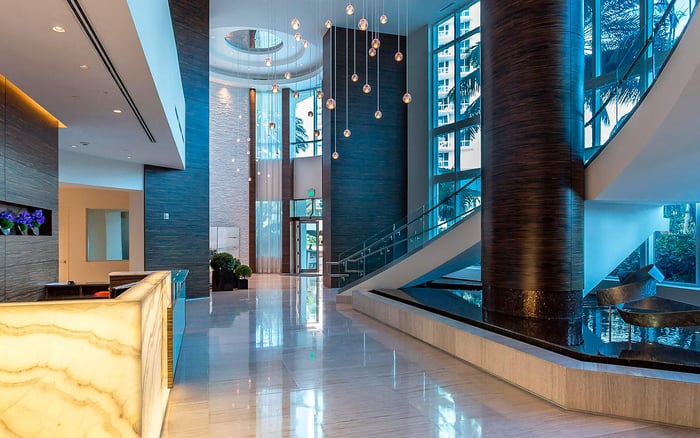
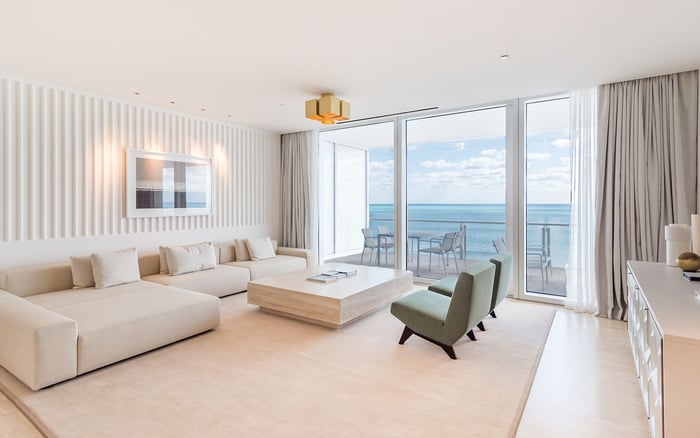
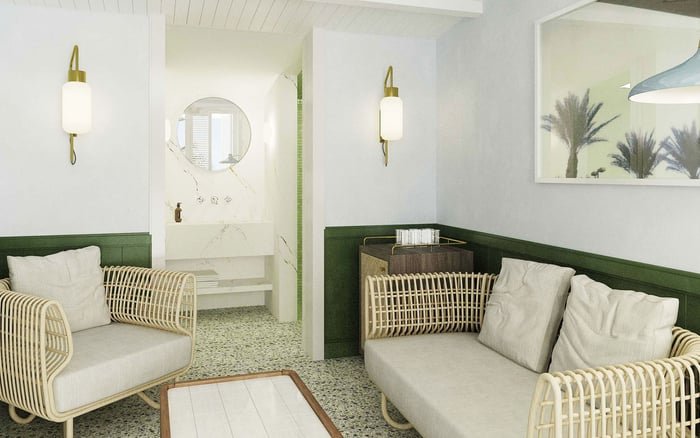
A buyer-focused comparison of how Shore Club Private Collections Miami Beach and The Surf Club Four Seasons Surfside translate historic preservation into distinct forms of contemporary oceanfront luxury.
In South Florida, preservation can function as either a design constraint or the very foundation of value. That distinction comes into sharp focus when comparing Shore Club Private Collections Miami Beach with The Surf Club Four Seasons Surfside. Both properties present history as a luxury asset, but each expresses it through a distinctly different residential philosophy.
At Shore Club, the historic building defines the property’s identity. The restored 1926 oceanfront structure, designed by Henry Hohauser, stands on Collins Avenue within Miami Beach’s Art Deco Historic District, where preservation is inseparable from the city’s visual legacy. The project relaunched in 2022 following an extensive restoration that preserved its Art Deco character while repositioning the address for contemporary luxury living.
At The Surf Club Four Seasons Surfside, the narrative unfolds differently. The preserved 1930 clubhouse remains the emotional and architectural anchor, but it sits within a broader mixed-use composition that includes a hotel and branded residences in contemporary towers. Put simply, one project restores a landmark as the destination itself, while the other places a landmark within a larger modern complex.
For buyers weighing Miami Beach against Surfside, that distinction extends well beyond aesthetics. It shapes privacy, programming, service culture, and even the meaning of ownership.
Shore Club Private Collections Miami Beach is best understood as a restoration-first proposition. The historic oceanfront building is not merely a decorative centerpiece. It is the property’s core identity, visual memory, and social framework. Publicly disclosed details describe more than 70 private residences and more than 40 member suites, along with dining, spa, and wellness amenities. Just as notably, it is positioned as a private residential club rather than a conventional hotel, with a membership-oriented ownership structure.
That positioning matters. In a market where many luxury developments treat heritage as a stylistic cue, Shore Club instead offers direct continuity with Miami Beach’s original Art Deco narrative. Because it sits within the city’s preservation framework, exterior changes are shaped by local historic review. The result is a project that feels connected not only to a single building, but also to the broader urban fabric that defines Miami Beach.
For buyers already comparing other design-led oceanfront opportunities such as The Perigon Miami Beach, The Ritz-Carlton Residences® South Beach, or Ocean House Surfside, Shore Club occupies a narrower, more historically charged lane. Its appeal is less about spectacle and more about inhabiting a restored landmark with club-style discretion.
The Surf Club Four Seasons Surfside approaches preservation through adaptive reuse on a larger mixed-use scale. The historic clubhouse preserves the legacy of an old-guard private club long associated with glamour and exclusivity. Today, however, that landmark sits within a more expansive development that includes branded residences and a hotel.
This makes The Surf Club a hybrid in the most sophisticated sense. The preserved historic structures carry the emotional resonance, while the contemporary towers deliver the scale, views, and residential expectations of today’s ultra-luxury buyer. Rather than asking owners to choose between heritage and new construction, the project layers both experiences into a single offering.
For some buyers, that integrated model represents the greater luxury. Surfside is not within Miami Beach’s Art Deco Historic District, and the property falls under a separate municipal jurisdiction. That means its preservation story is less about participating in a district-wide architectural fabric and more about the adaptive reuse of an iconic club within a full-service hospitality and residential scheme.
That context also helps explain why buyers considering The Delmore Surfside may view The Surf Club as a category unto itself. It is not simply a Surfside residence. It is a legacy property with branded service woven into daily life.
One of the most important differences between these two addresses is regulatory and cultural, not merely visual. Shore Club exists within Miami Beach’s historic-preservation framework, where protected historic resources are reviewed through the city’s Historic Preservation Board. In practical terms, that places the building within a civic narrative centered on protecting the Art Deco identity that has long distinguished Miami Beach from other waterfront markets.
The Surf Club, by contrast, is in Surfside, north of Miami Beach. Its significance is unquestionable, but its preservation context is more site-specific than district-wide. The revived clubhouse serves as the heart of a broader composition, framed by newer residential towers rather than by a surrounding historic streetscape.
For buyers, this means Shore Club may feel more immersed in a preservation environment, while The Surf Club may feel more like a self-contained world. Neither approach is inherently superior. Each simply answers a different definition of luxury authenticity.
The buyer drawn to Shore Club is often seeking privacy that feels residential first and hospitality second. The club model suggests a more selective rhythm, where ownership is tied to membership culture, intimate scale, and a landmark identity that is unmistakably Art Deco.
The buyer attracted to The Surf Club Four Seasons Surfside may value a different expression of prestige: a restored private-club legacy translated into a branded service environment. Here, heritage is paired with hotel infrastructure, contemporary towers, and the ease that comes with a globally recognized hospitality platform.
This distinction carries implications beyond aesthetics. It shapes the arrival experience, the way amenities are used, and whether daily life is defined by quiet club belonging or by seamless hotel-caliber support. In South Florida, where many new developments compete on finishes and views alone, these deeper histories create more enduring emotional differentiation.
For an architecture-minded collector, Shore Club may be the more purist proposition. Its historic building is the central event, and its luxury identity is inseparable from Miami Beach’s enduring Art Deco character. The value proposition rests in stewardship, rarity, and the privilege of occupying a restored landmark that still reads as itself.
For a buyer prioritizing service, legacy, and contemporary execution, The Surf Club may prove more compelling. Its preserved clubhouse delivers history, but the surrounding new-build elements expand the experience into something more programmatic and resort-like. The property does not ask residents to live inside the past. It invites them to enjoy the past as part of a highly polished present.
In that sense, these are not competing versions of the same idea. They are two mature interpretations of how history can be protected and lived at the highest tier of oceanfront real estate.
Shore Club Private Collections Miami Beach and The Surf Club Four Seasons Surfside both show how preservation can elevate luxury beyond finishes and square footage. But they do so through opposite emphases.
Shore Club treats the restored landmark as the primary identity, reinforcing the power of Art Deco authenticity within Miami Beach. The Surf Club treats the restored clubhouse as the soul of a larger branded development, creating a layered experience rooted in memory and modernity within Surfside.
For the discerning buyer, the decision comes down to a personal definition of heritage. If luxury means living within a restored architectural icon with club-style exclusivity, Shore Club is the sharper expression. If luxury means inheriting a storied social legacy within a fully integrated branded environment, The Surf Club is difficult to surpass.
What is the main difference between Shore Club and The Surf Club? Shore Club centers on a restored Art Deco landmark as the property’s primary identity, while The Surf Club places a preserved historic clubhouse within a larger mixed-use residential and hotel complex.
Is Shore Club in a protected historic area? Yes. It is within Miami Beach’s Art Deco Historic District, where exterior preservation is subject to local historic review.
Is The Surf Club located in Miami Beach? No. It is in Surfside, a separate municipality north of Miami Beach.
Does Shore Club operate like a hotel? Not in the conventional sense. It is positioned as a private residential club with a membership-oriented ownership structure.
Does The Surf Club include hotel services? Yes. The property includes a hotel alongside branded residences.
Which project is more focused on Art Deco authenticity? Shore Club is more directly tied to Art Deco authenticity because the restored historic building defines the development’s identity.
Which property blends old and new architecture more visibly? The Surf Club does, as the historic clubhouse is framed by contemporary residential towers.
Why does jurisdiction matter in this comparison? Preservation oversight and urban context differ between Miami Beach and Surfside, influencing how each landmark is restored and experienced.
Who is Shore Club best suited for? Buyers seeking privacy, club-style exclusivity, and a stronger connection to Miami Beach’s historic architectural fabric may find it more compelling.
Who is The Surf Club best suited for? Buyers who value branded service, legacy prestige, and a broader hospitality-driven residential environment may prefer it.
For a confidential assessment and a building-by-building shortlist, connect with MILLION Luxury.
If branded residences are on your mind — as a home or as an allocation — we would be glad to share what we are seeing, privately.
Begin a quiet conversation