Policy uncertainty on the West Coast, paired with Florida’s tax profile and lifestyle fundamentals, is accelerating a familiar pattern: ultra-wealthy buyers treating South Florida as a primary base, not a seasonal outpost. Recent nine-figure moves, record-setting condo trades, and resilient $10M-plus activity point to a market that is increasingly defined by scarcity, discretion, and a preference for controllable, low-friction assets.
For many ultra-high-net-worth households, relocation is rarely impulsive. It’s typically a multi-season choreography: establish a foothold, pressure-test social and school networks, then trade up into a long-term asset.
That cadence is shifting. A publicly discussed California wealth-tax concept has been framed as a one-time 5% levy on net worth above $1 billion, and the headline risk alone has introduced a new variable: speed. Luxury dealmakers have described West Coast billionaires touring and closing Miami-area purchases within roughly a week. Whether every transaction truly moves that quickly, the behavioral signal is the point. When policy uncertainty rises, the ultra-wealthy tend to pay for certainty and control.
In South Florida, certainty often takes a tangible form: waterfront land, a private-compound strategy, or a boutique building with limited inventory. The objective isn’t merely a residence. It’s jurisdictional clarity, long-term optionality, and the psychological comfort of owning something scarce.
A defining misconception in this cycle is that it’s purely an interstate story. Foreign capital remains a meaningful driver of South Florida housing demand, with the Miami-Fort Lauderdale-West Palm Beach corridor leading U.S. metros for foreign homebuyers in 2025. Total foreign-buyer purchases in the region were about $4.4 billion that year, representing roughly 15% of the area’s residential dollar volume.
That matters most at the luxury tier because it expands the qualified buyer pool precisely when local inventory is constrained. It also supports liquidity. In a market where many owners can hold without financial pressure, liquidity is less about the raw number of listings and more about the depth of ready demand when a truly compelling property surfaces.
Foreign-buyer medians vary across key cohorts, but the broader takeaway is consistent: South Florida is competing as an international, safe-haven lifestyle market-not simply a U.S. tax-migration destination.
Trophy trades reinforce the point. In Surfside, a Seaway at the Surf Club penthouse reportedly sold for $86 million in November 2025, setting a Miami-Dade condo price record with a reported size of 16,053 square feet. Another unit at the same property sold for $54 million in a separate deal. These sales don’t reprice the entire market on their own, but they do establish a psychological ceiling: buyers will pay for singular product, and they will do it in a condominium format when the building’s positioning is unimpeachable.
For today’s luxury buyer, a condominium isn’t a compromise. It’s a risk-managed expression of lifestyle-provided the building delivers privacy, security, and governance that matches the price point. That’s why attention continues to concentrate around best-in-class, service-rich towers and low-density waterfront enclaves.
Demand makes headlines, but supply determines negotiating leverage.
Miami-Dade inventory in December 2025 was reported at 17,266 units, down from 20,898 units in December 2019. Fewer choices change behavior: buyers move faster when a property checks the right boxes, and sellers of differentiated assets can afford to be patient. The outcome isn’t uniform appreciation across every product type. Instead, it’s a widening spread between “special” and “replaceable.”
In practical terms, the best waterfront lines, top-of-stack residences, and thoughtfully designed new construction tend to trade on their own timetable. Properties that feel compromised-whether by view corridors, floor plan inefficiency, or building governance-can face a more traditional negotiation.
Florida’s post-Champlain Towers condo safety reforms changed the conversation around older buildings. Inspections, reserves, and repair obligations are now central to underwriting, and that scrutiny has reshaped buyer-and-seller dynamics. In parts of South Florida, condo sales have shown signs of picking up as pricing and interest rates eased, but the discerning buyer is rarely “rate-led” at the ultra-luxury end.
Instead, the buyer is diligence-led. The question is no longer only, “Is the view worth it?” It’s also, “Is the building’s long-term capital plan aligned with my time horizon?”
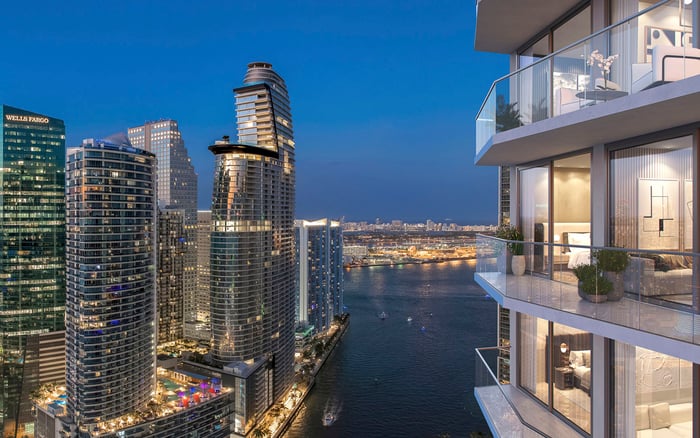
Newer construction and newly delivered luxury product can benefit in this environment because it reduces near-term unknowns. In Brickell, for example, residences within 2200 Brickell appeal to buyers who prioritize modern systems, newer governance structures, and a cleaner path for long-term planning.
Tax posture is an accelerant, but it’s not the whole explanation. Corporate and entrepreneurial ecosystems matter because they convert “second-home” intent into “primary-base” behavior.
Miami’s startup ecosystem was ranked 28th globally and 11th in the U.S. in the Global Startup Ecosystem Index 2025, and it posted the fastest growth rate among the top 100 ecosystems at 28.5%. The region has been described as hosting roughly 2,500 startups and six unicorns, with about $2.77 billion raised in 2024.
For founders and investors, that kind of momentum strengthens the case for being on the ground. For families, it reinforces the case for staying. This is how markets mature: lifestyle gets you there, and ecosystem keeps you there.
One of the clearest tells in today’s migration story is the preference for controllable privacy. A widely covered example is Google co-founder Larry Page, who was reported to have moved to Florida and purchased two Coconut Grove waterfront estates for about $173.4 million total, paying $101.5 million for one and $71.9 million for a neighboring property.
That “compound” approach isn’t simply about square footage. It’s about adjacency value: controlling sightlines, access points, and the future of the immediate environment. In a scarce waterfront market, buying the neighbor can be the most efficient way to secure permanence.
Coconut Grove’s appeal also extends to buyers who want a refined residential rhythm with proximity to the city’s commercial core. For those who want new development with a Grove address, Mr. C Tigertail Coconut Grove and The Well Coconut Grove speak to a clientele that values design credibility and a curated, health-forward lifestyle.
In a market defined by discretion, buyers still anchor decisions around three fundamentals: water, walkability, and governance.
Miami Beach continues to command a global lifestyle premium, especially where product is limited and design is uncompromising. For a buyer who wants a boutique, ocean-oriented residence without the scale of a mega-tower, 57 Ocean Miami Beach reflects the kind of constrained-supply profile that tends to hold value through cycles.
Surfside sits in a rare position: intimate, residential, and increasingly associated with trophy-level condominium pricing, as demonstrated by recent record-setting trades. The area is also defined by the presence of the Four Seasons-branded Surf Club ecosystem, and The Surf Club Four Seasons Surfside remains a shorthand for the very top of the condo market.
In Delray Beach, privacy-driven gated living has its own gravitational pull. Stone Creek Ranch has been characterized as a “billionaires’ secret” community with heavy security and privacy, which speaks to a broader point: at the highest tier, privacy isn’t a preference. It’s a requirement.
As capital becomes more mobile, allocation frameworks often grow more conservative. Real assets, including real estate, are frequently discussed as having inflation-hedging characteristics-particularly when cash flows can reprice with inflation. Replacement cost dynamics and rent resilience are part of why many investors view high-quality property as a stabilizer within a broader portfolio.
Locally, the argument is reinforced by long-term price performance in select municipalities. Over the past decade, some South Florida markets have posted especially strong gains, and leverage can amplify returns in a way that looks different from a pure equity allocation.
The key is discipline. The “real asset” thesis works best when the asset is genuinely irreplaceable: waterfront land, a unique floor plate, a building with governance that protects the brand, or a neighborhood with durable demand drivers.
Ultra-premium buyers are typically less sensitive to incremental rate moves and more sensitive to asymmetry: the risk that a decision made today becomes difficult to reverse later.
A practical underwriting checklist in this environment often includes:
This is where South Florida’s current profile becomes compelling: inventory is tighter than pre-2020 levels, $10M-plus velocity remains elevated, and trophy trades set reference points for the ceiling of buyer willingness.
Is California wealth-tax anxiety actually influencing moves to Miami? Public discussion of a one-time 5% tax above $1 billion has increased urgency for some ultra-wealthy households.
How strong is the $10M-plus market in South Florida right now? The region logged 361 residential closings at $10M+ in 2025, one of the strongest years on record.
What is the significance of the $86M Surfside penthouse sale? It set a Miami-Dade condo price record and signaled that trophy condo demand remains deep.
Is Miami-Dade inventory still tight compared with prior years? Yes, December 2025 inventory was reported at 17,266 units versus 20,898 in December 2019.
Are foreign buyers still an important part of South Florida demand? Yes, foreign buyers purchased about $4.4B in 2025 and represented roughly 15% of dollar volume.
Why are some buyers assembling “compounds” instead of buying one house? Adjacent acquisitions can improve privacy, control sightlines, and reduce long-term neighborhood risk.
Do Florida condo safety reforms affect luxury buyers too? Yes, inspections and reserve expectations have made building financials and repair planning central to diligence.
Is Miami’s business ecosystem a real factor in luxury housing demand? Yes, rapid startup ecosystem growth supports the shift from second-home ownership to primary residence.
Does luxury real estate function as an inflation hedge? Real assets can hedge inflation when replacement costs rise and cash flows have the ability to reprice.
What should a high-net-worth buyer prioritize when entering this market? Focus on scarcity, governance quality, privacy, and a clear long-term capital plan for any building purchase.
When you're ready to tour or underwrite the options, connect with MILLION Luxury.
If branded residences are on your mind — as a home or as an allocation — we would be glad to share what we are seeing, privately.
Begin a quiet conversation