South Florida’s condo market has shifted into buyer-market territory, but the experience is highly uneven by neighborhood, building age, and fee structure. With inventory elevated and pricing expectations still adjusting, sophisticated buyers can negotiate meaningfully, especially in oversupplied urban cores and older towers facing inspection and reserve realities. At the same time, ultra-luxury continues to transact with a heavy cash profile, underscoring that scarcity, location, and product quality still command attention. This MILLION Luxury playbook outlines where leverage is strongest, what to underwrite before you write an offer, and how to distinguish lasting value from temporary noise.
South Florida’s condo market has shifted decisively into buyer-market territory. Overall supply has hovered around roughly 12.9 months, with Miami-Dade condos around 13.2 months of inventory-implying it can take more than a year to clear today’s available listings at the current pace. That is the macro backdrop.
For a luxury buyer, the headline “average” masks meaningful extremes. Some areas are working through pronounced oversupply, while select coastal and scarcity-driven enclaves still behave more like tight markets-especially for best-in-class product.
The takeaway: this is a market that rewards discernment. Price discovery is real, but it is happening building by building, line by line, and sometimes floor by floor.
In the urban core, oversupply has been most visible. Greater Downtown Miami has been described with inventory around 26 months in late 2025. Brickell’s absorption was reported around 19.4 months with an average listing discount near 9%, and Edgewater posted buyer-market conditions as well, with absorption around 13.8 months.
These figures do not mean every home is negotiable. They do mean buyers generally have more time, more options, and a stronger negotiating posture than during the recent seller-driven cycle. In practical terms, leverage typically shows up as:
For buyers who want a new-build lifestyle without older-building uncertainty, the trade space in these districts can be compelling. In Edgewater, for example, newer luxury inventory often competes for attention on view corridors and amenity stacks-making positioning and pricing especially consequential. This is where a modern, amenity-forward option like Aria Reserve Miami can sit in the consideration set for those prioritizing newer construction in a high-supply submarket.
The most consequential structural story in South Florida condos is not purely pricing. It is ownership cost.
Across Miami-Dade and Broward, median monthly condo fees were cited rising from roughly $567 in 2019 to about $900 in 2024-a material increase that changes affordability and investor math. At the same time, post-Surfside legal requirements increased inspection and reserve-funding burdens, contributing to special assessments and a more rigorous underwriting environment, especially for buildings 30+ years old.
This helps explain why inventory pressure has been concentrated in older stock. In mid-2025, roughly 26,100 South Florida condos were listed for sale, including about 17,900 “vintage” units. Buyers are not simply reacting to aesthetics; they are reacting to balance sheets.
If you are considering a resale tower-especially a vintage building-treat due diligence like a capital markets exercise:
Florida’s HB 913, signed in June 2025, allows associations alternative funding approaches such as loans or credit lines for required reserves. That can ease immediate cash pressure, but it does not erase cost-it changes the timing and structure of how owners pay.
In mid-2025, the gap between asking and sold pricing widened notably. Average asking was cited around $901,900 (about $547 per square foot) while average sold was about $570,585 (roughly $391 per square foot). The mismatch was even sharper in vintage condos: average asking around $591,138 versus average sold about $336,862-roughly a 43% gap.
In luxury terms, this is the psychology of a turning market. Many sellers remain anchored to peak-era comparables and the narrative of “Miami exceptionalism,” while buyers are increasingly anchored to current carrying costs, rising supply, and the availability of alternatives.
Your advantage as a buyer is to negotiate from evidence and optionality. If a unit is lingering while the broader market shows longer time-to-contract, your offer does not need to be confrontational. It needs to be clean, well-supported, and structured around certainty.
This matters because it points to a buyer base that is less sensitive to traditional mortgage-rate pressure. Miami’s cash share in December 2025 was cited around 40% of closings versus roughly 27% nationally.
In practice, that creates a two-track market:
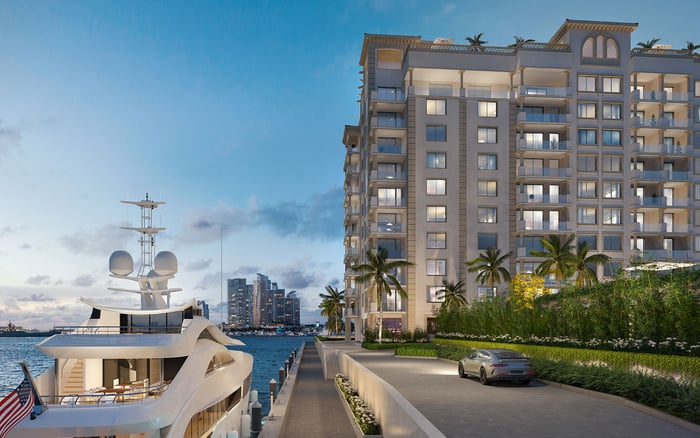
If your target is a generational oceanfront home, the competitive set can be smaller and more decisive. In Surfside, for example, boutique scale and limited new supply can keep demand concentrated in a narrow band of buildings. For buyers who value a quieter beachfront experience with architectural integrity, Eighty Seven Park Surfside is the type of offering that tends to live in that scarcity-driven category.
Not every submarket is absorbing inventory at the same rate. Coral Gables and Coconut Grove were described as relatively stronger in late 2025, with around 10 months of inventory and about 56 days on market. That is still not a tight market, but it is materially healthier than 19 to 26 months of absorption.
This is where lifestyle and long-term desirability can compress downside risk. Grove and Gables buyers often prioritize walkability, established streetscapes, and a more residential rhythm. In that context, newer boutique projects can attract buyers who want modern systems without high-rise scale. A wellness-oriented, design-forward choice like The Well Coconut Grove can appeal to buyers who are sensitive to building age and operating stability.
Along the coast, scarcity can still produce momentum. Surfside and Bal Harbour luxury condos saw a large year-over-year jump in closed sales in Q3 2025, consistent with demand for premier oceanfront enclaves.
In Miami Beach, performance has been more mixed by pocket. As always, micro-location and building quality decide outcomes. If your preference leans toward a quieter residential edge with beachfront adjacency, a project like 57 Ocean Miami Beach belongs in the conversation as an example of product that aims for privacy and refinement rather than sheer scale.
Luxury buying in 2026 is less about “getting in before it’s too late” and more about buying well.
Separate market risk from building risk. Oversupply is often concentrated at the building level, and underperformance can be specific even within prime neighborhoods.
Treat HOA and reserves as first-order variables. Rising fees and reserve funding requirements can influence resale liquidity as much as the view.
Use time as leverage. In the 2025 summer season window, sold units averaged roughly 108 days on market while active inventory averaged about 190 days-suggesting many listings were not meeting the market. That gap is negotiating oxygen.
Demand clarity on upcoming capital work. If projects are planned but not funded, bake that into your offer strategy.
In oversupplied cores, prioritize differentiation. Floor height, exposure, parking, and amenity access matter more when buyers have many similar options.
Some analyses have pegged cap rates in certain condo submarkets at levels that are difficult to justify as income investments, including estimates around 0.80% in Greater Downtown and 0.70% for Miami Beach vintage under that framework.
The point is not that every condo is a poor investment. It is that many condos are lifestyle assets first, and they should be priced that way. If you need an investment thesis, it has to be grounded in scarcity, durability of demand, and long-term holding power-not short-term rental optimism.
Also consider rental competition. South Florida has had a meaningful pipeline of multifamily units under construction, with a sizable share concentrated in Downtown, Brickell, and Edgewater. More rental supply can pressure rents and, indirectly, investor appetite for condos.
In a higher-inventory environment, the best outcomes often go to the buyer who is both assertive and easy to transact with.
Is South Florida a buyer’s market for condos in 2026? Conditions have leaned buyer-favorable, with overall supply near a year in many readings. Leverage is strongest where inventory and days on market are elevated.
Which areas show the most condo oversupply right now? The urban core has shown some of the highest absorption readings, including Greater Downtown and Brickell. Edgewater has also reflected buyer-market conditions.
Are sellers discounting more in Brickell? Listing discounts have been reported around 9% in Brickell in late 2025 conditions. Actual leverage still depends on the specific building and unit.
Why are vintage condos under more pressure than newer buildings? Older buildings often face higher inspection, reserve, and capital-repair obligations. That can translate into fee increases and special assessments.
How much have condo fees risen in South Florida? Median monthly condo fees in Miami-Dade and Broward were cited rising from about $567 in 2019 to roughly $900 in 2024. Higher fixed costs can reduce buyer demand.
What is HB 913 and why does it matter to condo buyers? HB 913, signed in June 2025, allows alternative reserve funding approaches like loans or credit lines. It may soften near-term cash calls, but costs still exist.
Is the ultra-luxury market still active despite higher inventory? Yes, with 361 South Florida sales over $10M in 2025, among the highest totals on record. Trophy demand tends to be more selective than broad-based.
Are most $10M+ transactions financed or cash? Cash has dominated, with 81% of $10M+ sales in 2025 closing in cash. This reduces sensitivity to mortgage-rate shifts.
How should I price an offer when asking and sold prices are far apart? Anchor to market-clearing comparables and all-in carrying costs, not the list price. Longer days on market can support a firmer negotiation stance.
What should I review before buying into a condo association? Focus on reserves, inspections, planned capital work, and the full monthly cost structure. In this cycle, association health is central to resale liquidity.
For a discreet conversation and a curated building-by-building shortlist, connect with MILLION Luxury.
If branded residences are on your mind — as a home or as an allocation — we would be glad to share what we are seeing, privately.
Begin a quiet conversation