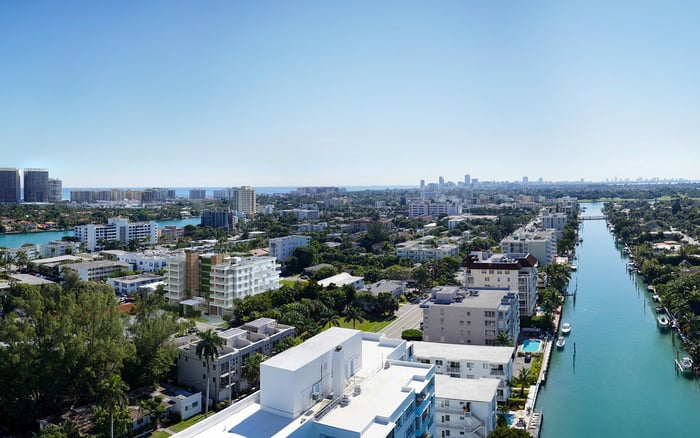
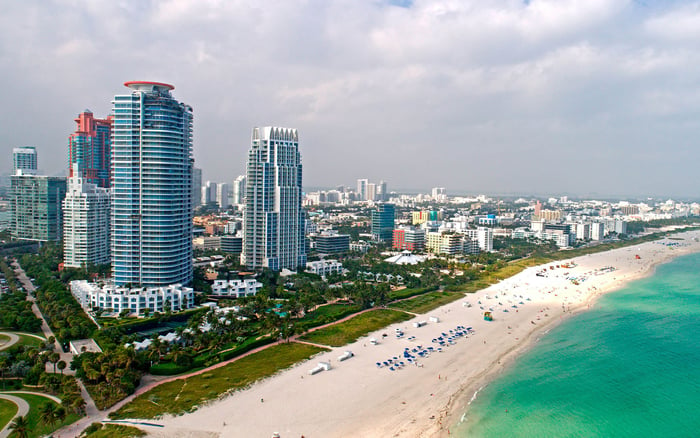
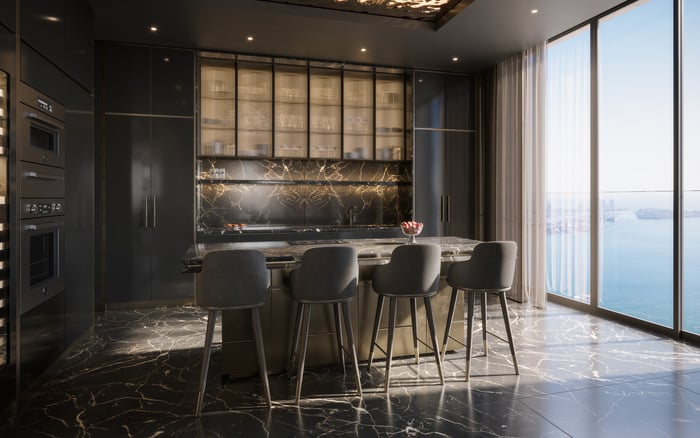
In South Florida, the next era of waterfront value is being defined by resilience: insurance access, engineered defenses, nature-based protection, and the micro-geography of elevation. Here is how sophisticated buyers are underwriting risk without giving up the lifestyle.
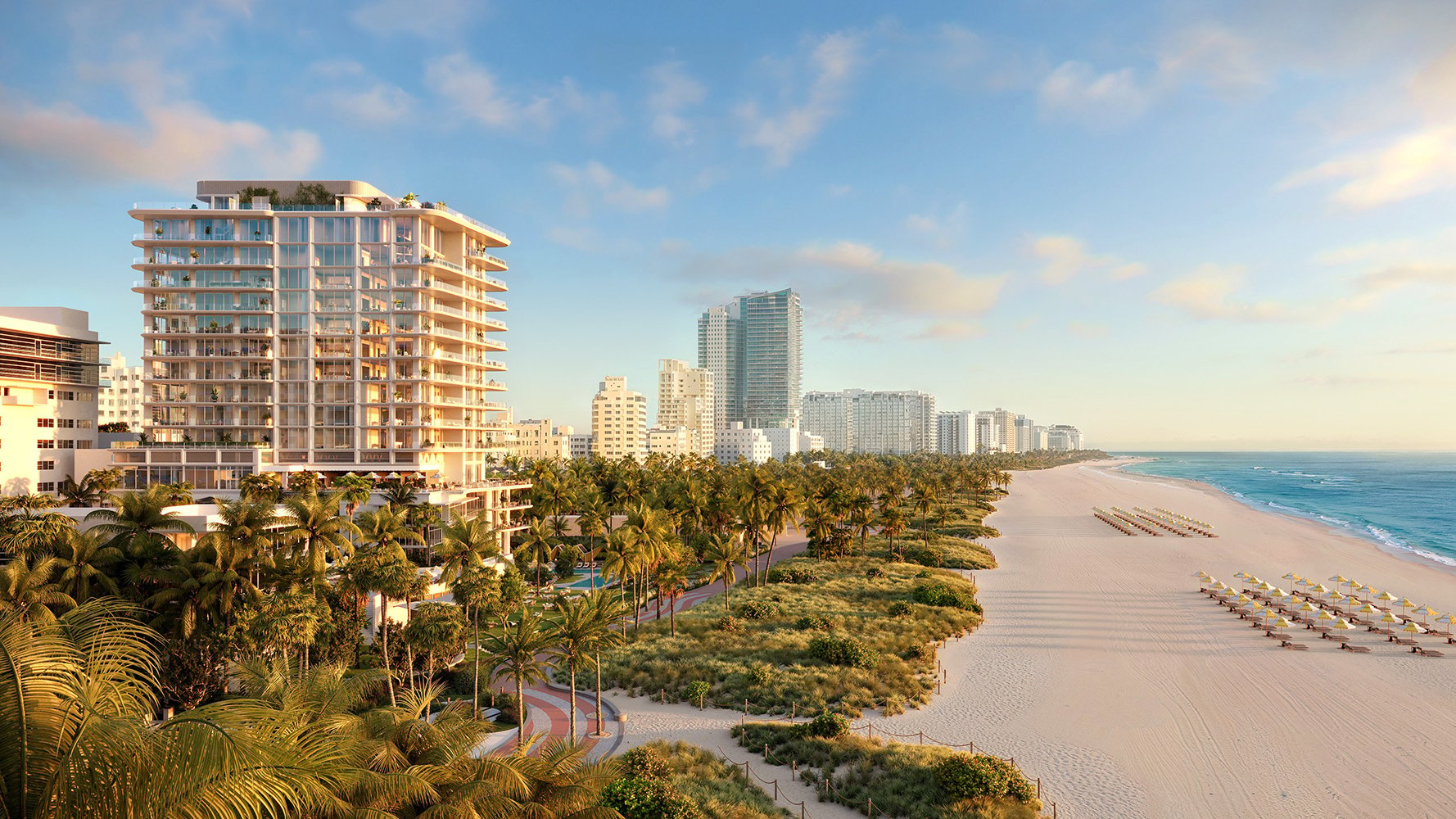
For decades, South Florida’s high-end market treated climate exposure as background noise: a line item for storm shutters, a brief conversation about views, and a familiar seasonal rhythm. That posture is fading. Today’s most sophisticated buyers are not abandoning the coastline. They are underwriting it with the same rigor they bring to architecture, governance, and long-term value.
The shift is not ideological. It is operational. The questions that can define a closing now extend well beyond finishes and floor plans: Will insurance be available on terms that support both lifestyle and balance sheet? Will financing remain smooth, or introduce new conditions late in the process? How does a specific building perform in a real storm, not in a brochure rendering? In practical terms, buyers are increasingly paying for confidence.
Globally, mean sea level has already risen roughly 8 to 9 inches since 1880, and widely cited projections contemplate as much as about 45 additional inches by 2100. The range of outcomes varies by region, but the direction is clear. For luxury real estate, the relevance is not only a distant number. It is the way long-horizon risk becomes near-term friction through insurance, repeat flooding, and coastal erosion.
Historically, academic research has found that sea-level rise was not clearly reflected in coastal waterfront pricing across multiple U.S. states over several decades. Put simply: markets can discount a slow-moving risk until something forces it into everyday decision-making.
That forcing mechanism is increasingly the transaction layer of real estate. Insurance availability, lender requirements, and the cadence of claims after major weather events are no longer peripheral. They are central. Recent market coverage has emphasized a widening neighborhood divide, where lower-risk areas have outperformed higher-risk pockets even within the same metro. Buyers are not necessarily rejecting an entire city. They are selecting within it with far more precision.
This is where climate risk becomes a luxury concept. Ultra-premium purchases have always been selective. The difference now is the intensity of the filter. Micro-elevation, drainage patterns, building systems, reserve strength, and maintenance discipline are being evaluated alongside ocean frontage.
South Florida’s appeal remains intact, but the underwriting has matured. For investors and end users alike, that maturity matters. The market is beginning to separate properties that are merely “oceanfront” from properties that are oceanfront with resilient fundamentals.
Sea-level rise is often framed as incremental: roughly 0.13 inches per year globally in a commonly cited overview, with meaningful local variation. Incremental can sound manageable, until you translate it into compounding pressure on infrastructure, groundwater, storm surge, and tidal flooding.
Erosion is the fast version of the same story. A widely covered Cape Cod case illustrates how quickly conditions can change for high-end assets: a $5.5 million home purchased in 2022 was reported to be threatened by rapidly advancing erosion, with nearby bluffs estimated to be eroding on the order of several feet per year. The lesson for South Florida is not the specific geography. It is the timing. Environmental change that reads as “long-term” on paper can become a short-term property event.
For luxury buyers, the practical takeaway is to treat shoreline and flood risk as dynamic, not static. Map-based designations are a starting point, not a conclusion. The more decisive question is how a given site and structure respond to changing conditions over time, and how that response affects insurability, usability, and eventual resale.
In coastal markets, the most expensive mistake is assuming the transaction mechanics will always be there. Insurance, in particular, can be a gating item rather than a routine checkbox. Flood insurance continuity can affect closings at scale. Reporting has highlighted that the risk of an NFIP lapse has put coverage for nearly 5 million homes in limbo at times, threatening roughly 1,300 home closings per day. In a market that values certainty, that is not a footnote. It is a structural constraint.
Financing is similarly foundational. For properties in FEMA-designated Special Flood Hazard Areas, flood insurance is generally required for federally backed mortgages. Even cash buyers should care, because exit liquidity often depends on the next buyer’s ability to finance. A property that becomes difficult to insure can become difficult to sell, regardless of how compelling the lifestyle may be.
For a luxury audience, the right frame is less “Will I buy insurance?” and more “What is the long-term insurability narrative of this specific asset?” That narrative is shaped by claims history, building resilience, local infrastructure, and the broader insurance market’s appetite. In 2026, underwriting is part of the lifestyle decision.
Resilience value is rarely delivered by a single feature. It is a stack, and sophisticated buyers increasingly want to understand how the layers work together.
Engineered defenses can include elevation strategies, flood barriers, improved pumping, stormwater upgrades, and building-level hardening. Some cities pursue large-scale perimeter protection, including seawalls, but those plans can be expensive and politically complex. Public reporting on Charleston, for example, has described a flood-defense project around $1.3 billion focused on protecting the historic downtown peninsula, while raising questions about how protection is distributed across neighborhoods. South Florida buyers can read that as a reminder: public infrastructure matters, and so does where it is prioritized.
Nature-based defenses are the quieter layer of the stack, and increasingly the most financially legible. A UC Santa Cruz summary of Zillow-data-based research reported that proximity to mangroves can reduce post-hurricane home value losses by tens of thousands of dollars per $1 million in home value, with estimates commonly described in the ~$20,000 to $40,000 range and up to about $60,000 in some cases. The same coverage noted that price declines were nearly twice as large in areas farther from mangroves after hurricanes.
For South Florida, the conclusion is straightforward: coastal ecosystems are not just aesthetic. They function as financial infrastructure, and buyers are starting to price that protection more explicitly.
In Miami-beach, the luxury calculus now runs on two tracks. The first is the obvious one: the address, the water, the cultural energy, the sense of arrival. The second sits beneath the surface: how the residence performs under stress, and how predictably it operates when conditions are not ideal.
At the top of the market, branded and service-driven residences can offer a kind of operational resilience. Not because a nameplate changes sea level, but because well-capitalized buildings tend to treat maintenance, staffing, and systems as core product, not optional overhead. Buyers considering Shore Club Private Collections Miami Beach are often drawn to the heritage and hospitality posture. Increasingly, that posture is also interpreted as a form of confidence that the building is professionally run through all conditions.
Similarly, the appeal of Setai Residences Miami Beach is not only the address and service culture. It is the broader idea that as ownership becomes more operationally complex, a residence that functions like a well-managed luxury hotel can feel like a hedge against friction.
None of this removes risk. It reframes it. In a climate-affected future, the premium is often paid for competent operations, strong governance, and a predictable ownership experience.
“New-construction” is no longer a purely aesthetic preference. It has become a proxy for systems, codes, and modern building practices, even though every buyer still needs to verify specifics building by building.
The most discerning clients are asking more technical questions: Where is critical equipment placed? How is water managed at ground level? What redundancy exists for power, mechanical, and life-safety systems? How quickly can a building return to normal operations after an event?
For oceanfront buyers who want a more intimate scale without sacrificing contemporary design, 57 Ocean Miami Beach can sit in the conversation as an example of a boutique-leaning approach that still speaks to the modern expectation of quality and durability.
The goal is not to buy a promise. The goal is to buy a system, and to understand that system well enough to anticipate future costs, future insurability, and future buyer demand.
As risk is priced in, a familiar pattern is taking shape: capital concentrates in places perceived as safer, better protected, or more resiliently managed. Academic literature has described this within-city shift as climate gentrification, where higher-income households may move toward relatively safer or elevated neighborhoods.
In South Florida, that does not always mean simply “inland.” It can mean higher floors, better drainage corridors, or submarkets with stronger infrastructure investment. It can also mean buildings with stronger governance and reserves, where maintenance is consistent and future assessments are less likely to surprise.
This is where the conversation becomes both financial and social. Large-scale defenses may protect the most valuable districts first, influencing desirability and the tax base that funds further protection. Buyers should pay attention not only to a building’s specs, but to a city’s long-term capital plan. Neighborhood-level protection and investment can shape long-term value as much as interior design.
Brickell has long been associated with global capital, skyline living, and walkable urban energy. Increasingly, it can also represent a “vertical hedge” concept: higher-floor living that is structurally separated from some ground-level exposure, paired with newer building stock and professional management.
This is not a blanket claim that any tower is immune. It is a recognition that luxury demand can migrate toward formats that feel operationally controlled: secured lobbies, staffed services, centralized maintenance, and a more standardized relationship to risk.
For buyers with an investment mindset, the question is whether the asset’s future buyer pool will remain deep. Format matters. Insurability matters. Governance matters. In a market that is learning to price resilience, the buildings that communicate competence clearly often enjoy a quieter, more durable premium.
Surfside reflects another dimension of the resilience premium: scarcity. When supply is limited and the lifestyle is singular, demand can persist even as risk becomes more visible. Market coverage elsewhere has illustrated the same paradox, including reports of ultra-wealthy capital assembling multiple oceanfront lots in high-risk coastal California. The signal is not that risk disappears. It is that scarcity can keep money in the game.
The implication for South Florida is nuanced. Scarcity can support pricing, but it does not eliminate volatility. Disasters can reset valuations quickly, as recent reporting on the 2025 Los Angeles wildfires illustrated: billions in erased home value in affected neighborhoods, and destroyed properties selling as vacant lots at steep discounts relative to pre-fire valuations.
A luxury buyer in Surfside should think like a curator and an underwriter at the same time. What is truly rare? What is demonstrably resilient? And what is the practical plan for insurability and recovery if the area experiences a severe event? The lifestyle can be extraordinary, but the ownership strategy must be equally deliberate.
The best deals in the next cycle will not necessarily be the lowest price per square foot. They will be the assets with the fewest future frictions. Before signing, sophisticated buyers typically pressure-test the following:
At the ultra-premium level, diligence is not pessimism. It is professionalism, and it is increasingly the dividing line between a beautiful purchase and a durable one.
Luxury is ultimately an operating model. In a more volatile climate, the ability to execute consistently becomes a value driver. Service buildings tend to have staff, procedures, and vendor relationships that can shorten the distance between disruption and normalcy.
That is one reason branded residences remain central to the Miami-beach conversation. The Ritz-Carlton Residences® Miami Beach speaks to the enduring appeal of a managed environment where owners can expect consistent standards. In a future where climate volatility can create operational complexity, consistent standards become an asset.
The broader point is not that branding replaces diligence. It is that operational discipline is being repriced. Buyers should quantify it as seriously as they quantify views, because governance, reserves, and management quality can determine how smoothly a building navigates the next decade.
Is sea-level rise a 2100 problem or a 2026 problem? Both. Sea-level rise is incremental, but it affects near-term issues like tidal flooding, infrastructure stress, and insurance underwriting.
Can insurance really stop a luxury closing? Yes. Flood insurance availability and continuity can directly affect mortgageability and timing, and market reporting has shown that coverage disruptions can threaten closings at scale.
Do buyers actually price nature-based protection like mangroves? Increasingly, yes. Research summarized using transaction data has associated proximity to mangroves with meaningfully smaller post-hurricane value losses.
What is the most important resilience indicator for a condo buyer? A combination: governance and reserves, building systems and maintenance discipline, and the property’s risk classification for financing and insurance.
Explore South Florida’s most resilient addresses with MILLION Luxury.
If branded residences are on your mind — as a home or as an allocation — we would be glad to share what we are seeing, privately.
Begin a quiet conversation