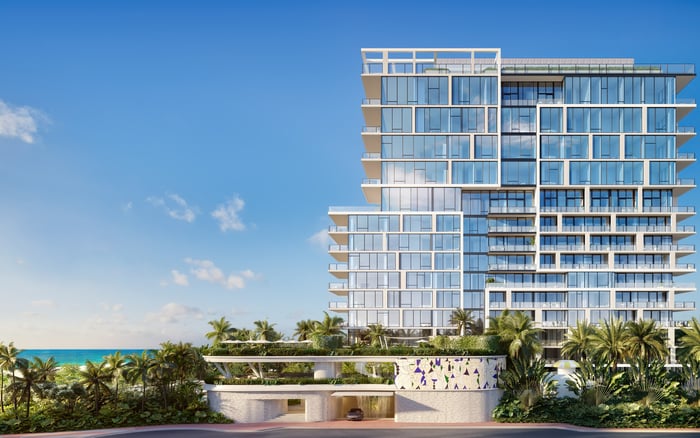
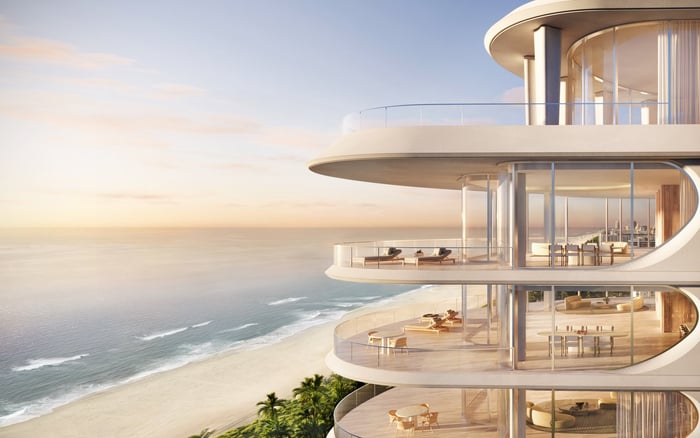
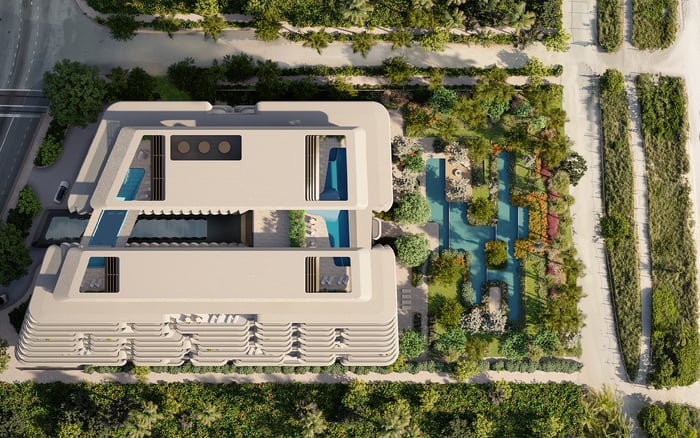
A discreet buyer’s guide to South Florida’s most limited-count, hospitality-leaning new developments, with practical underwriting notes for pre-construction in Miami Beach and Surfside.
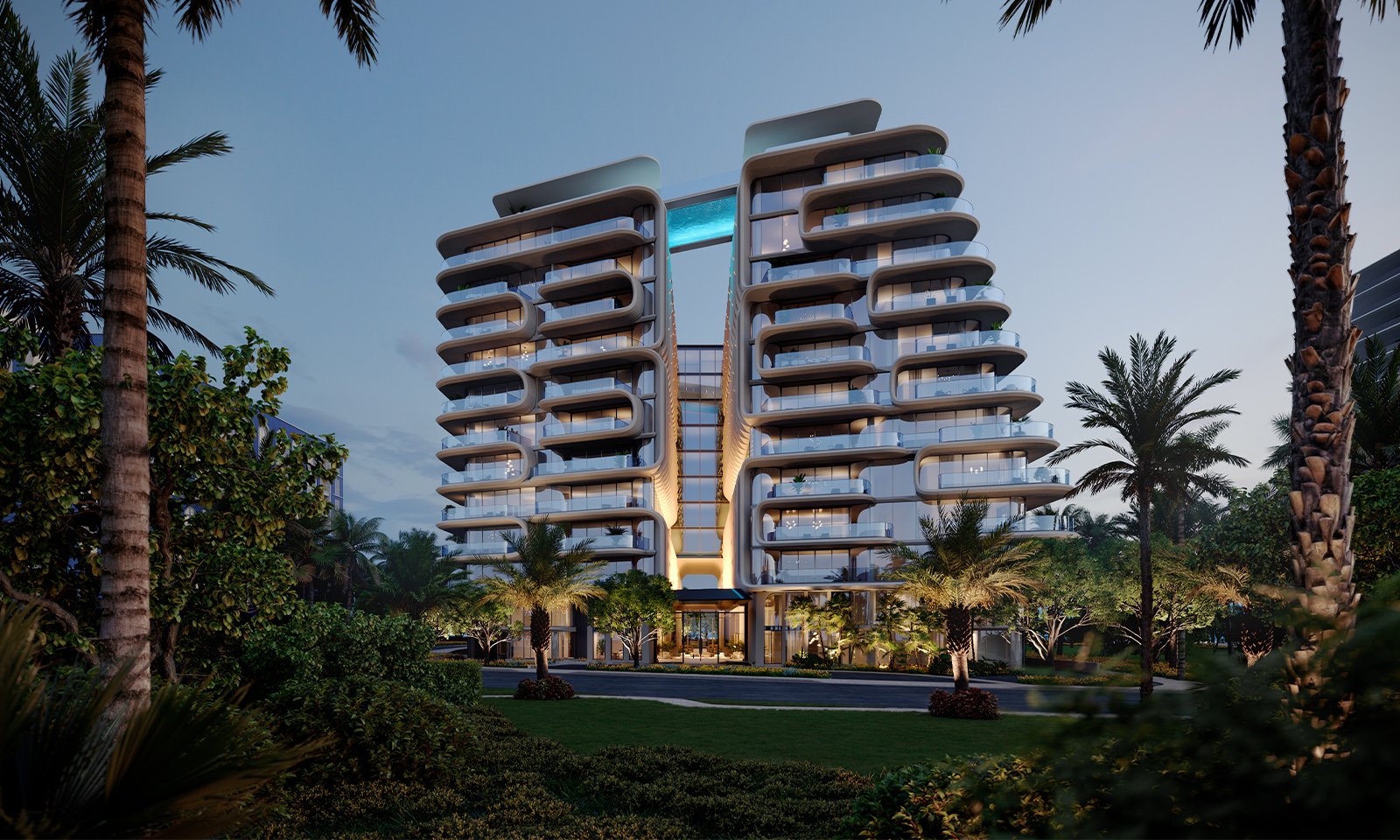
Miami has always understood spectacle, and it prices it quickly. In that environment, boutique condominium living has emerged as the quieter status signal. The message is not more height or louder amenities. It is fewer front doors, tighter service ratios, and an arrival experience designed for residents who value privacy as much as ocean views.
Across Miami Beach and neighboring Surfside, the boutique thesis is not theoretical. It is being engineered into new developments deliberately capped under 50 residences, often paired with hospitality-level staffing and carefully curated programming. For buyers, the appeal is straightforward: genuine scarcity that can support long-term value, and an operating model that can feel closer to a private club than a traditional condominium.
From an editorial standpoint, this guide intentionally sits at the intersection of Miami-beach, Surfside, Boutique, and Pre-construction. That is where the lowest-density new supply is concentrating, and where the difference between “small” and “truly boutique” matters most.
Luxury demand in South Florida has not disappeared. It has refined itself.
Recent reporting placed Miami’s luxury condo market at a Q3 2025 median price around $1.8 million, up about 4.3 percent year over year, while the same dataset noted a cooling of roughly 5.3 percent quarter over quarter. The takeaway is not a reversal. It is a shift in cadence: buyers are still active, but they are more selective about product quality, building profile, and future resale narrative.
Within Miami Beach, the signal has been even clearer. South Beach pricing was reported around $1,538 per square foot in Q3 2025, up sharply year over year from approximately $1,123 per square foot in Q3 2024. For purchasers evaluating pre-construction against legacy inventory, this matters because the replacement cost conversation is increasingly concrete. Truly high-quality oceanfront sites are scarce. Entitlements are not getting easier. The market tends to recognize that constraint.
Boutique projects sit inside that premium band for a reason. They are not designed to compete on volume. Their competitive edge is the lived experience: fewer neighbors, higher staff-to-resident ratios, and in many cases hospitality branding that signals a globally recognizable standard.
It is easy to assume that larger buildings automatically mean more amenities and, therefore, more value. At the ultra-premium level, many buyers optimize for the opposite.
Boutique buildings, when properly conceived and operated, can deliver advantages that mega-developments struggle to replicate. Fewer residences can mean less wear on common areas, quicker response times from management, and a calmer arrival sequence. Privacy is not only about floor plans. It is about daily friction: fewer elevators in rotation, fewer unknown faces in the lobby, and fewer competing agendas in association governance.
The resale narrative can also be cleaner when the product is genuinely rare. “There are only 19 of these” lands differently than “there are 400 of these.” In a soft quarter, rarity is often the first line of defense.
Still, boutique is not a guarantee. It is a framework. The distinction between a lasting boutique building and a merely smaller building is usually visible in the same due-diligence questions:
Buyers often anchor their expectations by triangulating against established, hospitality-anchored, high-service properties, even when their target is newer and lower in count. In Miami Beach, Setai Residences Miami Beach is frequently used as a reference point for what “service-forward” can mean in practice.
Below is a shortlist of low-density projects most consistently disclosed as under 50 residences, paired with positioning that reads as distinctly ultra-luxury. The ranking is calibrated for buyers who prioritize privacy, brand adjacency, and long-term collectability.
The intent here is not to suggest that one address fits every buyer. It is to identify where scarcity is structural, and where the service profile and branding are clearly part of the investment thesis.
1. The Shore Club Private Collection - 1901 Collins Ave, Miami Beach; 49 residences A boutique offering in South Beach with a publicly described 49-residence program. The project’s hospitality positioning includes Auberge Resorts Collection involvement in official materials, an alignment that tends to resonate with buyers who want hotel-grade service without a condo-hotel feel.
Reported pricing has spanned roughly $5 million to $50 million depending on residence type and size, placing it squarely in the “generational purchase” bracket rather than the purely discretionary tier.
2. Aman Residences Miami Beach - 3425 Collins Ave, Miami Beach; 22 residences Aman’s entry into Miami Beach has been widely covered as an ultra-low-density residential offering, publicly described at 22 residences. The key differentiator here is the brand itself. In global luxury real estate, Aman’s residential strategy is often associated with privacy, ritualized service, and a highly controlled aesthetic.
For Miami Beach, the implication is direct: this is intended to function as a residential enclave with a global client base, not as a conventional condo competing on a checklist of amenities.
3. Surf House (Surfside) - 8995 Collins Ave, Surfside; 19 residences Surfside is a distinct municipality, but it is inseparable from the Miami Beach luxury search pattern, especially for buyers prioritizing a quieter beachfront rhythm. Surf House has been disclosed as a 19-residence boutique project at 8995 Collins Ave.
Marketing has presented pricing in a broad band from approximately $8.5 million to $28 million, depending on residence size and configuration. With this unit count, scarcity is not just a feature. It becomes part of the asset identity.
4. Rosewood Residences Miami Beach - 1775 Collins Ave, Miami Beach; 44 residences Rosewood Residences Miami Beach has been marketed as 44 residences associated with the redevelopment and restoration of the Raleigh property site. Rosewood’s brand typically reads as a refined, service-forward approach, which tends to translate well for buyers who want luxury without maximalism.
For underwriting, the 44-residence count matters. It suggests a boutique operating context, but with enough scale to sustain robust staffing and a full amenity program when properly budgeted.
5. The Delmore (Surfside) - 8777 Collins Ave, Surfside; 37 residences The Delmore in Surfside has been publicly disclosed as a 37-residence project at 8777 Collins Ave, designed by Zaha Hadid Architects. Early works and engineering milestones have been reported, and the project has been marketed with pricing starting around $15 million.
For buyers who prioritize design authorship, this is the kind of architectural signature that can help a building retain mindshare in a competitive oceanfront corridor.
Pre-construction is not simply “buy early, hope later.” In South Florida, it is a capital plan with a timeline. Boutique projects can magnify both sides of the equation: the upside of rarity, and the friction that comes with low liquidity and limited comps.
Start by treating the purchase as a structured allocation decision. Your deposit schedule is real capital tied up over time. Your timeline is a moving target influenced by permitting, scope, and construction conditions. And your exit strategy should be considered before you sign, not after.
Three underwriting baselines are commonly cited for Miami pre-construction transactions, with project-specific schedules varying by developer:
For boutique buyers, the practical point is that low unit counts change the risk profile. A 19 to 49 residence building can sell through quickly, but it can also provide fewer comparable resales if you need optionality mid-cycle. Scarcity supports value, but it can also reduce liquidity in a narrower buyer pool.
Neighborhood context is part of the underwriting, not an afterthought. If you want Surfside’s quieter cadence but still want proximity to Miami Beach’s dining and cultural circuit, you will naturally compare new boutique inventory with both established landmarks and newer oceanfront entrants. Surfside’s current new-build narrative, for example, is frequently discussed alongside The Delmore Surfside precisely because the unit count is limited and the positioning is unambiguously ultra-luxury.
It is tempting to begin with finishes, ceiling heights, and terrace depth. Sophisticated buyers often do better starting with the micro-market.
Miami Beach, particularly along the Collins Avenue corridor, tends to reward buyers who want an energetic, high-touch lifestyle with immediate access to hotels, restaurants, and a constant calendar. Surfside, by contrast, often appeals to buyers seeking a calmer beachfront sensibility and a more residential identity.
If your routine is built around South Beach access and hospitality-driven living, a project like Shore Club Private Collections Miami Beach signals the direction of travel: boutique scale, branded service, and an address that performs socially as well as financially.
If your preference leans toward design-led quiet luxury, you may benchmark against Miami Beach’s strongest design identities. A property such as Faena House Miami Beach remains a useful reference for what buyers will pay for a cohesive aesthetic language and a tightly curated residential experience.
The decision is not only Miami Beach versus Surfside. It is how you intend to live. Boutique buildings are at their best when they match the owner’s rhythm: privacy for residents who travel frequently, staffing that supports lock-and-leave use, and a building culture that protects discretion.
In ultra-luxury, diligence is less about whether the lobby photographs well and more about whether the building will age with grace.
The most capable buyers and advisors tend to run the same set of questions early, because small buildings can concentrate both strengths and weaknesses. Consider the following buyer-forward checklist before committing:
Because boutique buildings are inherently scarce, the story should be specific. The strongest narratives usually concentrate around one or more of the following: a globally recognized hospitality brand, a signature architect, a historically significant site, or a location that cannot be replicated.
Also keep an eye on the less glamorous line items. In a boutique building, service expectations are high, and the HOA budget must support them. A convincing service plan is one that is both aspirational and operationally credible.
Finally, remember that discretion is a deliverable. The best boutique projects protect it through design, staffing, and governance. If any one of those legs is weak, the building may be small, but it will not feel truly private.
What qualifies as a “boutique” condo in this guide? Projects publicly described with under 50 residences, paired with ultra-luxury positioning in Miami Beach or Surfside.
Are pre-construction deposits negotiable in Miami Beach and Surfside? Deposit schedules are typically set by the developer, and staged deposits totaling roughly 40 to 50 percent are commonly cited, though terms vary by project.
How long does delivery usually take for Miami pre-construction? Timelines are often described around 3 to 5 years from early sales to delivery, but permitting and construction conditions can shift schedules.
Do boutique buildings always have better resale performance? Not always. Boutique can support scarcity value, but resale depends on execution, service costs, location, and how well the design holds up over time.
To explore South Florida’s most discreet new-construction opportunities with a private advisory approach, connect with MILLION Luxury.
If branded residences are on your mind — as a home or as an allocation — we would be glad to share what we are seeing, privately.
Begin a quiet conversation