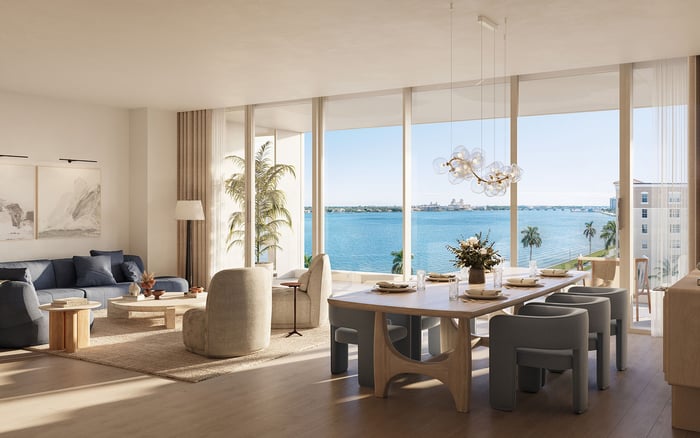
A buyer-focused look at why utility-room depth at South Flagler House in West Palm Beach deserves technical verification beyond polished renderings, especially for owners who value long-term function as much as views and finishes.

At South Flagler House in West Palm Beach, the most revealing question may not be the first one asked in a sales gallery. Views, finishes, arrival sequence, ceiling presence, and amenity tone all matter. Yet the daily experience of ownership is often determined in quieter rooms. The utility room is one of them.
For a discerning buyer, utility-room depth is not a minor technical detail. It is a measure of whether the residence has been planned for life after closing: laundry cycles, household staff movement, maintenance visits, storage overflow, appliance replacement, and the small rituals that allow a large home to feel effortless. A shallow utility room can photograph cleanly, but it can frustrate daily use if it lacks workable clearance once appliances, doors, service panels, and circulation are taken into account.
This is especially relevant in the West Palm Beach and Palm Beach conversation, where new-construction and pre-construction residences are often evaluated first by high-floor outlooks, water-view orientation, and formal design language. The deeper due diligence question is whether the back-of-house plan supports the same level of refinement promised by the front-of-house presentation.
A rendering can convey mood, materiality, and proportion, but it is not a substitute for technical verification. Utility spaces are particularly vulnerable to visual compression because a clean image may not reveal the true depth required for appliance doors, a standing user, cleaning tools, laundry baskets, or a technician working behind a machine.
The right question is not whether the utility room appears sufficient in marketing material. The right question is how it functions when full-size equipment is installed and the room is being used by people. Buyers should verify whether the space accommodates appliance fit, service access, and usable clearance without forcing awkward daily choreography.
In ultra-luxury ownership, the cost of inconvenience is not simply financial. It is operational. If a service person cannot work comfortably, if a staff member blocks a corridor while managing laundry, or if appliance replacement becomes difficult because the room is too shallow, the residence loses some of the quiet ease that luxury is meant to deliver.
The first request should be for the dimensioned condition, not only the illustrated condition. A buyer should seek clarity on the planned or built depth of the utility room, the location of appliances, the direction of door swings, and the clear working area that remains once everything is installed. The goal is not to redesign the residence from the sales table. The goal is to understand whether the plan works as a lived environment.
Second, ask how fixed building systems affect the room. Shafts, structural walls, plumbing paths, mechanical systems, and electrical panels can define what is possible and what is not. If those elements sit behind or beside the utility area, future modification may be limited. A buyer who assumes a utility room can be adjusted later may discover that the most important boundaries are not cosmetic.
Third, understand service access. Appliances need more than a place to sit. They need room for installation, ventilation where applicable, access for maintenance, and the ability to be removed or replaced without damaging finished surfaces. A beautiful laundry cabinet elevation means little if service work requires extraordinary effort.
The reason to verify utility-room depth before committing is straightforward: correcting a back-of-house problem after closing can be expensive, disruptive, and constrained by building conditions. In a high-rise residence, utility areas are not always flexible zones. They may be tied to vertical systems and shared infrastructure, which can make later changes more complicated than a buyer expects.
A shallow utility room may also create a chain of small compromises. A door may need to remain open during use. A laundry basket may sit in a hallway. Cleaning supplies may migrate into visible storage. Staff circulation may conflict with resident circulation. Maintenance may become more intrusive. None of these issues is dramatic in isolation, but together they weaken the sense of calm that an ultra-premium home should protect.
This is why back-of-house planning should be treated as part of luxury due diligence, not as an afterthought once views and finishes have been admired. The best residences feel composed because their invisible systems are as carefully considered as their public rooms.
A serious review should move from image to operation. Start with the utility-room footprint, then layer in the actual appliances, door positions, cabinetry, service panels, and human movement. Imagine a typical week, not a staged afternoon. Where does laundry sort? Where do supplies live? Can one person work while another passes? Can a technician access the rear or side of an appliance without turning the room into a construction event?
The question is not whether the room is large in the abstract. It is whether the depth is usable. Usable depth is the dimension left after real objects enter the room. In many residences, the difference between nominal depth and functional clearance is the difference between elegance and irritation.
Buyers should also ask whether the construction documents, not only sales visuals, support the intended condition. If the residence is not yet complete, the most valuable confirmation may be the technical plan that shows walls, systems, and clearances. If the residence is built, the best verification is physical measurement and a walk-through with the daily-use scenario in mind.
South Flagler House is being considered in a market where the definition of finish has expanded. Stone, wood, glass, and hardware remain important, but so does the infrastructure of comfort. A residence can be visually superb and still feel less than seamless if utility spaces are under-scaled for the owner’s lifestyle.
For buyers who expect staff support, frequent wardrobe care, household management, or simply a refined standard of order, the laundry and utility zone carries real weight. It is not a secondary room. It is part of the private operating system of the home.
That is the larger lesson. Luxury due diligence is not only about what can be seen from the terrace. It is about what happens behind the most discreet doors, where planning either supports the day or interrupts it.
Why is utility-room depth important at South Flagler House? It affects appliance fit, service access, storage, staff movement, and daily ease, all of which shape long-term livability.
Can a rendering accurately show whether a utility room works? Not by itself. A rendering may suggest proportion, but it does not confirm usable clearance or service conditions.
What should buyers verify first? Buyers should verify the dimensioned utility-room depth and the remaining clear space once appliances and doors are accounted for.
Why does appliance access matter? Appliances need room for installation, maintenance, and replacement, not just enough space to appear fitted in a plan.
Can a shallow utility room be corrected after closing? Sometimes, but fixed shafts, walls, and building systems may limit changes and make retrofits costly.
Is this issue only relevant for staff-served households? No. Even owners without staff benefit from proper clearance, storage logic, and easy maintenance access.
Should buyers rely on sales-gallery visuals? Visuals are useful for design intent, but buyers should confirm the construction-document or built condition.
How does this relate to high-rise living? High-rise residences often have fixed building systems, so service spaces may be less flexible than they appear.
Does utility-room planning affect resale appeal? It can. Sophisticated buyers often notice whether the home supports daily function as well as presentation.
What is the main takeaway for South Flagler House buyers? Treat the utility room as a core livability feature and verify its real depth before making assumptions from images.
To compare the best-fit options with clarity, connect with MILLION.
If branded residences are on your mind — as a home or as an allocation — we would be glad to share what we are seeing, privately.
Begin a quiet conversation