From Sunny Isles Beach’s in-home sky garages to trackside “car condo” campuses across the country, automotive real estate has matured into a discreet asset class. For South Florida buyers, the story is less about novelty and more about control: climate, security, provenance, and the ability to enjoy a collection without surrendering privacy. This editorial looks at what’s been publicly disclosed, what’s been widely marketed, and what sophisticated buyers should underwrite before they bring the garage into the living room.

In ultra-luxury real estate, discretion has always been the product. In South Florida, that discretion now includes the arrival itself. Instead of a porte-cochere, valet handoff, and a public walk through the lobby, a growing segment of buyers is drawn to a more controlled sequence: street to residence, with the car treated as a companion object rather than a stored possession.
This is not simply aesthetic theater. Serious collectors manage temperature and humidity, security exposure, service scheduling, and the lingering question of where a collection lives when the owner is out of town. “Sky garages”, along with the parallel rise of privately owned garage-condo communities, are real estate’s answer to those operational pressures.
For buyers splitting time between Sunny Isles and Miami Beach, the appeal is straightforward. The home becomes a vault, a showroom, and, increasingly, an extension of personal identity, all while keeping privacy intact.
Sunny Isles Beach holds an outsized role in the global conversation about residential design. Few coastal markets combine extreme vertical living with a buyer base that is both international and vehicle-forward.
The modern reference point remains Porsche Design Tower, an oceanfront, 60-story residential tower developed by Dezer Development in collaboration with Porsche Design. Publicly disclosed details position it as a purpose-built experiment in automotive privacy. The building is organized around the patented Dezervator robotic car-elevator system, designed to deliver residents and their vehicles directly to in-unit “sky garages.” The tower is reported to have 132 residences, each designed with an in-unit private garage served by the car elevator. In the resale and rental market, listings have been marketed in a roughly $4 million to $14.6 million range, with luxury rentals often advertised around $22,500 to $45,000 per month, depending on unit and timing.
Its staying power is not the spectacle. It is the operating logic. The arrival becomes controlled and repeatable, and the car transitions from “parking” to part of the interior program, closer to art storage than a conventional garage.
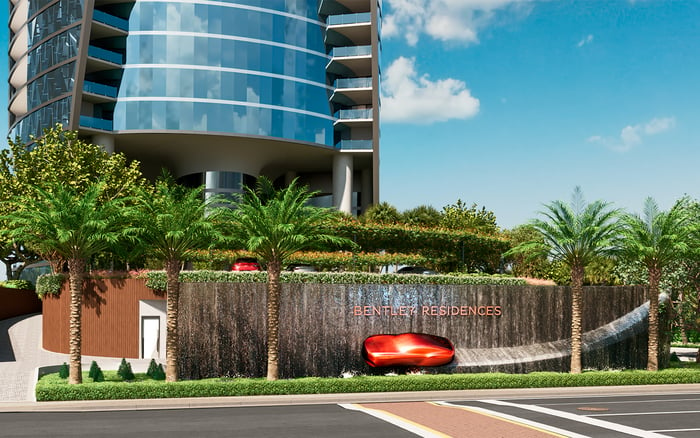
That logic is being extended in planned form at Bentley Residences Sunny Isles, a 63-story oceanfront condo tower marketed with 216 residences and in-unit car garages via vehicle elevators. As publicly advertised, the plan includes four high-speed vehicle elevators using Dezervator technology. Pre-construction pricing has been marketed as starting around $5.6 million, with top residences and penthouses marketed up to roughly $20 million and above.
The larger point is simple: the “garage as gallery” is no longer a one-off. In Sunny Isles, it has become a recognized lane within oceanfront new development.
Miami Beach does not need to replicate Sunny Isles to capture the same buyer psychology. The most resilient ultra-luxury demand here tends to concentrate on lifestyle curation: walkability, design credibility, and buildings that operate more like private clubs than traditional condominiums.
That distinction matters for collectors. Many are not seeking to display vehicles to neighbors. They are seeking to reduce friction. They want a residence that performs like a hotel while allowing the owner to control access, storage, and scheduling. This is where the branded and hospitality-adjacent market intersects with automotive living.
In practice, buyers cross-shopping Miami Beach often evaluate the building as a lifestyle platform first, then layer in a collection plan. Consider how Shore Club Private Collections Miami Beach frames its value around service and discretion, or how Setai Residences Miami Beach signals a preference for quietly delivered hospitality rather than overt spectacle. For those prioritizing a newer, design-forward address with a contemporary sensibility, Five Park Miami Beach is frequently discussed as a modern residential alternative.
The practical takeaway is consistent: even when a building is not marketed around vehicle elevators, buyers can still apply the same discipline. Define where the car lives, how it is accessed, and how the service model affects privacy.
Outside South Florida’s vertical skyline, a different format has gained legitimacy: privately owned garage condos and motor-club campuses. These are not storage lockers. They are marketed as lifestyle real estate, often with customization potential, social components, and in some cases, track access. For Miami-area owners, they also function as a useful comparison point for how “automotive real estate” can be structured and governed.
Reported examples span multiple markets. In Houston, Toy Cave Luxury Garage Condos has been described as a 56-unit development targeting classic-car owners, with coverage citing about 1,500 square feet of garage space plus an approximately 500 square foot mezzanine, and pricing cited around $839,000 to $865,000 per unit. In Central Texas, Gearspace, positioned between Austin and Dripping Springs, is marketed as a premium garage-condo campus with units starting around 1,600 square feet, mezzanine buildout potential, and pricing marketed “from $200 per square foot,” across 69 units in 11 buildings on a roughly six-acre campus with a shared clubhouse concept.
Garages of the Americas in Austin, across from Circuit of the Americas, markets privately owned garage condos starting around 1,000 to 3,000 square feet, with the ability to combine multiple units. It also highlights its location within a federal Opportunity Zone and markets units as commercially deeded real estate with potential tax-incentive relevance for some buyers.
Florida also reflects the club-and-track framing. The Motor Enclave in Tampa markets a large private garage community with track-focused amenities and dedicated car-condo ownership, including a 1.72-mile Tilke-designed road course plus additional driving features such as off-road and skidpad areas. Near Dallas, G2 Motorsports Park sells private two-level garage condos with track views and VIP track membership positioned as part of ownership, publishing example models and pricing: SPA at approximately $495,000, MONACO at approximately $695,000, and LE MANS at approximately $795,000, with sizes spanning roughly 1,260 to 2,220 square feet including mezzanine totals.
Apex Motor Club in Maricopa, Arizona lists garage condo ownership with stated starting pricing such as “starting at $750,000,” and published unit size options including 625 square feet and 1,250 square feet. Autoweek has separately described an Apex “Ultimate Motorsports Package” priced at $2,000,000 that bundled a new McLaren with a trackside garage condo and member experiences. On the brokered resale side, LoopNet has marketed suites in projects such as “The Garage Den” in Centennial, Colorado (about 1,080 to 1,950 square feet and approximately $359,000 to $649,000, snapshot-dependent) and Finish Line Auto Club in Calabasas, California (published around 1,475 to 3,022 square feet and about $1.45 million, listing-dependent).
The temptation in this niche is to buy the idea instead of the operating reality. Sophisticated buyers treat automotive-forward real estate as a hybrid of trophy home, secure storage, and private club.
Start with title and permitted use. Some garage-condo developments are positioned as commercially deeded real estate, while others function more like specialized condos with strict rules. Either way, you are buying into a governance structure. Ask what can be built inside the unit, what uses are prohibited, how guests are handled, and what qualifies as a nuisance.
Then underwrite operations. Vehicle elevators and robotic systems concentrate complexity. The questions are unglamorous but decisive: redundancy, maintenance cadence, downtime protocols, and who funds major capital replacements. A “wow” arrival only retains value if it performs predictably.
Finally, be honest about liquidity. Pre-construction starting points, marketing ranges, and listing snapshots are not the same as a durable market-clearing price. Uniqueness can widen value for the right buyer while narrowing the buyer pool.
When the car moves inside the home, the residence changes in meaningful ways.
First, interiors become curated around objects with mechanical presence. Lighting, circulation, and finishes stop being purely residential decisions. They become exhibition decisions, and the line between living room and private museum softens.
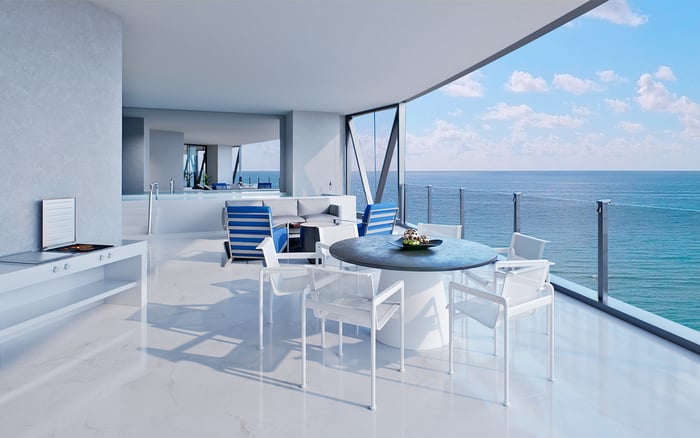
Second, privacy becomes architectural. A vehicle elevator or private in-unit garage is not only a convenience. It acts as a boundary, reducing exposure, minimizing staff touchpoints, and giving owners control over when and how the collection is seen.
Third, the emotional value of the home rises. For the right buyer, a daily view of a significant vehicle can matter as much as an ocean view. At this tier, indulgence is often simply part of the brief.
What is a “sky garage”? A private, in-unit garage concept, often served by a vehicle elevator, designed to bring the car directly into the residence.
Where did South Florida’s sky-garage trend take hold? Sunny Isles Beach is widely associated with early, high-profile examples of in-unit vehicle-elevator living.
How many residences are reported at Porsche Design Tower? It has been publicly described as having 132 residences.
What makes Porsche Design Tower operationally distinct? It is built around the patented Dezervator robotic car-elevator system delivering vehicles to in-unit garages.
What has been marketed for Bentley Residences Sunny Isles? A 63-story oceanfront tower planned with 216 residences and in-unit car garages via vehicle elevators.
What are garage condos, in plain terms? Privately owned units designed for vehicle storage and social use, often with customization and shared amenities.
Are garage-condo prices stable? They are highly project- and market-dependent, and published figures can be time-sensitive and listing-dependent.
Which projects connect garages to track access? Examples marketed with track-oriented experiences include The Motor Enclave (Tampa) and G2 Motorsports Park (near Dallas).
What should buyers ask about a vehicle elevator system? Maintenance responsibilities, downtime procedures, redundancy, and how major replacements are funded.
Is automotive real estate only about display? No. For many buyers, it is about privacy, control, and simplifying ownership logistics.
For a discreet tour of South Florida’s most design-forward addresses, connect with MILLION Luxury.
If branded residences are on your mind — as a home or as an allocation — we would be glad to share what we are seeing, privately.
Begin a quiet conversation