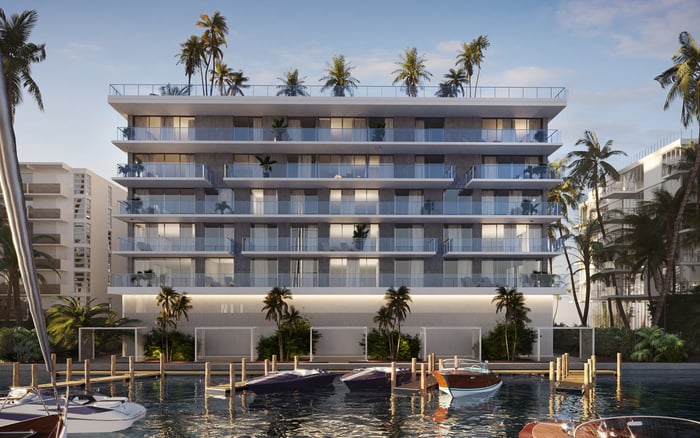
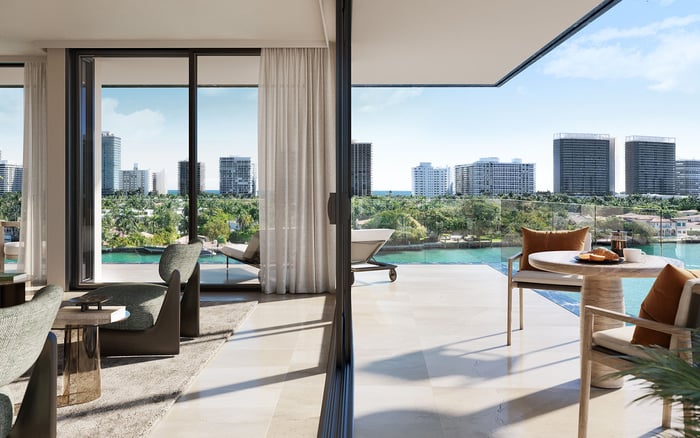
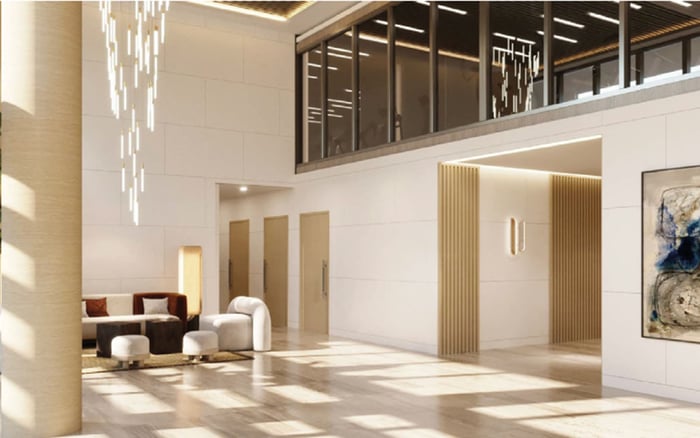
A discreet buyer’s comparison of two Bay Harbor Islands waterfront launches: Origin Residences’ curated boutique model versus La Maré’s multi-collection, privacy-forward campus.
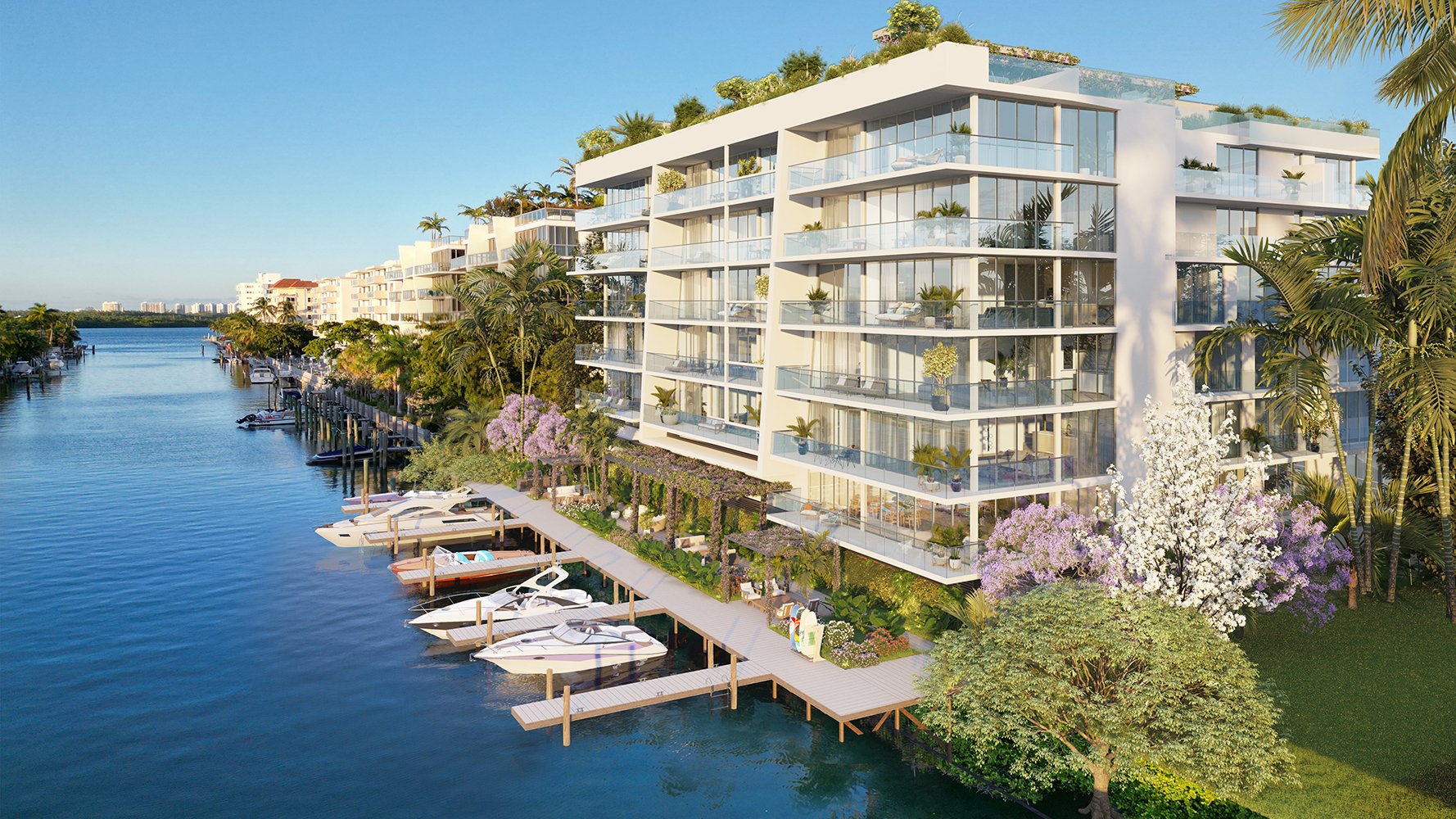
Bay Harbor Islands remains one of South Florida’s most practical luxury plays: close enough to Miami Beach to enjoy it regularly, yet residential enough to feel genuinely removed. For buyers considering a full-time residence or a low-friction second home, the newest waterfront options are less about spectacle and more about how a building works, including circulation, privacy, storage, boating access, and how the property feels on an ordinary Tuesday.
Two launches capture this shift through very different operating philosophies. Origin Residences is presented as a boutique, 7-story waterfront condominium with 27 residences, unified by a consistent design language and a turnkey delivery mindset. La Maré is positioned as a multi-building, multi-collection campus with three distinct “collections,” and a more segmented privacy strategy that, on paper, changes how residents and guests move through the property.
This is not a beauty contest. It is a decision about lifestyle and day-to-day operations, where the right answer depends on how you want to live and how much choice you actually want to manage in a pre-construction purchase.
Origin Residences centers its proposition on a curated, fully furnished concept with interiors by Artefacto. The practical benefit is decision reduction: fewer design variables to resolve before closing, and fewer moving parts immediately after. The planned unit mix runs from 2 to 4 bedrooms (including den options), with currently presented floor plans in a relatively tight band of approximately 1,367 to 2,328 square feet. In real terms, this reads as family-capable residences that prioritize livability without drifting into ultra-large “estate in the sky” territory.
La Maré takes a different approach, organizing the offering into three collections: Regency Collection, Signature Collection, and Bay Collection. Architecture is credited to Kobi Karp, with interiors by Debora Aguiar, and the positioning leans toward a hospitality-influenced sensibility. The Regency Collection is described as an 8-story building with 33 residences. The Bay Collection is marketed as larger-format “villa” living, with 3 to 4 bedrooms and publicly presented floor plans in the roughly 2,897 to 5,389 square foot range.
The headline difference is not only size. It is how each project frames daily life: Origin leans into consistency and ease, while La Maré emphasizes segmentation, private thresholds, and distinct micro-experiences by collection.
Luxury buyers tend to divide into two camps: those who want breadth of choice, and those who want certainty that the final result will feel coherent. Origin’s turnkey positioning, paired with a fully furnished package curated by Artefacto, is built for certainty. Standardization often creates a more cohesive building-wide aesthetic, and it can simplify the ownership experience with fewer change orders, fewer post-closing vendor timelines, and fewer months of disruption.
La Maré’s multi-collection structure suggests a different promise: a layered residential experience, with distinct lifestyle cues by collection. That can translate into a stronger sense of individuality and a more “custom residence” mindset, even when the finish selections remain developer-driven.
If your priority is a clean, immediate move-in with a design that reads intentional from day one, Origin’s model is compelling. If your priority is to arrive in a residence that feels closer to a private home in its planning and arrival sequence, La Maré’s concept may align more naturally.
In prime markets, the most expensive square foot is often the square foot you do not use. Origin’s published plans focus on 2 to 4 bedroom configurations with den options, and the overall scale can appeal to buyers who want true bedrooms, proper entertaining space, and meaningful outdoor living without managing a multi-thousand-square-foot footprint.
La Maré’s Bay Collection, with its larger stated floor plans, speaks to buyers who want a true “villa” feeling: stronger separation between public and private zones, greater storage opportunity, and the ability to host with less compression. If you entertain frequently with staff support, or you want a residence that can absorb extended family visits without reorganizing daily routines, the extra scale can matter.
Both projects include floor-to-ceiling glass and private outdoor space as part of the narrative. Origin highlights floor-to-ceiling glass with private balconies or terraces, an approach that typically prioritizes view corridors and indoor-outdoor flow. La Maré similarly emphasizes elevated lifestyle zones such as a rooftop pool, which reframes outdoor living as more “club deck” than “backyard.”
Waterfront is not a single category. Some buildings sit near the water; others actively integrate boating into the weekly rhythm of ownership.
Origin’s program explicitly includes a private marina with boat slips, positioning boat-to-building access as a daily convenience, not a special occasion. For owners who keep a vessel active, this can function like a second front door and influence how the property is used, with arrivals and departures by water and amenity spaces acting as transitional zones.
La Maré also positions marina and boating as part of its amenity narrative, though within a campus organized by collections. The implication is that waterfront use is integrated, but experienced through the lens of the collection you live in.
When comparing amenity stacks, the operational question is subtle: do you want amenities that encourage overlap and familiar faces, or amenities that preserve separation? Origin’s shared spaces, as described, include building staples such as a pool and fitness, which naturally increases casual social contact. La Maré’s collection-based concept, with distinct offerings referenced in its materials, suggests a more curated and potentially more compartmentalized experience.
In a boutique building, privacy is often a function of scale. Origin’s 27-residence count can translate into fewer day-to-day encounters, shorter elevator waits, and a quieter common-area environment. The tradeoff is that a single-building model typically concentrates circulation into one lobby, one elevator system, and one amenity spine.
La Maré’s differentiator is more explicit. Its marketing emphasizes privacy through elevator planning, including private and/or semi-private elevator access for certain residences. This matters not only as a status signal, but as practical discretion. Private elevator arrivals can reduce corridor exposure, simplify guest handling, and create a clearer psychological boundary between public and private life.
As with all pre-construction planning, the lived reality will depend on as-built layouts and building rules. Still, the intent reads clearly: Origin relies on intimacy and consistency; La Maré prioritizes privacy engineering and segmentation.
Delivery schedules are part of value, and part of risk. Origin is marketed for 2025 delivery. La Maré’s timeline is presented as phased, with later delivery for the Bay Collection.
For some buyers, earlier delivery reduces time-in-market exposure and brings the lifestyle online sooner. For others, phased delivery is not a drawback, particularly if they are purchasing the largest-format homes and are comfortable waiting for the most ambitious portion of a development.
In both cases, pre-construction buyers should underwrite flexibility. Floor plans, amenity programs, and schedules are often subject to change. The better approach is to buy the concept you want to live, not a single rendering you hope remains identical.
Bay Harbor Islands is not trying to outcompete Miami Beach on nightlife. It competes on quality of life and proximity. Still, Miami Beach remains a useful reference point for service expectations, arrival experiences, and the idea of turnkey living as a luxury category.
If you prefer the frictionless cadence of a hospitality-forward environment, note how Miami Beach residences define lifestyle. Setai Residences Miami Beach is emblematic of buyers who want an elevated, globally familiar standard of service.
For those drawn to a more private, residential tone while staying close to the sand, The Ritz-Carlton Residences® Miami Beach provides a reference for how a brand can translate into daily discretion and predictable operations.
And for an oceanfront, design-driven counterpoint where the building itself becomes part of the lifestyle identity, consider the tone set by 57 Ocean Miami Beach.
These are not direct substitutes for Bay Harbor living. They are proxies for understanding what kind of managed luxury you expect, and how much you value being able to lock-and-leave with confidence.
Origin Bay Harbor Islands tends to suit the buyer who values immediate usability, cohesive interiors, and an ownership experience with fewer variables. The building’s scale can feel personal, and the marina emphasis supports owners who want the water to be part of their weekly routine, not an occasional excursion.
La Maré Bay Harbor Islands aligns with buyers who place a premium on threshold privacy, larger-format living, and the idea that the property contains distinct lifestyle environments depending on the collection. If you want more of a private-home feel in a condominium context, the elevator planning and collection segmentation are meaningful signals.
A final practical note: whichever direction you lean, ask to understand circulation as a lived experience. Where do deliveries arrive? How do guests enter? How do you move from marina to residence? Luxury is often decided in the five minutes before you reach your front door.
What is the headline difference between Origin and La Maré? Origin is a single boutique building with a turnkey design concept; La Maré is organized into three collections with a more segmented privacy approach.
How many residences are planned at Origin? Origin is described as a 7-story waterfront project with 27 total residences.
What is Origin’s unit mix? Origin’s floor plans are presented as 2 to 4 bedrooms, including den options.
What size range is currently shown for Origin? Current materials show interiors spanning approximately 1,367 to 2,328 square feet, depending on the plan.
How is Origin positioned on interiors? Origin is marketed as turnkey and fully furnished or curated by Artefacto.
What is La Maré’s structure? La Maré is organized into the Regency Collection, Signature Collection, and Bay Collection.
Who are the named design leads for La Maré? Architecture is credited to Kobi Karp and interiors to Debora Aguiar.
What is the Bay Collection size positioning? The Bay Collection is marketed with larger 3 to 4 bedroom residences, with floor plans presented in the roughly 2,897 to 5,389 square foot range.
Do both projects include boating elements? Yes. Origin describes a private marina with boat slips, and La Maré also positions marina and boating within its amenity narrative.
What should buyers prioritize in a pre-construction comparison? Focus on privacy and circulation, amenity usage patterns, and delivery timing, then align them with how you will actually live week to week.
For tailored guidance on Bay Harbor and Miami Beach new construction, connect with MILLION Luxury.
If branded residences are on your mind — as a home or as an allocation — we would be glad to share what we are seeing, privately.
Begin a quiet conversation