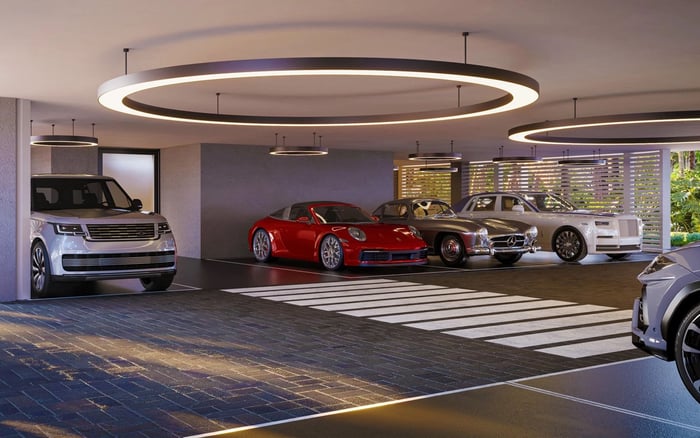
From in-home lifts to concierge vaults and in-unit sky garages, South Florida collectors are treating parking as an amenity, a security plan, and a preservation strategy.

In South Florida, the most discerning buyers no longer treat parking as a utility. It’s part security plan, part preservation protocol, and part daily ritual. The region’s lifestyle rewards spontaneity, but humidity, salt air, and intense sun punish complacency. The result is a new hierarchy of parking solutions that looks less like “find a space” and more like curating the right environment.
At the center of the issue is geometry. A typical two-car garage is often around 24 feet by 24 feet-roughly 576 square feet. That footprint feels generous until a household adds a third vehicle, a weekend car, or a true collection. Without redesign, the garage becomes a bottleneck: door-swing clearance, maneuvering angles, and storage cabinets start competing with paintwork and carbon fiber.
For affluent households who split time between residences, another pressure point emerges: consistency. A car may sit for weeks. That makes climate control, battery maintenance, and tire care as important as square footage. Parking stops being a place and becomes a system.
Below are five approaches shaping the collector-grade parking playbook across South Florida, from the most residentially adaptable to the most experience-driven.
1. Residential four-post parking lift - the modern baseline for stacking A four-post lift is often the cleanest way to expand capacity without changing the home’s footprint. In a garage that already accommodates two cars, stacking can effectively double storage when ceiling height allows-turning one bay into a two-car vertical solution.
For collectors, the appeal is composure. Four posts provide stability for long-term storage, and operation is intuitive: park on the runways, raise, and reclaim the floor. This is typically the first serious step beyond standard parking because it scales quickly without forcing a full architectural overhaul.
2. Two-post parking lift - when you want independent access in a tight bay Where a four-post lift prioritizes simplicity, a two-post design can be compelling when access and footprint are the priority. Two-post parking lifts are positioned for tighter spaces and can offer more independent access than tandem stacking-a meaningful distinction if the “upper” car isn’t strictly seasonal.
Pricing varies by capacity and configuration, but the broader point is functional: two-post solutions can feel like a tool for an active collection rather than a storage rack. They tend to suit owners who rotate cars frequently and value retrieving the “wrong” vehicle without a choreography.
3. Tri-level lift systems - maximum vertical density for serious collectors For the collector who measures space by vehicles per bay, tri-level parking lifts represent the most aggressive in-home density play. Certain tri-level designs are engineered to park up to three vehicles in a single bay, trading higher complexity and cost for the benefit that matters: vertical capacity.
In a market where land and enclosed garage volume can be the limiting factor, tri-level systems can be the difference between owning the collection you want and editing it for storage. This solution is best approached as a project, not a purchase: ceiling height, structural adequacy, electrical work, and day-to-day usability should be planned as carefully as the lift itself.
4. Private in-unit “sky garage” living - the elevator-to-residence statement Some buyers want more than storage. They want proximity, privacy, and a sense of arrival that begins with the car. Sunny Isles Beach has become a global reference point for residence-level garages, with Porsche Design Tower widely known for in-unit “sky garages” enabled by the Dezervator car elevator concept.
This idea is evolving. Bentley Residences Miami is planned as a 63-story beachfront tower with in-unit garages served by multiple car elevators. For the right buyer, this isn’t about how many cars fit. It’s about eliminating the public interface entirely and making the vehicle part of the home’s interior life.
5. Car condo ownership and track lifestyle - storage becomes a destination When a collection outgrows the home, a purpose-built alternative can be more satisfying than another garage expansion. Car condo models offer privately owned suites designed for storage plus social and club use, shifting the value proposition from capacity alone to a lifestyle ecosystem.
The Motor Enclave in Tampa is one example, offering privately owned “car condo” garage suites and track amenities including a 1.72-mile circuit plus additional driving areas. For South Florida collectors, this approach reframes storage as a weekend ritual: the cars aren’t “away”-they’re staged for experiences.
The right answer is rarely a single tactic. Most collections perform best with a tiered strategy:
First, identify your “daily set.” These cars need frictionless access. A conventional garage with a lift can work-but only if retrieval feels effortless and safe. If you find yourself hesitating to take a car out because the process is annoying, the system is failing.
Second, define the “display set.” These cars benefit from being seen, but not exposed. In-unit garage concepts are the extreme version, yet the broader principle applies anywhere: the closer the car is to your living experience, the more likely it stays maintained and enjoyed.
Third, assign the “seasonal set.” These cars can live off-site, but only with a preservation plan. Climate-controlled storage is widely recommended to reduce humidity and temperature driven deterioration, which is particularly relevant in Florida’s humid conditions.
Finally, reserve the “legacy set” for the highest standard of care. For a rare classic or a long-hold exotic, you want redundancy: climate control, security, and routine attention.
Collectors often underestimate the delta between lift pricing and the true all-in project budget. Installation and site readiness can materially change the total cost. Concrete adequacy, electrical work, and clearance constraints can turn a seemingly simple purchase into a measured build.
As a reference point, typical 2025 pricing ranges cited for residential lifts include single-post lifts around $2,800 to $5,000 and four-post lifts around $2,700 to $9,000, varying by capacity and height. Nameplate pricing on certain models can sit higher depending on width, load rating, and configuration. The disciplined approach is to treat the lift as one line item within a garage plan-not the plan itself.
Even the best home setup has a ceiling-literally and figuratively. Off-site storage earns its keep when it delivers services a private garage typically can’t.
In Delray Beach, Valuable Vehicles Vault markets climate-controlled vehicle storage aimed at exotic and classic vehicles, paired with security and concierge-style support. It highlights 24/7 surveillance and practical infrastructure such as battery tending and charging options. In Miami, CarSafe Storage publishes tiered monthly memberships with indoor storage and varying levels of startups, inspections, detailing, and concierge services.
For many owners, the ideal pairing is straightforward: keep a lift-equipped home garage for the cars you drive most, then use concierge storage for overflow and travel seasons. You’re buying consistency, not just square footage.
Luxury parking isn’t only about where the car sits. It’s about what happens while it sits.
Climate control is the headline. In humid regions, reducing exposure to humidity and temperature swings helps protect finishes, metals, and interiors.
Long-term storage also demands routine mechanical empathy. Tire flat-spot risk can be reduced by periodically moving the vehicle and or taking load off the tires. Battery tenders help prevent battery discharge, especially for cars with modern electronics that quietly draw power over time.
The goal is to make “not driving” neutral rather than harmful.
Collectors value two things in parking environments: predictability and low drama. Automated parking systems use shuttle or robotic mechanisms to maximize density and reduce parking damage risk versus conventional self-parking layouts. While this has historically been a commercial or multi-family play, the principle is beginning to influence luxury expectations: fewer tight turns, fewer door dings, fewer unknown drivers.
Security is equally decisive. Smart garage door ecosystems add remote open and close monitoring, alerts, and timed closing. In practice, that means fewer moments of exposure when travel schedules change or staff turnover happens. It’s one of the simplest upgrades that aligns with the way luxury households actually operate.
Parking is increasingly part of how sophisticated buyers compare neighborhoods and buildings-not just floor plans.
In Brickell, the conversation often centers on the relationship between tower living and daily mobility. A building like 2200 Brickell fits the buyer who wants a refined residential experience in the city core and then solves the collector question with a deliberate mix of on-site spaces and off-site vaulting.
On Miami Beach, beachfront living amplifies the need for an intentional storage plan. Owners looking at 57 Ocean Miami Beach or Five Park Miami Beach often think in layers: secure daily parking for a primary car, plus protected storage for the vehicles that shouldn’t sit in coastal exposure without climate control.
In Sunny Isles, ultra-luxury towers have helped normalize the idea that parking can be a signature amenity, not a compromise. Buyers already drawn to the design culture of Bentley Residences Sunny Isles tend to understand the broader point: when parking is engineered as part of the lifestyle, the collection becomes easier to live with.
How many cars can a typical two-car garage hold with a lift? With adequate ceiling height, stacking can roughly double capacity by parking one car above another.
Are four-post lifts better for storage than two-post lifts? Four-post lifts are often favored for stability and straightforward parking and storage use.
What is the main advantage of a two-post parking lift? Two-post parking lifts are often chosen for tighter footprints and can provide more independent access.
Can a single bay really store three cars? Certain tri-level parking lifts are designed to park up to three vehicles in one bay.
Is lift pricing the full budget for a garage build-out? No; electrical work and concrete adequacy can materially change the all-in cost.
Why is climate-controlled storage recommended in Florida? It helps reduce humidity and temperature driven deterioration that can affect metal, paint, and interiors.
What should I do about a car that sits for weeks at a time? Use a battery tender and reduce flat-spot risk by periodic movement and or unloading the tires.
Do any South Florida towers offer in-unit garages? Porsche Design Tower is known for in-unit sky garages using car elevators, and Bentley Residences is planned with in-unit garages.
What is a car condo and who is it for? It is a privately owned garage suite concept that combines storage with social and club use, often tied to driving amenities.
How can automated parking reduce damage risk? By using shuttle or robotic mechanisms, it can reduce tight-turn self-parking scenarios where scrapes and dings occur.
When you're ready to tour or underwrite the options, connect with MILLION Luxury.
If branded residences are on your mind — as a home or as an allocation — we would be glad to share what we are seeing, privately.
Begin a quiet conversation