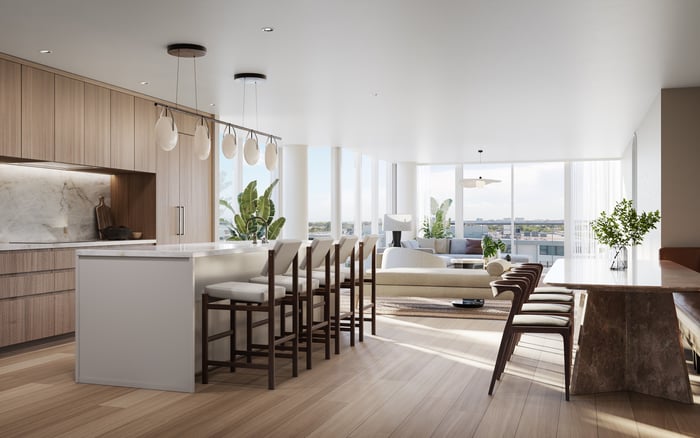
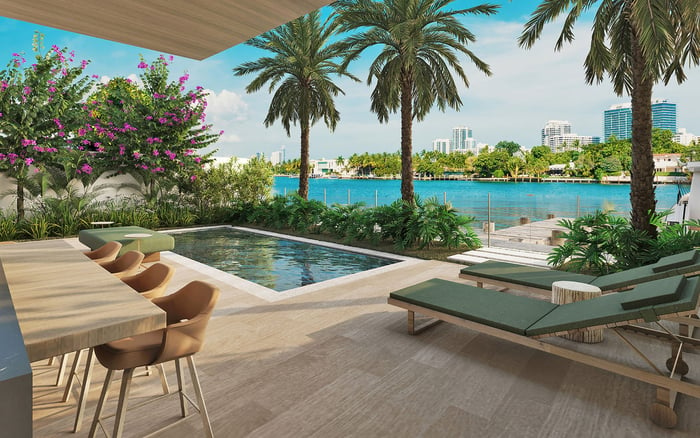
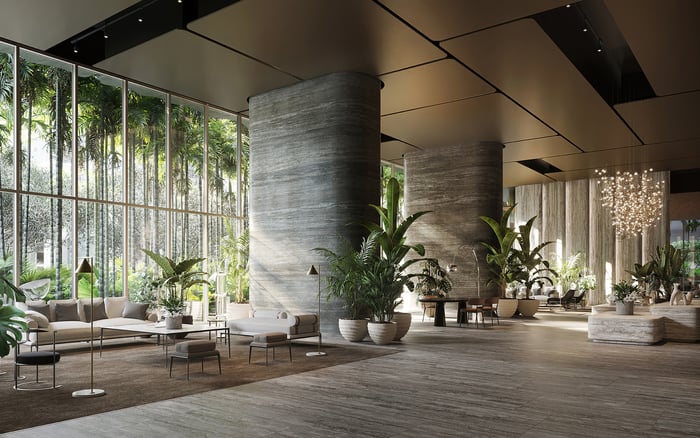
In South Florida, sustainability and wellness have shifted from optional amenities to an expected baseline for premium new construction. From LEED mandates in Miami and Miami Beach to human-centric standards like WELL and Fitwel, today’s luxury buyer is increasingly fluent in certification language. This guide clarifies what the major programs actually measure, why municipalities require certain levels, and how discerning purchasers can interpret labels without confusing design intent for verified performance.
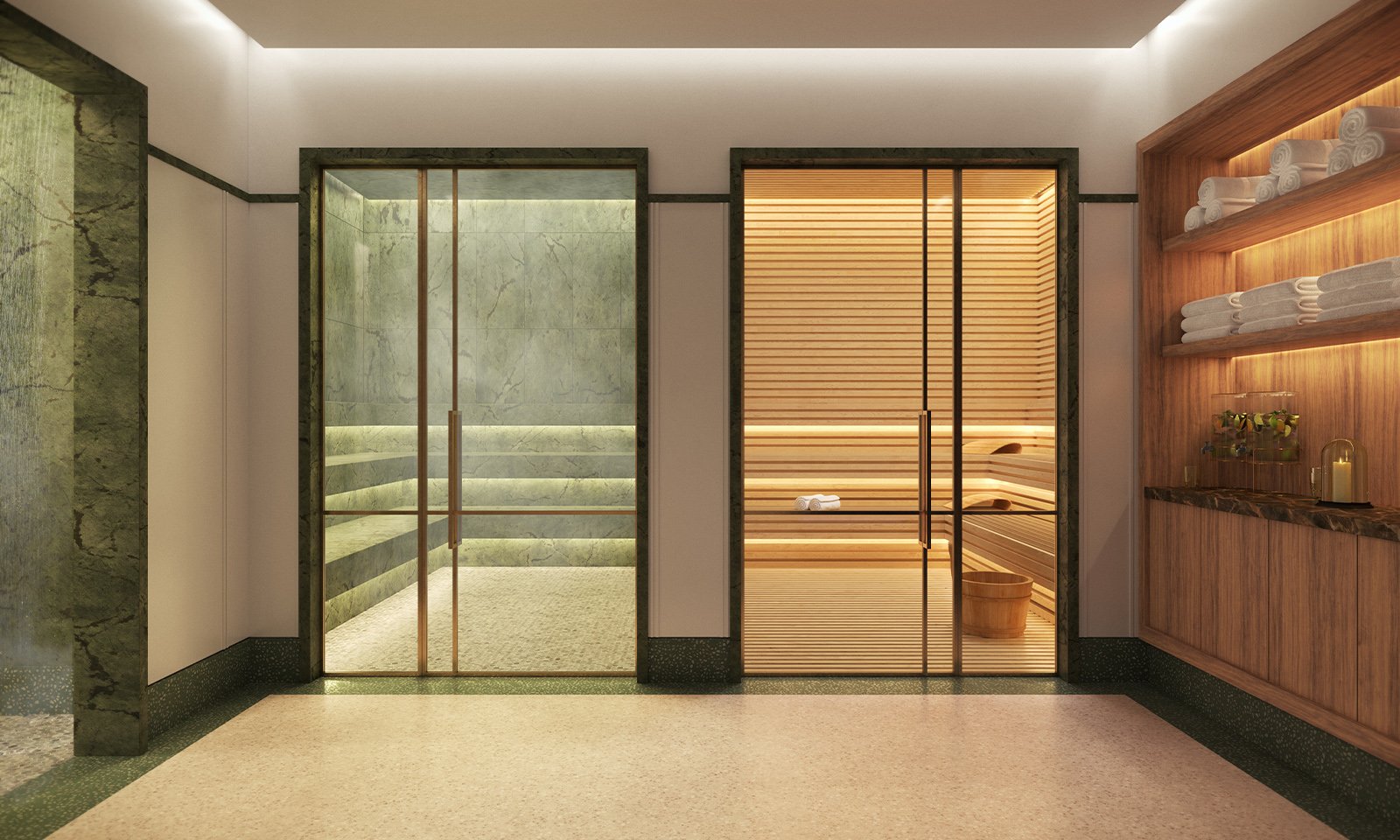
Luxury in South Florida has always been defined by light, air, water, and view corridors. What has changed is that these experiential qualities are increasingly expressed as measurable building outcomes-energy and water use, indoor air quality, and the materials that quietly shape how a residence feels over time.
In Miami, new construction projects over 50,000 square feet are required to achieve at least LEED Silver. Miami Beach sets a higher threshold for projects larger than 7,000 square feet, requiring LEED Gold standards. In practical terms, the market’s “baseline” for many new buildings is no longer a generic promise of sustainability. It is a formal checklist, reviewed by a third party, with a clear hierarchy of outcomes.
For buyers, this evolution matters because certification language has become a proxy for risk management: operating costs, resilience-minded design choices, comfort in a humid climate, and the credibility of a developer’s execution. It can function as social signaling, but its most sophisticated role is practical. If you are underwriting a long-hold waterfront residence, you want clarity on how the building is designed to perform.
LEED, established in 1998, is one of the most widely used green building rating systems. It is best viewed as a broad sustainability framework spanning multiple categories-not a single-issue label.
LEED certification levels progress from Certified to Silver to Gold to Platinum. The hierarchy signals relative ambition, but it does not automatically explain how a building operates day-to-day. A LEED plaque can reflect rigorous design and documentation, yet it may not capture ongoing operational performance in the way continuous monitoring programs can.
For residences, the practical benefits of LEED-aligned design are clear: homes are designed to use less energy and water and generally provide improved indoor air quality compared to typical homes. In a coastal climate where humidity control is inseparable from comfort, these outcomes often show up as quieter mechanical systems, steadier temperatures, and fewer ownership surprises.
Finally, LEED is not a self-attested marketing claim. It is a documented process, moving from registration to application review to a certification decision. For sophisticated buyers, that third-party review is often the real value: a credible paper trail.
If LEED is the sustainability language most buyers recognize, wellness-focused programs are increasingly the language they experience.
The WELL Building Standard is a performance-based system focused on people’s health and well-being in buildings and communities. WELL v2 uses a points-based approach across a set of “concepts,” with certification levels from Bronze through Silver, Gold, and Platinum. Crucially, the pathway includes performance verification, which can involve third-party testing. In other words, WELL is designed to reward a building that can demonstrate outcomes-not just describe them.
Fitwel is another health and well-being certification system, positioned as more accessible and more operationally oriented than some alternatives. Fitwel uses a score-based approach through a “scorecard,” evaluating strategies that influence occupant experience.
For a luxury buyer, the distinction is strategic:
In markets like Brickell and Miami Beach, where buyers increasingly compare buildings on quiet details rather than square footage alone, these standards become shorthand for how seriously a project treats comfort.
A sophisticated buyer’s question is no longer “Is it green?” It is “How do we know?”
Several newer frameworks emphasize measured outcomes and ongoing verification. RESET, for example, is a performance- and data-driven certification approach that relies on ongoing measurement rather than one-time design intent, commonly using air quality monitoring. This matters because indoor air is not static; it responds to occupancy, filtration choices, maintenance, and the realities of a coastal environment.
At the far end of rigor is the Living Building Challenge, positioned as a demanding regenerative standard that emphasizes verified performance outcomes, not just modeled design. Not every luxury residential tower will pursue that level of difficulty, but the philosophy is influential: buyers are learning to separate what is verified, what is modeled, and what is simply promised.
Even outside these programs, third-party certification broadly remains a way to distinguish performance in a market saturated with similar finish packages. Through a luxury lens, the focus is less ideology and more confidence.
South Florida’s ultra-premium market is increasingly professionalized. Buyers who operate like investors-even when purchasing for lifestyle-pay close attention to signals that can influence liquidity.
One reason is that certified buildings can carry market advantages in certain property types. In the office sector, LEED-certified buildings have been associated with a persistent rent premium versus non-certified peers even after controls. Residential is not office, but the directional takeaway is useful: when a third-party standard becomes widely recognized, it can shape how the market prices risk and desirability.
In luxury condominiums, the buyer-visible impact often shows up in resale narratives and leasing conversations: operating costs that feel more predictable, wellness features that read as current, and a building story that is easier to communicate without leaning on superlatives.
This is where location and project positioning intersect with certification language. A buyer comparing a Brickell residence such as 2200 Brickell to other new-construction options is not only comparing views and amenity decks. They are often comparing the credibility of the building’s performance story-particularly as municipal requirements raise the baseline.
Luxury buyers do not need to become consultants, but they do benefit from a disciplined set of questions. Prioritize clarity and verification.
Which standard, and which level? LEED Certified and LEED Gold are not interchangeable. The same goes for WELL Gold versus WELL Platinum.
Is it certified, or pursuing certification? Many projects market intent. Intent can be meaningful, but it is not the same as completion.
What is verified through performance testing? WELL includes performance verification; RESET leans on ongoing measurement. If testing is part of the story, ask what is tested and how often.
What is the operations plan? Fitwel’s operational orientation is a reminder that buildings live or die by maintenance-not renderings.
How do envelope and ventilation strategies support efficiency? Passive building principles, as described by PHIUS, focus on very high energy efficiency via envelope, airtightness, and ventilation strategies. Even if a project is not formally certified as passive, questions around these fundamentals are a fast way to gauge seriousness.
Is the team using product-level standards? Cradle to Cradle Certified is a product standard that evaluates material health and circularity. It does not certify an entire building, but it can support a credible materials narrative.
These questions are especially relevant in Miami Beach, where LEED Gold requirements for larger projects make the plaque less differentiating on its own. In that context, buyers tend to value the deeper story: indoor air quality strategy, filtration, humidity control, and how the building will actually be operated.
Certification talk is not evenly distributed across the region. It tends to cluster where new construction is most concentrated and where the buyer base is most globally literate.
In Brickell, wellness language often sits alongside concierge services and high design. The buyer profile is time-sensitive and brand-aware, which helps explain why human-centric standards can resonate. If your short list includes newer vertical living options such as Una Residences Brickell, listen for whether the project’s narrative clearly separates verifiable performance from generalized “eco” claims.
In Miami Beach, the municipal push toward LEED Gold on larger projects helps explain why sustainability has become table stakes. For buyers weighing boutique oceanfront and park-adjacent buildings, the differentiator is often the lived experience of wellness and comfort. Projects like Five Park Miami Beach sit within a landscape where buyers increasingly evaluate not only amenities, but how the building supports daily health.
In Bay Harbor and adjacent islands, wellness branding can feel especially coherent because the lifestyle is already tuned to walkability, water access, and a quieter cadence. For buyers drawn to a health-forward residential concept, The Well Bay Harbor Islands is a useful reference point for how wellness can be positioned as a primary value proposition rather than an add-on.
Across all neighborhoods, the throughline is discernment: labels are helpful, but the most valuable skill is understanding what a label actually measures.
LEED is not the only pathway, and sophisticated projects sometimes assemble a portfolio of standards.
Florida’s own Florida Green Building Coalition Green Home standard (v7) provides a state-specific framework that includes energy, water, site, health, materials, and disaster mitigation. For buyers, the relevance is not only “green.” It is that Florida-tailored frameworks can speak directly to realities like storm exposure and resilience-minded design.
There are also alternative certification systems with distinct emphases:
The luxury takeaway is not that one label is universally superior. It is that standards are tools, and the best projects use them to create a legible, third-party framework for what would otherwise be marketing language.
Is LEED required for new buildings in Miami? For new construction projects over 50,000 square feet, Miami requires at least LEED Silver.
What is the Miami Beach requirement for LEED? Miami Beach requires projects larger than 7,000 square feet to meet LEED Gold standards.
What are the LEED certification levels? The levels are Certified, Silver, Gold, and Platinum, with Platinum as the highest.
Does LEED apply to homes, not just commercial buildings? Yes. LEED-certified homes are designed to use less energy and water and can improve indoor air quality.
What does WELL certification focus on? WELL is focused on people’s health and well-being in buildings and communities.
How does WELL v2 scoring work? It is points-based across multiple WELL concepts, with levels from Bronze through Platinum.
Is WELL verified, or mainly based on design plans? WELL includes performance verification as part of its certification pathway.
What is Fitwel in simple terms? Fitwel is a health and well-being certification that uses a scorecard to evaluate strategies.
What makes RESET different from other labels? RESET emphasizes ongoing measurement and data-driven performance rather than one-time intent.
Are there Florida-specific green home standards? Yes. Florida has a state-specific green home framework that covers areas like energy, water, and disaster mitigation.
To compare the best-fit options with clarity, connect with MILLION Luxury.
If branded residences are on your mind — as a home or as an allocation — we would be glad to share what we are seeing, privately.
Begin a quiet conversation