A buyer-focused comparison of W Pompano Beach Hotel & Residences and The Links Estates at Fisher Island, framed around service culture, private-island governance, lifestyle fit, and resale logic.

For ultra-prime South Florida buyers, the choice between W Pompano Beach Hotel & Residences and The Links Estates at Fisher Island is not simply about location or architecture. It is about how prestige should function. One model expresses status through hospitality branding, service rhythm, amenity programming, and an immediately recognizable lifestyle. The other is quieter, more filtered, and more dependent on private access, governance discipline, and scarcity.
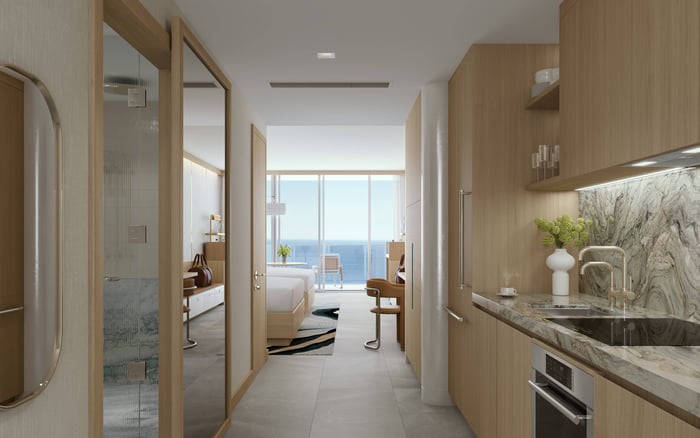
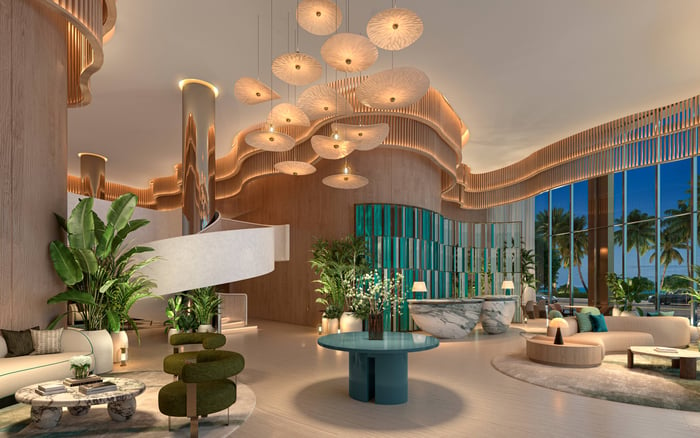
W Pompano Beach Hotel & Residences belongs to the hospitality-branded hotel-and-residences category. Its appeal is clear: a known brand, resort-style service culture, and a beachfront condominium format suited to buyers who want convenience without constant ownership friction. It sits within the vertical, lock-and-leave luxury-condo tradition that has shaped much of South Florida’s oceanfront development corridor.
The Links Estates at Fisher Island is a different proposition. It should be read as an ultra-private estate offering, not a branded condo product. Fisher Island prestige is created through separation, access control, and club-oriented social infrastructure. The address is not designed to be broadly understood by everyone. Its power rests in being selectively understood by the right audience.
Even the market shorthand feels different: Pompano Beach reads as accessible beachfront energy, while Fisher Island signals private arrival and social filtration.
The daily-use distinction is immediate. W Pompano Beach Hotel & Residences is likely to resonate with buyers who want serviced living, social ease, and a resort-adjacent cadence. The value is not only in the residence itself, but in the convenience of a hospitality environment where amenities, atmosphere, and service are part of the ownership experience.
That model is especially attractive for buyers who want flexibility. A branded residence can feel intuitive for international owners, seasonal users, and executives who prefer a simplified lifestyle structure. The building does more of the work. The brand translates the product quickly, and the hospitality identity communicates status without requiring lengthy explanation.
The Links Estates at Fisher Island is less about instant accessibility and more about controlled intimacy. The lifestyle is private, low-profile, and club-anchored. Buyers are not simply acquiring a place to stay. They are entering a community framework where privacy, rules, membership structures, and cost allocation are part of the value system.
That distinction matters. At W Pompano Beach, the buyer may be drawn to an energetic beachfront environment that feels open, serviced, and recognizable. At The Links Estates, the buyer is likely prioritizing protected daily life, reduced public exposure, and the subtle prestige of belonging to a highly limited enclave.
Governance is where the comparison becomes more serious. Branded residences often appeal because the ownership proposition feels organized around convenience. A hotel-and-residences format generally suggests service standards, common-area programming, and a structure that is easier for a broad luxury-condo buyer to understand.
That does not make governance irrelevant at W Pompano Beach Hotel & Residences. Any vertical luxury condominium requires attention to rules, operating costs, service expectations, and long-term maintenance. But the psychology is different. The buyer is evaluating a managed residential product whose prestige is amplified by brand clarity and hospitality culture.
The Links Estates at Fisher Island demands a more governance-intensive reading. Ownership value is tied not only to the physical estate, but also to the discipline of the private-island ecosystem. Rules, membership structures, cost allocation, and community expectations become central to the asset. In this context, governance is not a background issue. It is part of the moat.
This is why The Links Estates may appeal to buyers who view restrictions as protective rather than burdensome. The same filters that reduce casual access may also support long-term exclusivity. For buyers who prize privacy and order, community discipline can feel like a luxury feature.
Resale is not one conversation here. It is two different forms of market behavior.
W Pompano Beach Hotel & Residences can be understood as a branded-residence asset whose liquidity may benefit from name recognition and a broader condominium-buyer pool. The brand creates an easy point of entry for buyers who know the hospitality language. The product is legible across markets, and that legibility may support interest from those seeking a serviced beachfront home with familiar cues.
That is the strength of brand prestige. It shortens the explanation. Buyers do not need to be educated from the ground up on why a hospitality-branded residence has appeal. The value proposition is visible in the name, the service promise, and the resort-style setting.
The Links Estates at Fisher Island operates through scarcity-based logic. Its resale thesis is less about broad liquidity and more about rarity, privacy, and long-term capital preservation. The potential buyer pool may be narrower, but the asset’s appeal is rooted in qualities that cannot be easily replicated: private-island separation, limited access, and a club-oriented social environment.
For investment analysis, that difference is crucial. W Pompano Beach may fit buyers who prioritize flexibility, recognizability, and a more accessible exit audience. The Links Estates may fit buyers who are less concerned with mass-market liquidity and more focused on durable scarcity. In one case, brand recognition helps create demand. In the other, limited access helps preserve distinction.
Condo-hotel logic and resale logic therefore point in different directions. One favors hospitality visibility and a broader condominium conversation. The other favors private-enclave discipline and a rarer estate narrative.
The W Pompano Beach buyer is likely to be attracted to ease. This buyer may want a beachfront residence that feels polished, serviced, and socially fluid. The ownership experience can be framed around convenience: arrive, use, entertain, leave, and return without the heavier psychological weight of a private-island estate structure.
The W model also suits buyers who value recognizable prestige. In South Florida, not every luxury buyer wants discretion to the point of invisibility. Some want the social confidence of a brand that travels well. For them, a hospitality identity is not superficial. It is part of the product’s emotional and practical efficiency.
The Links Estates buyer is different. This buyer likely values privacy over visibility, control over energy, and social filtration over broad accessibility. The estate format and Fisher Island setting create a more selective lifestyle proposition. It may be less immediately legible to the general market, but more meaningful to those who already understand private-island prestige.
The choice is ultimately philosophical. W Pompano Beach Hotel & Residences offers serviced beachfront living with brand fluency. The Links Estates at Fisher Island offers private, low-profile ownership shaped by scarcity and governance. Both are luxury propositions, but they reward different instincts.
Buyers should begin by deciding what kind of prestige they want to live with every day. If the desired experience is resort-oriented, socially open, service-rich, and easy to understand across a global audience, W Pompano Beach Hotel & Residences is the more natural conceptual fit. It offers the appeal of a branded residence in a beachfront condominium format, where convenience and recognition are central.
If the desired experience is private, guarded, club-based, and insulated from the broader beachfront market, The Links Estates at Fisher Island is the stronger conceptual match. Its value logic is not built around public-facing brand visibility. It is built around scarcity, separation, and disciplined ownership culture.
Neither model is universally superior. The better choice depends on whether the buyer wants luxury to be immediately legible or quietly protected. In South Florida’s upper tier, that distinction may matter more than almost any finish, amenity, or view.
Is W Pompano Beach Hotel & Residences a branded residence? Yes. It is framed as a hospitality-branded hotel-and-residences project with a service-oriented beachfront lifestyle.
Is The Links Estates at Fisher Island a condo product? It is better understood as an ultra-private estate offering rather than a hospitality-branded condominium product.
Which option feels more socially accessible? W Pompano Beach is the more accessible concept, with branded service, resort energy, and broader lifestyle legibility.
Which option is more private? The Links Estates at Fisher Island is more privacy-driven, with prestige shaped by access control and enclave separation.
How does governance differ between them? W Pompano Beach suggests a managed condo-hospitality framework, while The Links Estates places more emphasis on community discipline and membership structures.
Which has broader resale appeal? W Pompano Beach may appeal to a broader condo-buyer pool because brand recognition can make the asset easier to understand.
Which has stronger scarcity logic? The Links Estates at Fisher Island is the stronger scarcity play because its value is tied to rare private-island ownership.
Is brand prestige the same as enclave prestige? No. Brand prestige is visible and immediately recognizable, while enclave prestige is quieter and built through restricted access.
Which is better for a lock-and-leave lifestyle? W Pompano Beach is the clearer lock-and-leave fit because it aligns with serviced vertical beachfront living.
Which buyer should consider The Links Estates? A buyer who prioritizes privacy, club-oriented living, and long-term scarcity over broad market liquidity should consider it.
If you'd like a private walkthrough and a curated shortlist, connect with MILLION.
If branded residences are on your mind — as a home or as an allocation — we would be glad to share what we are seeing, privately.
Begin a quiet conversation