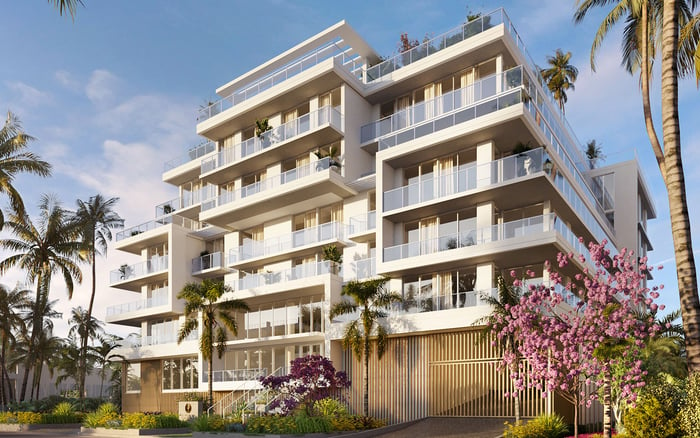
A discreet family-buyer guide to evaluating nursery proximity at The Surf Club Four Seasons Surfside, with due-diligence questions on childcare, staff access, valet flow, and weekday school-run feasibility.

For many buyers considering The Surf Club Four Seasons Surfside, the conversation starts with architecture, service, privacy, and the rare atmosphere of Surfside. For families with infants or toddlers, however, a quieter question can become just as important: how well does the morning nursery run actually work?
Nursery proximity is often misunderstood in luxury real estate. It is not simply the distance from a residence to an early-childhood program. It is the full experience of leaving the apartment, navigating elevators and service areas, managing strollers and car seats, coordinating with valet or drivers, and reaching drop-off during the same compressed window as other families. At an oceanfront address with resort-level service, those details can feel almost invisible during a polished private tour. In daily life, they define livability.
The Surf Club Four Seasons Surfside is best approached as a luxury Four Seasons-branded residential and hotel environment in Surfside, where family buyers should distinguish hospitality services from formal childcare. The essential question is not whether the property feels broadly family-friendly. It is whether the building, the target nursery, and the household’s own structure can work together reliably on school mornings.
The first due-diligence point is straightforward: buyers should not assume that resort service equals nursery service. There is no provided basis to state that The Surf Club Four Seasons Surfside has an on-site nursery, preschool, or daycare. A prudent family buyer should therefore proceed as if external early-childhood options must be verified independently.
That does not make the property unsuitable for young families. It simply sharpens the inquiry. Buyers should ask whether concierge services can assist with vetted babysitting, nanny referrals, children’s programming, or playroom-style support. More importantly, they should ask which of those services, if any, constitute formal licensed childcare and which are hospitality conveniences. The distinction matters for parents who need daily coverage, not occasional help during dinner or travel.
This is also where private-school planning begins earlier than many buyers expect. Age cutoffs, application timelines, waitlists, and drop-off protocols can shape the value of a residence for a young family long before a child reaches kindergarten. Before contract, parents should speak with target nursery directors as carefully as they speak with the building team.
A quiet weekday test drive is more valuable than an elegant drive-by. Buyers should request or arrange a realistic weekday-morning route from The Surf Club Four Seasons Surfside to any target nursery or preschool under consideration. The route should be tested during the actual drop-off window, not at midday, in the evening, or on a weekend.
That test should include the entire sequence. How long does it take to leave the residence with a stroller, diaper bag, and possibly another child? How are elevators managed at peak times? Where does a car seat get installed or checked? Does valet staging feel seamless when several residents are leaving at once? If a driver is used, where does that person wait, and how quickly can the car be brought around?
Distance alone can flatter a property. A short drive can become a long morning if elevator access, car retrieval, and school drop-off queues do not align. Conversely, a nursery that appears slightly farther away may be easier if the route is predictable and the building’s departure process is smooth. For primary and semi-primary users, that distinction is not incidental. It is part of the property’s core livability.
Infant and toddler logistics are physical. A buyer should ask management how stroller storage is handled, whether there are preferred areas for temporary staging, and whether common-area rules affect daily movement with young children. If multiple strollers are used, one for home and one for travel, the family should understand where each can be kept without creating friction.
Car-seat handling deserves equal attention. Some families rely on their own vehicle, some on a driver, some on rotating caregivers, and some on a mix. Each model creates different questions. Can car seats remain installed? How does valet handle cars used for daily child transport? Are there procedures for caregivers who need to retrieve a vehicle or meet parents at the entrance?
Elevator flow is another understated issue. A residence can feel serene during a private showing and more complex during the school-run rush. Buyers should ask whether weekday morning patterns create pinch points for families with strollers, luggage, pets, staff, or hotel guests using shared circulation areas. The answer should be operational, not merely reassuring.
For many ultra-premium buyers, nursery proximity is not only about parents driving children themselves. It is about the ecosystem around the household. Nannies, tutors, drivers, nurses, and rotating caregivers may all be part of the daily rhythm, especially when a residence is used as a second home for part of the year and a primary base during school periods.
Buyers should ask whether household staff require registration, access cards, parking arrangements, or specific arrival procedures. They should also understand whether caregivers use the main entrance, a service entrance, valet, or another access point. These rules may be entirely reasonable, but they must support the family’s actual routine.
The building’s guest, staff, and vendor policies should also be reviewed for pickup and drop-off flexibility. A full-time nanny who arrives every morning is different from a rotating babysitter, visiting grandparent, tutor, or driver. If several caregivers are authorized, the family should know whether the process is smooth or administratively burdensome. In a condo-hotel environment, the clarity of those rules can be just as important as the quality of the service culture.
Family buyers should ask the project team, directly and discreetly, whether many current residents have young children. The answer may influence more than playdates. A meaningful family presence can affect informal support networks, birthday invitations, shared caregivers, and the social ease of raising young children in a highly serviced building.
It may also shape future resale. A buyer with toddlers today may eventually sell to another family evaluating the same practical questions: nursery access, stroller ease, staff policies, valet flow, and daily convenience in Surfside. If the building is already understood by family buyers as workable for early childhood, that can strengthen the property’s appeal within a specific segment of the luxury market.
This does not mean every buyer needs a building dominated by families. Some will prefer a quieter, more adult atmosphere with occasional family use. The important point is alignment. Parents should decide whether they want a discreet family network around them or simply a polished residence from which they can manage childcare privately.
Before signing, family buyers should reconcile three conversations: the building team, the target nursery, and the household’s own staff plan. The building team should clarify residential, hotel, service, and amenity configuration as it currently operates. The nursery should confirm application timing, age requirements, waitlist expectations, arrival windows, and drop-off rules. The family should map who will actually perform the morning routine.
A strong checklist includes concierge childcare support, licensed-care distinctions, stroller storage, valet procedures, car-seat handling, elevator access, caregiver registration, staff parking, guest policies, pickup permissions, and realistic commute testing. None of these questions diminish the glamour of The Surf Club Four Seasons Surfside. They protect it by ensuring that the residence works gracefully under daily pressure.
For discerning parents, the best answer is not always the shortest distance. It is the most reliable routine.
Does The Surf Club Four Seasons Surfside have an on-site nursery? There is no provided basis to state that it has an on-site nursery, preschool, or daycare. Buyers should verify any childcare assumptions directly before relying on them.
Should buyers treat concierge babysitting as formal childcare? No, not without confirmation. Buyers should ask whether any babysitting, nanny referral, or children’s programming is licensed childcare or hospitality support.
Why is a weekday test drive important? Nursery commutes can change significantly during real drop-off windows. Testing the full morning route is more useful than relying on off-peak impressions.
What should parents ask about stroller storage? They should ask where strollers may be stored, staged, and moved during daily routines. The answer should fit the family’s actual morning pattern.
Are car-seat procedures worth discussing before contract? Yes. Families should understand how valet, drivers, and caregivers handle cars used for daily child transport.
Do nanny and caregiver access rules matter? They matter greatly for families using full-time or rotating caregivers. Registration, parking, access cards, and entrance rules can affect daily ease.
Should buyers ask whether other residents have young children? Yes. Family density can influence playdates, informal support, and future resale appeal to similar buyers.
Is nursery proximity only relevant for primary residences? No. It also matters for semi-primary use if the family spends meaningful school-year time in Surfside.
What should be confirmed with target nursery directors? Parents should confirm application timing, waitlists, age cutoffs, arrival windows, and drop-off policies. These details can shape whether the residence works day to day.
How should buyers think about oceanfront luxury and childcare logistics? They should enjoy the setting while testing the routine with precision. The best family residence is one that feels effortless on ordinary mornings.
For a confidential assessment and a building-by-building shortlist, connect with MILLION.
If branded residences are on your mind — as a home or as an allocation — we would be glad to share what we are seeing, privately.
Begin a quiet conversation