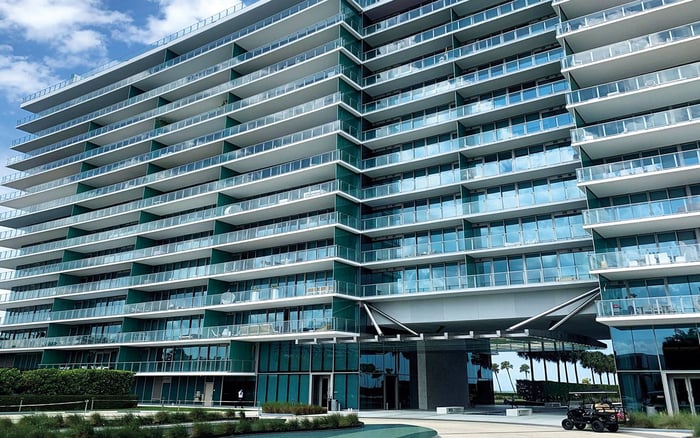
A buyer-focused comparison of Shoma Bay North Bay Village and Oceana Key Biscayne through the lenses of reserves, insurance, lender comfort, and the certainty that comes with an established completed building.

For a luxury buyer seeking a finance-friendly urban base, Shoma Bay North Bay Village and Oceana Key Biscayne should not be compared only by lifestyle, waterfront setting, or brand impression. The sharper comparison sits below the surface: reserve exposure, insurance structure, lender comfort, and the practical certainty of buying into a completed building versus a project whose final operating profile requires careful evaluation.
That does not make one choice inherently superior. It means the buyer profile matters. A purchaser prioritizing efficient access to Miami, a more urban rhythm, and potential entry into an evolving waterfront district may view Shoma Bay North Bay Village differently than a buyer who values the established feel of Oceana Key Biscayne. Both can be compelling, but the due diligence is not the same.
In South Florida, the most sophisticated condominium buyers now underwrite the association almost as closely as the residence. Monthly carry, reserves, insurance, assessments, financing eligibility, and future resale liquidity all influence the real cost of ownership. The residence may win the heart, but the building balance sheet often wins the lender.
Reserve exposure is now a central question in any high-end condominium purchase. Buyers should ask how reserves are funded, whether contributions are expected to rise, and whether future capital needs could lead to special assessments. In practice, the reserve conversation is not only about building condition. It is about predictability.
For Shoma Bay North Bay Village, the relevant questions should focus on the expected association budget, how reserve assumptions are framed, and how a lender may treat the building once financing is requested. A finance-friendly urban base should not require a buyer to accept vague operating assumptions. It should offer enough clarity for a private banker, portfolio lender, or conventional lender to understand the association’s financial structure.
For Oceana Key Biscayne, the completed-building context may allow a buyer to examine operating history, current association practices, reserve posture, and real-world maintenance patterns. That can be powerful for buyers who prefer evidence over projections. A completed condominium does not eliminate future risk, but it may give buyers more concrete documents to review before committing capital.
The distinction is not new versus established in a simplistic sense. It is modeled certainty versus documented certainty. Buyers should decide how much uncertainty they are willing to price into the deal.
Insurance has become one of the defining variables in coastal South Florida ownership. For waterfront condominium buyers, the question is not simply whether the building carries insurance. The more useful questions are how coverage is structured, what deductibles apply, what is covered by the association versus the individual owner, and how premiums may affect monthly assessments over time.
At Shoma Bay North Bay Village, a buyer should examine the insurance framework as part of the total carrying-cost equation. If the attraction is an urban-base location with convenient access to mainland Miami and Miami Beach, the ownership model still needs to withstand lender review and personal cash-flow modeling. A low-friction lifestyle can be undermined if insurance assumptions are too soft.
At Oceana Key Biscayne, buyers can typically focus on the existing insurance structure, how it flows through association dues, and whether any changes are anticipated. For a finance-minded buyer, this can be useful because lenders often want building-level clarity. The completed-building profile may help reduce ambiguity, especially when the buyer is comparing all-in monthly obligations rather than purchase price alone.
The best practice is to ask for the master policy summary, current association budget, deductible schedule, reserve position, and any owner insurance requirements. High-net-worth buyers often have the liquidity to absorb surprises, but that does not mean they should accept them casually.
Completed-building certainty is not merely about walking through a lobby. It is about knowing how a building operates after theory becomes reality. A completed property allows buyers to assess governance, maintenance standards, resident mix, amenity performance, staffing, and the lived cadence of the address.
That is where Oceana Key Biscayne may appeal to buyers who want fewer unknowns. The Key Biscayne setting has a more established residential identity, and a completed condominium can give the purchaser a clearer view of monthly carry, building culture, and resale comparables. For buyers seeking a calm island base with a more settled ownership profile, that certainty may justify a different valuation approach.
Shoma Bay North Bay Village speaks to another type of buyer: one who wants proximity, flexibility, and an urban waterfront position in a district that may feel more connected to the broader Miami grid. North Bay Village can appeal to buyers who do not want the formality of a traditional island enclave yet still want bayfront energy. In that context, the diligence burden shifts toward understanding timing, delivery, association formation, financing terms, and future operating costs.
For investment-minded purchasers, the question is whether the location and product strategy create enough long-term demand to offset early-stage uncertainty. For resale-focused buyers, the question is whether the unit will be easy to finance and easy to explain when it returns to market.
A finance-friendly buyer should begin with lender eligibility. Before falling in love with a floor plan, ask whether the building or future building profile is likely to support the type of loan being used. Some buyers assume liquidity solves every issue. In condominium purchases, building eligibility can still affect rate, leverage, timing, and the pool of future buyers.
Next, model total monthly carry under more than one scenario. Include association dues, reserves, insurance pass-throughs, taxes, interior insurance, parking costs if applicable, and a cushion for increases. The cleanest comparison is not which unit has the lower purchase price. It is which ownership structure looks more predictable three to five years from now.
Third, review exit liquidity. Shoma Bay North Bay Village may suit buyers comfortable with an urban-growth thesis, while Oceana Key Biscayne may suit buyers who prize the clarity of a mature luxury condominium environment. The buyer planning to hold for ten years may tolerate a different risk profile than the buyer who wants optionality within three years.
Finally, insist on document discipline. Budgets, reserve information, insurance summaries, association documents, financing disclosures, and closing timelines should be reviewed early. In a luxury market, discretion is prized, but precision is what protects the acquisition.
North Bay Village and Key Biscayne are not interchangeable residential ideas. One reads as connected, transitional, and urban-facing. The other reads as insulated, established, and island-residential. The better choice depends on whether the buyer wants movement or remove.
Shoma Bay North Bay Village may feel more intuitive for a buyer who wants access to multiple Miami submarkets without committing fully to downtown, Miami Beach, or the mainland. Oceana Key Biscayne may feel more natural for a buyer who wants privacy, a quieter daily cadence, and a stronger sense of arrival.
The financial question follows the lifestyle question. If the buyer values urban optionality, the diligence should confirm that the building’s future operating profile supports easy financing and future liquidity. If the buyer values completed-building certainty, the diligence should test whether the current association structure remains durable in a rising-cost insurance and reserve environment.
The comparison between Shoma Bay North Bay Village and Oceana Key Biscayne is not a contest between new energy and established prestige. It is a study in risk preference. Shoma Bay North Bay Village may appeal to buyers willing to underwrite urban-base potential with careful attention to future costs and lender acceptance. Oceana Key Biscayne may appeal to buyers who put a premium on completed-building evidence, established operations, and clearer association history.
For the finance-friendly buyer, the winning property is the one that can be explained cleanly to a lender today and to a future buyer tomorrow. The most elegant purchase is not only the one with the better view. It is the one whose financial structure remains composed after closing.
Is Shoma Bay North Bay Village better for an urban-base buyer? It may fit buyers who value connected waterfront access and are comfortable studying future operating assumptions closely.
Is Oceana Key Biscayne more finance-friendly because it is completed? A completed building can provide more concrete documents for review, but buyers should still examine reserves, insurance, and association health.
What is reserve exposure in a condominium purchase? It refers to the buyer’s indirect exposure to future building costs through reserves, dues, and potential assessments.
Why does insurance structure matter so much in South Florida? Insurance can materially affect monthly carry, association budgets, deductibles, and lender comfort for coastal properties.
Should cash buyers care about financing issues? Yes. Even without a loan, future resale liquidity can be affected if later buyers have difficulty financing in the building.
What documents should buyers request before comparing these properties? Buyers should review association budgets, reserve information, insurance summaries, governing documents, and any financing-related disclosures.
Does completed-building certainty eliminate risk? No. It reduces certain unknowns, but buyers still need to examine current operations, reserves, and insurance trajectory.
Which option is better for resale planning? The better resale option is the one with stronger buyer demand, clearer financing pathways, and a well-understood carrying-cost profile.
How should investors compare North Bay Village and Key Biscayne? Investors should weigh urban-growth potential against established island demand, then test both against financing and operating-cost assumptions.
What is the simplest rule for choosing between them? Choose the property whose lifestyle appeal is matched by the clearest association, insurance, reserve, and financing picture.
For a discreet conversation and a curated building-by-building shortlist, connect with MILLION.
If branded residences are on your mind — as a home or as an allocation — we would be glad to share what we are seeing, privately.
Begin a quiet conversation