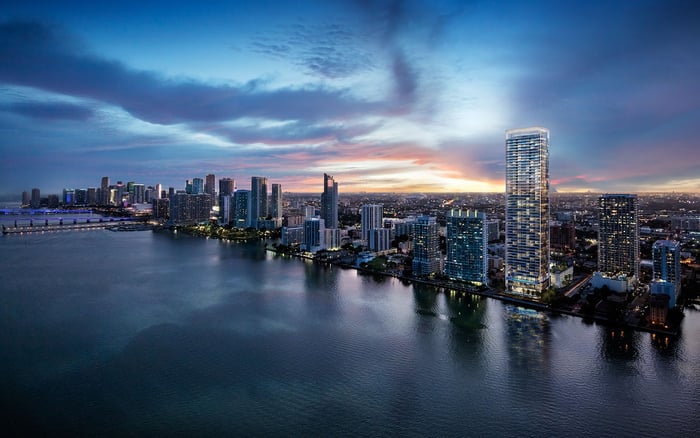
A buyer-focused look at how Latin America connectivity shapes ownership decisions in South Florida luxury real estate, from privacy and structure to neighborhood fit and long-term flexibility.

For globally mobile families, South Florida is rarely just a warm-weather address. It is a base. The question is no longer simply whether a residence offers water views, hotel-level service, or a recognizable skyline. The more consequential question is how ownership should function for a household whose personal, business, and family life may span South Florida and Latin America.
Connectivity sharpens that question. When a buyer can move between hemispheric obligations with relative ease, the residence becomes more than a second address. It can become a family meeting point, a private retreat, a capital allocation, a schooling-adjacent foothold, or a long-term option on personal flexibility. Each use case points to a different ownership strategy.
This is where the South Florida conversation becomes more sophisticated. The most compelling buyers are not merely asking what to buy. They are asking how to own, where to anchor, and what level of transparency, liquidity, and control will still feel appropriate five or ten years from now.
The instinct in luxury real estate is to begin with product type: oceanfront condominium, branded tower, private home, boutique building, or new development. For Latin America-connected families, that sequence is often incomplete. The better first question is use.
Will the property be occupied seasonally by one household, shared among extended family, held primarily for wealth preservation, or kept as a flexible landing point? Will it need to accommodate staff, visiting relatives, work calls across time zones, or extended stays during school holidays? Will the buyer prioritize immediate occupancy, pre-construction optionality, or a finished residence that can be used without delay?
A residence that looks perfect in a presentation may be wrong if its governance, rental limitations, parking, privacy profile, or maintenance rhythm conflicts with the buyer’s actual life. Conversely, a quieter building in the right location may outperform a more theatrical address if it allows the family to move naturally between travel, work, and rest.
For this audience, luxury is not only finish level. It is friction reduction.
The ownership question is also a governance question. South Florida buyers with cross-border lives often think carefully about how a property will be titled, who will use it, how decisions will be made, and what information will be visible. Those are legal and tax matters that require specialized advice, but they are also lifestyle matters.
A family that values discretion may prefer fewer shared spaces, stronger arrival sequences, and residences that do not require constant interaction with building staff or neighbors. Another family may prefer a highly serviced condominium where security, maintenance, and daily logistics are handled with consistency. Neither answer is inherently better. The right answer depends on the family’s comfort with visibility, delegation, and control.
Ownership structure should be addressed before negotiation becomes emotional. Once a buyer has become attached to a view, a floor plan, or a private terrace, it becomes harder to pause and ask whether the broader structure is elegant. The best acquisitions feel calm at contract, at closing, and on the first holiday weekend.
South Florida is not one ownership market. It is a series of micro-decisions. Brickell can appeal to buyers who want urban energy, business proximity, and condominium services in a dense vertical environment. Downtown may suit those who prefer cultural access and a skyline setting with a more metropolitan rhythm. Edgewater offers a waterfront-adjacent posture that can feel residential while remaining close to the urban core.
Aventura has a different logic. It can feel practical for families seeking convenience, shopping, nearby schools, and a rhythm that is less dependent on nightlife. Surfside speaks to buyers who want a quieter coastal identity, where the tone is more intimate and the ocean remains central to the daily experience.
The point is not to crown one district over another. The point is to match location to family behavior. Some owners want to be in the center of movement. Others want to arrive, close the door, and disappear. South Florida allows both, but the ownership plan should distinguish between a glamorous weekend and a sustainable life.
Investment considerations are unavoidable, but they should not flatten the residence into a spreadsheet. A luxury home is also an emotional asset, a family instrument, and a time-saving device. Still, discipline matters.
Buyers should consider liquidity, building reputation, maintenance obligations, association rules, insurance exposure, and the long-term appeal of the location. New construction may offer modern design, amenities, and the chance to secure a residence before completion, but it also requires patience and comfort with delivery timelines. Resale may offer certainty, immediate use, and the ability to judge the building as it currently operates.
The strongest ownership decisions hold both ideas at once: the home must serve the family, and the asset must make sense under sober review. For internationally connected buyers, that review should be especially deliberate because the property may be one part of a broader cross-border portfolio.
Before selecting a residence, buyers should ask a tighter set of questions. How often will the family actually be in South Florida? Who will use the property when the principal owner is away? Is the priority beach, business, schools, privacy, boating, dining, or medical access? How important is staff support? How much building activity feels acceptable?
They should also ask what future change might look like. A second home can become a primary base. A pied-à-terre can become a family compound strategy. A condominium purchased for convenience can later feel too public, while a private home can later feel too management-intensive. The best buyers leave room for that evolution.
South Florida rewards clarity. Its range of neighborhoods, product types, and ownership styles can be a strength, but only when the buyer’s priorities are articulated before the search expands. Without that clarity, choice becomes noise.
The most valuable asset in this conversation may be optionality. A residence that allows a family to host, retreat, work, recover, and gather has value beyond architecture. It becomes a private platform for continuity.
For Latin America-connected households, that continuity is especially meaningful. The property may be used for celebrations, urgent travel, business transitions, children’s milestones, and periods when the family simply wants a reliable place that feels known. The address matters, but the feeling of readiness may matter more.
In the end, the South Florida ownership question is not only about connectivity. It is about what connectivity makes possible. When movement becomes easier, the home must justify itself with substance. The right purchase should make the family’s life feel more composed, not more complicated.
Why does Latin America connectivity matter to South Florida ownership? It changes the residence from a vacation asset into a practical base for family, work, and long-term flexibility.
Should buyers choose location before ownership structure? No. Structure, intended use, and advisory planning should be considered before emotional commitment to a specific property.
Is Brickell best for internationally connected buyers? Brickell can be compelling for urban convenience and services, but it is only right when it matches the buyer’s lifestyle.
How should buyers compare Aventura and Surfside? Aventura may feel practical and family-oriented, while Surfside may appeal to those seeking a quieter coastal setting.
Does new construction make sense for cross-border families? It can, particularly for buyers who value modern design and future delivery, but timing and use plans must align.
When is resale a better option? Resale can be attractive when a buyer wants immediate use, known building operations, and less delivery uncertainty.
What role does privacy play in the decision? Privacy affects building choice, arrival experience, service preferences, and the comfort of extended family use.
Can a second home become a primary residence later? Yes, and buyers should consider whether the property could support a more permanent lifestyle if needs change.
Is investment value the main consideration? It is important, but the residence should also serve daily life, family rhythm, and long-term personal flexibility.
What is the first step for a serious buyer? Define the property’s true purpose, then align location, product type, and advisory planning around that purpose.
To compare the best-fit options with clarity, connect with MILLION.
If branded residences are on your mind — as a home or as an allocation — we would be glad to share what we are seeing, privately.
Begin a quiet conversation