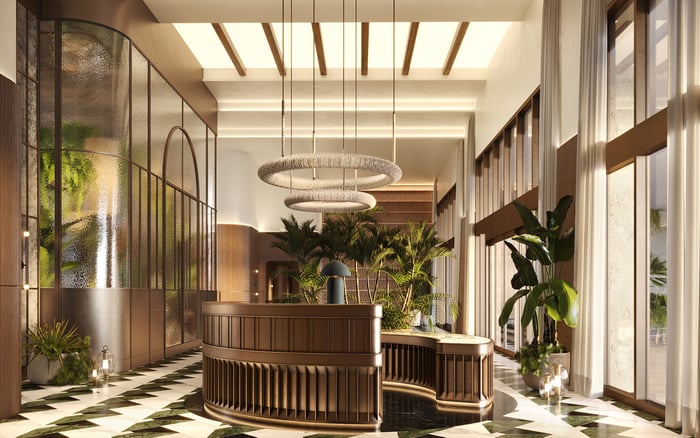
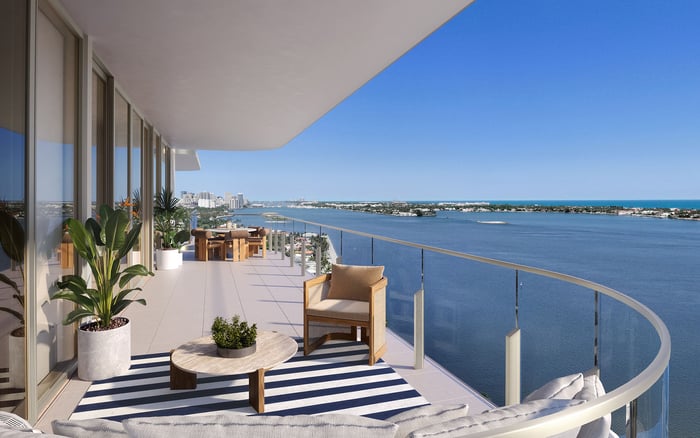
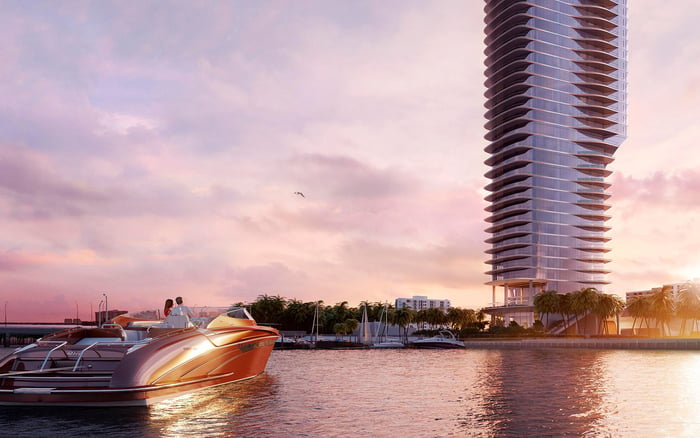
A buyer-focused comparison of Banyan Tree Residences West Palm Beach and Four Seasons Residences Coconut Grove, focused on dining access, urban sound, and the social rhythm of each luxury address.
At the top of South Florida’s residential market, prestige is often treated as the starting point. Brand, architecture, service, and privacy all matter, but the final choice often turns on something more personal: how a buyer wants daily life to sound, move, and unfold beyond the lobby.
That is the essential distinction between Banyan Tree Residences West Palm Beach and Four Seasons Residences Coconut Grove. Both names belong in the language of high-end residential aspiration, yet they lead to different lifestyle questions. One buyer may want a residence connected to restaurants and a familiar social circuit. Another may prioritize a more controlled sense of arrival, privacy, and acoustic calm.
The clearest lifestyle position in this pairing belongs to Four Seasons Residences Coconut Grove. Its Coconut Grove setting makes neighborhood life central to the buying conversation, particularly for buyers who value dining access, street-level activity, and social energy near home. Banyan Tree Residences West Palm Beach also belongs in the prestige conversation, but project-specific claims about relative quiet, dining radius, or social positioning should be reviewed carefully through current materials before being treated as definitive.
Four Seasons Residences Coconut Grove is best understood as a luxury residential address whose appeal is inseparable from the Coconut Grove lifestyle. For buyers who entertain often, dine out spontaneously, or prefer a home near an active social scene, that context is not incidental. It is part of the decision.
This is why Four Seasons Residences Coconut Grove reads as the more restaurant-proximate and socially connected option in this comparison. The value proposition is not simply that a resident can go out to dinner. It is that dining plans, neighborhood movement, and informal social encounters can become part of the residential rhythm.
For some buyers, this creates a persuasive form of ease. A weeknight dinner can feel less like a planned excursion. Visiting friends can move from an aperitif to a nearby table and back home without changing the tone of the evening. Seasonal residents, in particular, may prize this ability to re-enter South Florida socially with less friction.
Restaurant proximity is rarely neutral. The same neighborhood energy that makes a setting feel alive can also introduce sound considerations. In a luxury context, the issue is not whether a buyer accepts noise in a casual sense. It is whether the building, the residence orientation, and the buyer’s own expectations align with a more active urban environment.
For Four Seasons Residences Coconut Grove, the noise conversation is tied directly to the advantages of its setting. Dining access and neighborhood activity can create a livelier atmosphere, and that atmosphere requires careful buyer review. The most useful questions are practical: What is the residence elevation? Which direction does it face? How does terrace use change by time of day? How sensitive is the buyer to surrounding movement?
The ultra-premium buyer often asks a more refined question than “Is it quiet?” The better question is “Quiet in what way?” A residence above an animated neighborhood can still feel composed indoors while preserving the pleasure of visible life below. Conversely, a residence that appears calm on paper may feel less convenient if every dinner, meeting, or spontaneous outing requires more planning.
Banyan Tree Residences West Palm Beach carries a name that suggests a distinct form of branded hospitality and retreat-oriented luxury, but this comparison should avoid unsupported assumptions. Without verified project-level detail, it would be imprecise to declare exactly how it compares on restaurant counts, acoustic performance, walkability, or seclusion.
That does not make the comparison less useful. It makes the buyer’s due diligence more targeted. For Banyan Tree Residences West Palm Beach, the right questions are practical: How immediate is dining access? What is the character of the surrounding streets at night? Is the residence designed to emphasize a quieter private realm, a connected urban address, or a hybrid of both? How do arrival sequences, amenity placement, and residence elevations shape the sense of retreat?
West Palm Beach has its own luxury context, and buyers considering this address may be weighing a different pattern of life from Coconut Grove. The conversation can include privacy, waterfront access, club life, and seasonal rhythms, but each factor should be tied to current, project-specific evidence. The most sophisticated buyer does not need exaggeration. They need clarity.
The Four Seasons Residences Coconut Grove buyer is likely to place a premium on immediacy. They may want a recognizable residential brand, but they also want the neighborhood to do some of the work: dinner nearby, a livelier evening atmosphere, and a sense that home is embedded in a social landscape. For this buyer, restaurant proximity is not merely a convenience feature. It is a lifestyle engine.
The Banyan Tree Residences West Palm Beach buyer may be seeking a different answer, but that answer should be confirmed rather than assumed. If the appeal is a quieter retreat, ask how the building delivers that experience. If the appeal is access to West Palm Beach’s polished lifestyle scene, ask how that access functions in daily use. If the appeal is brand-driven calm, evaluate how the residence separates private life from surrounding activity.
This comparison sits across Coconut Grove, West Palm Beach, Palm Beach, new construction, second-home, and branded-residence decision-making. Those categories are not just search labels. They reflect the way buyers now compare South Florida addresses: not only by finishes and views, but by how a residence edits the outside world.
For some buyers, the social charge of Coconut Grove is a luxury because it reduces friction. Dinner is close, the neighborhood feels active, and the residential setting is connected to a recognizable Miami lifestyle identity. Four Seasons Residences Coconut Grove is strongest in that frame: restaurant proximity, walkability, and social energy are central to the experience.
For others, the highest luxury is not proximity but control. They may want to decide when the outside world enters the day. They may prefer fewer ambient cues from restaurants and street life, or they may want a residence where the sense of retreat is more pronounced. Banyan Tree Residences West Palm Beach may appeal to that instinct, but the details should be verified through the exact building program and setting.
The better choice is not universal. It depends on whether the buyer wants the neighborhood to be a stage, a backdrop, or something held at a greater distance. In this tier of the market, that is often the real difference between two prestigious names.
Is Four Seasons Residences Coconut Grove the more restaurant-proximate option? Yes. In this comparison, its Coconut Grove setting supports the stronger restaurant-proximity and social-energy position.
Does restaurant proximity create more noise consideration? It can. A livelier dining environment may add sound considerations that should be evaluated by residence location, exposure, and personal sensitivity.
Can Banyan Tree Residences West Palm Beach be called quieter? Not definitively from the available project detail. Buyers should confirm acoustic, location, and lifestyle specifics through current project materials.
Which project is better for buyers who dine out often? Four Seasons Residences Coconut Grove is the clearer fit for buyers prioritizing dining access, walkability, and neighborhood vitality.
Is Coconut Grove’s social energy part of the value proposition? Yes. In this comparison, dining access, walkability, and neighborhood movement are central to how the Four Seasons Coconut Grove lifestyle is framed.
Should buyers compare restaurant counts? They should avoid relying on unsupported exact counts. The more useful test is how conveniently dining fits into daily life.
Is this primarily a Miami versus West Palm Beach decision? Partly, but it is more specifically a tempo decision. Buyers are comparing neighborhood energy, privacy, and ease of use.
What should second-home buyers prioritize here? They should decide whether they want immediate social re-entry or a more controlled retreat experience during seasonal stays.
What should buyers ask about Banyan Tree Residences West Palm Beach? They should ask how dining access, arrival, residence orientation, and surrounding activity shape the daily experience.
What is the safest conclusion from this comparison? Four Seasons Residences Coconut Grove is the stronger social and dining-access choice in this framing, while Banyan Tree details require project-specific verification.
When you're ready to tour or underwrite the options, connect with MILLION.
If branded residences are on your mind — as a home or as an allocation — we would be glad to share what we are seeing, privately.
Begin a quiet conversation