South Florida’s next chapter of luxury real estate is being written by private clubs. From ultra-exclusive golf communities to yacht-club-style waterfront living and members-only dining, the region’s most coveted addresses increasingly trade on access: to tee times, slips, services, and social calendars that are intentionally curated. For buyers, club infrastructure has become a form of long-term value, shaping daily life as much as views or floor plans. This new era is not one-size-fits-all. Some communities tie ownership and membership closely; others deliver “club” through hospitality brands and resident-only venues. The common denominator is a shift from amenity checklists toward controlled environments, where privacy, programming, and concierge-level execution are the product. The result is a market where lifestyle governance can matter as much as architecture. For discerning purchasers, the questions are practical: What exactly is private, and how is access controlled? Is the club a stand-alone membership, a residents-only feature, or a hybrid? And which assets, golf, marina, wellness, dining, are truly foundational rather than decorative?
In South Florida’s upper tier, “club” no longer means a single building with a bar and a fitness room. It signals an operating system: controlled access, curated social proximity, and the staff-and-services layer that turns property into lifestyle. The appeal is straightforward. When privacy is the baseline, what differentiates a residence is who can enter the ecosystem, and what life looks like once inside it. That’s why golf communities, yacht-forward buildings, and branded residential towers increasingly read from the same playbook. Each sells frictionless time: protected tee sheets, professionally managed docks, dining rooms that feel like a second home, and wellness programs that don’t require leaving the property. For buyers, the shift is practical. Amenities matter less as a checklist and more as governance. A smaller, tightly controlled program can outperform an enormous amenity deck when it’s executed with consistency, intentionality, and real access restrictions.
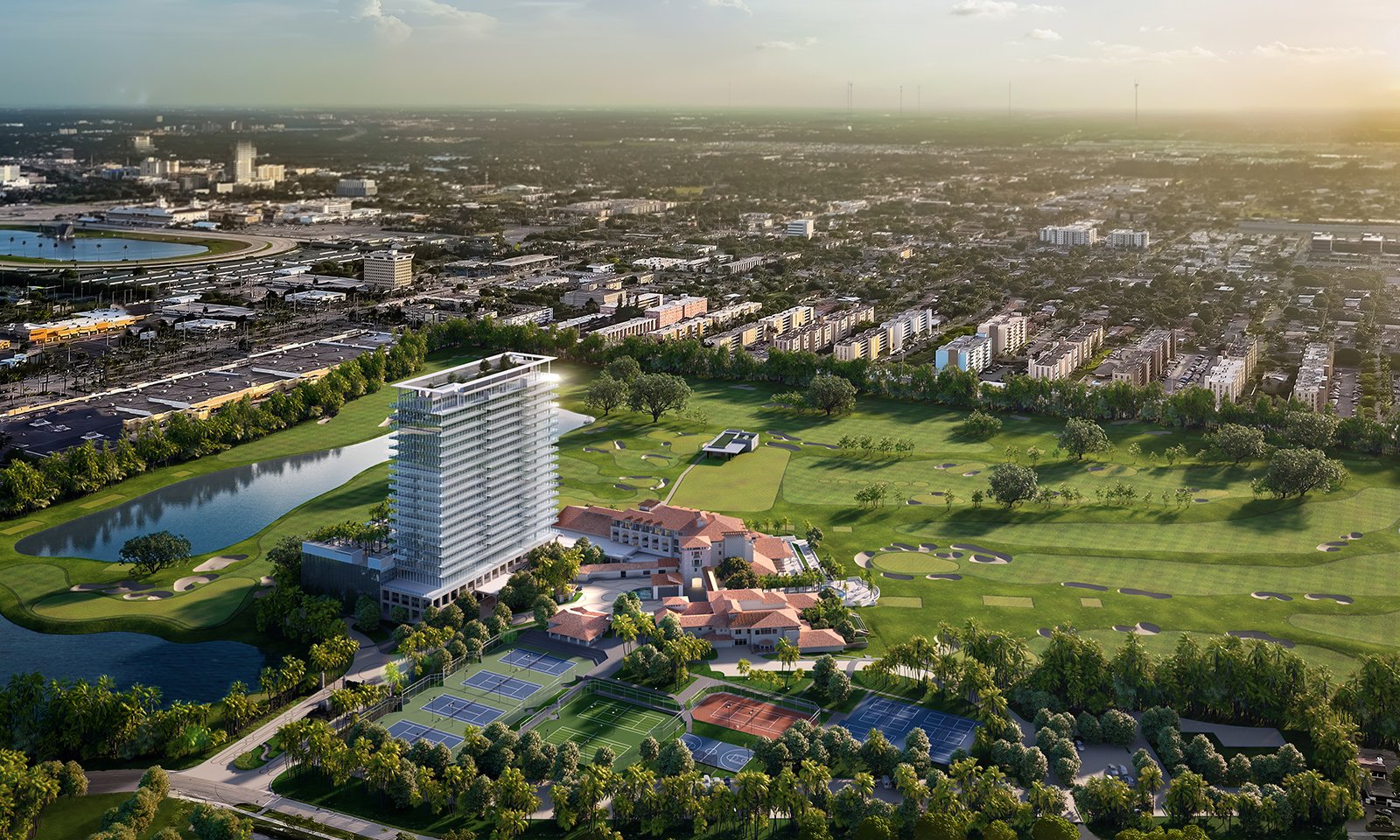
Golf is one of the clearest expressions of luxury-by-access because it is inherently capacity-limited. A course has a finite number of tee times, and an even smaller number of prime-time tee times, so scarcity becomes a social filter. At Shell Bay by Auberge Hallandale, the club is anchored by a Greg Norman-designed 18-hole championship course alongside a 12-acre practice facility and a 9-hole par-3 course. The residential component is limited to 108 residences under the Auberge Resorts Collection brand, reinforcing the premise that the community is built around a deliberately narrow membership and ownership universe. The club has been marketed with initiation fees over $1 million, less a price point than a signal that entry is intended to be difficult. Farther north, Panther National in Palm Beach Gardens centers on a private club community with a Jack Nicklaus and Justin Thomas-designed course. Its real estate offering includes “Signature Estate Homes,” with positioning that emphasizes modern design within a private-club context. The takeaway isn’t simply that golf is present, it’s that golf is the identity, with real estate as the long-term anchor for owners who want their primary residence to live inside that identity. For buyers evaluating golf as a lifestyle, focus on what’s truly foundational: practice facilities, short-course options that make weekday play realistic, and operational quality that keeps the experience consistent. The best golf-led communities are engineered for repeatable satisfaction, not occasional spectacle.
If golf is the gatekeeper on land, marinas play a parallel role on the water. In South Florida, where boating is both recreation and ritual, direct access to a slip or a yacht-club-style environment can be a decisive advantage. In Palm Beach Shores, HAVN Residences and Yacht Club presents a waterfront concept built around Intracoastal access and a yacht-club-style lifestyle. Residences are marketed from $1.25 million, reflecting a broader trend: translating club cues, access, branding, and program, into a more residential-forward format. In North Miami Beach, Marina Palms Yacht Club and Residences pairs 468 condo residences with a 112-slip marina designed to accommodate yachts up to 90 feet. The project highlights direct ocean access via Haulover Inlet at roughly 20 minutes away. For many owners, that time-to-open-water metric isn’t trivia, it’s a weekly quality-of-life calculation, especially when spontaneous departures are the point of ownership. Within this conversation, the North Miami and North Miami Beach corridor has become increasingly relevant for buyers who want water adjacency without giving up access to Miami’s core. A residential option like One Park Tower by Turnberry North Miami can appeal to those who want modern condominium living while staying within reach of marinas and the broader coastal network.
Not every buyer wants to plan life around tee times or vessel management, yet many still want the social and service architecture of a club. Branded residential towers have evolved to meet that demand, translating private-club expectations into vertical living. In Miami, Villa Miami’s “Copper Club” is positioned as a private, multi-level club concept integrated into the resident experience. It reflects a shift toward layered programming, spaces designed for different moods and hours, rather than a single multipurpose lounge. Similarly, Casa Cipriani Miami includes a private members club, tying hospitality culture directly to real estate. For buyers, the proposition is clear: an environment where dining, meetings, and evenings out can happen inside the same controlled, familiar setting. On Miami Beach, The Perigon Miami Beach’s lifestyle program includes resident-only food-and-beverage concepts, including a restaurant and a speakeasy-style cocktail lounge. The point isn’t novelty, it’s repeatability. Private programs win when residents actually use them, because they’re elegant, convenient, and consistently operated. This is where a project like The Perigon Miami Beach enters the conversation as more than an address. It reflects a broader Miami Beach shift: luxury defined by intimacy, controlled access, and resident-first hospitality.
The club era also pushes buyers to evaluate structure, not just aesthetics. “Membership” can mean radically different things depending on how it’s organized, and what rights, obligations, and access controls come with it. On Fisher Island, Fisher Island Club membership is equity-based, with privileges structured so that some elements, such as golf, are noted as optional or additional. Amenities include a golf course, tennis, marinas, dining venues, spa and fitness, and family programming. That framing matters: equity-based structures can signal a long-horizon community mindset, where members are invested in continuity and standards. Elsewhere, Turnberry Isle Country Club’s Golf Membership lists benefits such as advance tee-time priority, member charging privileges, and access to dining, wellness, and fitness programming. The club also advertises an “Executive Club” option for members under age 45, with reduced initiation fees and discounted dues until a stated age threshold. For younger buyers who want to enter a premium club ecosystem earlier, age-tiered access can be a pragmatic bridge, particularly when the broader lifestyle matters as much as the golf. In Palm Beach County, Old Palm Golf Club’s offering documents describe a structure in which ownership and membership are linked through a required membership category for property owners. This ownership-linked model can appeal to buyers who want community standards protected by design, but it also underscores why diligence matters: club terms can shape long-term economics and the day-to-day experience. For those who prioritize privacy and controlled admission, clubs like The Bear’s Club maintain a membership inquiry process, reinforcing a controlled-access culture that’s as much about fit as it is about finance.
In a market dense with amenity language, underwriting the club layer comes down to practical questions. First, identify the core asset. If the club is golf-led, is there a serious practice facility and a short-course option that supports frequent use? If the club is marina-led, are slip capacity and yacht-length capability aligned with your actual boating needs? If the club is hospitality-led, are the venues resident-only, member-only, or public-facing with priority access? Second, test operational realism. Dining rooms, lounges, and wellness programs are only as valuable as their consistency. A private club with strong programming can become part of your weekly rhythm; a weak one becomes decorative square footage. Third, calibrate the club to your personal calendar. Some owners want an active social scene; others want an elegant, quiet default with the option to engage. The strongest communities support both, with spaces and programming that scale to your mood. Finally, connect lifestyle to location. In Brickell, for example, many buyers want a private, members-only feel without leaving the urban core. Casa Cipriani Miami Beach and Villa Miami show how the club concept can be embedded into vertical residential life, while a project like Bentley Residences Sunny Isles underscores how branded luxury can expand into spa- and wellness-forward amenity stacks that emulate resort living.
Traditional luxury signifiers still matter: views, architecture, finishes, and provenance. But in South Florida’s current market, the most sophisticated differentiator is time, not in the abstract, but in the measurable reduction of friction: less planning, less waiting, fewer compromises. A well-run club ecosystem compresses life into a smaller radius while expanding what’s possible inside it. Golf becomes a spontaneous afternoon, not a logistical exercise. Boating becomes a quick departure, not a weekend project. Dining becomes familiar, not transactional. Wellness becomes habitual, not aspirational. That’s the real reason the private club era is reshaping luxury real estate across Miami Beach, Hallandale, Palm Beach, and North Miami Beach. It isn’t about adding more. It’s about making access, service, and privacy feel effortless.
What defines the “private club era” in South Florida real estate? It’s the shift from amenity volume to controlled access, curated programming, and consistent service.
Why are golf communities gaining renewed prestige? Golf is capacity-limited, so tee-time access and practice infrastructure naturally create scarcity and status.
What makes Shell Bay distinctive as a club-led community? It combines a Greg Norman-designed championship course with extensive practice facilities and a limited 108-residence component.
How does marina access translate into real-world value? Slip availability and time-to-open-water can directly affect how often owners actually use their boats.
What is notable about Marina Palms’ marina component? It pairs 468 residences with a 112-slip marina designed for yachts up to 90 feet, with ocean access via Haulover Inlet.
How do branded residences replicate private club living? They integrate resident-only venues and hospitality services so owners can socialize, dine, and relax on-site.
What is an equity-based club membership, like on Fisher Island? It is a membership structure built around equity participation, paired with a defined set of club privileges.
Are there membership options designed for younger buyers? Some clubs offer age-based tiers, such as an executive option with reduced initiation fees and discounted dues.
What does it mean when membership is linked to property ownership? In some communities, owners must hold a required membership category, tying club participation to ownership.
How should buyers evaluate a club-led purchase beyond the marketing? Focus on access rules, operational consistency, and whether the core asset, golf, marina, or hospitality, matches your daily life.
Explore South Florida’s most private, club-driven addresses with MILLION Luxury.
If branded residences are on your mind — as a home or as an allocation — we would be glad to share what we are seeing, privately.
Begin a quiet conversation