In Miami’s Edgewater, the newest waterfront proposals are not just selling height or skyline presence. They are selling exposure: how light enters a home, how a terrace extends daily life, and how directly you can step from lobby to bay. Villa Miami and Aria Reserve approach that promise from opposite ends of the spectrum, one built around extreme scarcity and private arrival, the other around resort-scale frontage and a campus of amenities. For buyers calibrating privacy, community, and the way a view is framed from room to room, understanding those differences is the real due diligence.
Edgewater has long served as a quieter counterpoint to Downtown and Brickell: close enough for an easy arrival, yet oriented toward the open water of Biscayne Bay. What is evolving is the precision with which new developments convert waterfront adjacency into day-to-day living. Buyers are not only asking, “Do I have a bay view?” They are asking how the view reads from different rooms, whether terrace depth actually changes outdoor use, and if the scale of the building heightens or softens the sense of retreat.
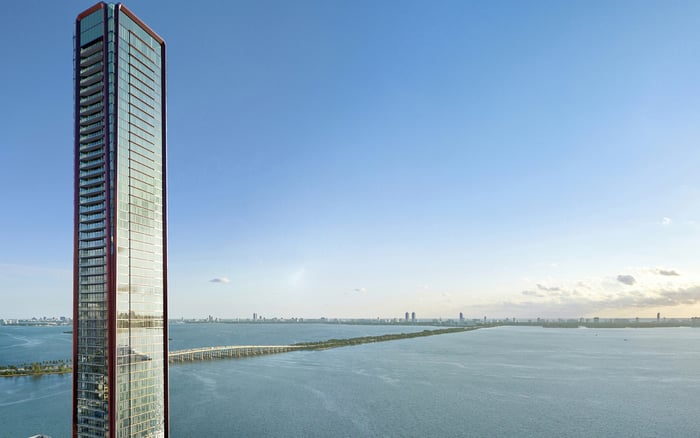
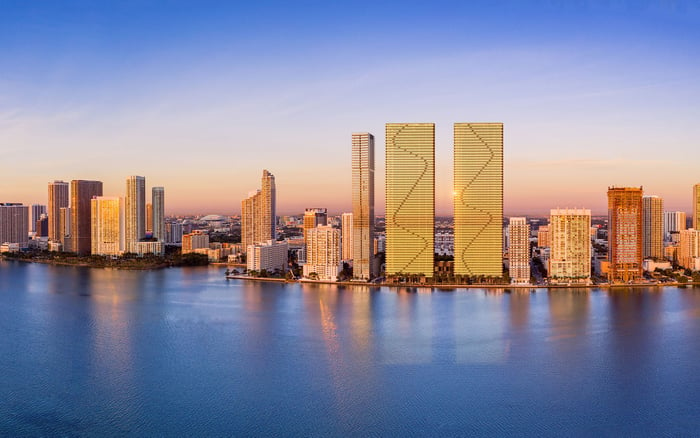
Two proposals capture that shift clearly. Villa Miami is planned as a 55-story, roughly 650-foot luxury condominium tower at 700 NE 29th St, Miami, with an ultra-low density program of 64 residences. Aria Reserve, at 725 NE 24th St, is envisioned as twin 62-story towers across an approximately 5-acre waterfront site, with about 782 residences and an amenity campus designed to keep residents connected to the baywalk as much as to the skyline.
Both sell a high-exposure lifestyle, but they define “exposure” differently. One emphasizes privacy, controlled arrival, and a small residential community. The other leverages frontage, open space, and activity zones to create a broader, resort-like waterfront rhythm.
At the top of the market, decisions still hinge on familiar fundamentals: privacy, proportion, and the quality of light. What changes is the delivery. Boutique density can make the view feel curated: fewer neighbors per floor, quieter elevator traffic, and a more controlled sense of who shares the amenities.
In a larger, campus-style development, the waterfront behaves more like an ecosystem. The baywalk, pools, courts, and watersports areas operate as additional “rooms,” where Biscayne Bay is not only scenery but the setting for daily movement and activity.
MILLION Luxury has previously framed this as scarcity-driven living versus twin-tower, resort-scale living. It is a useful lens because it keeps the comparison grounded in lived experience, not only architectural presence.
Villa Miami is marketed as ultra-low density with 64 total residences, arranged as large half-floor and full-floor homes with private elevator access. For buyers who prioritize discretion, this is not a footnote. It is the operating system. It shapes how you arrive, how you host, and how the building feels on an ordinary weekday.
The project’s exterior design has been described as featuring a cast-bronze exoskeleton as a signature element. In this segment, design language matters because it signals permanence and intent. A distinctive facade is not just branding; it becomes part of the identity a buyer is choosing in a market crowded with glass.
What most sharply separates Villa Miami is its transportation and water-access narrative. The arrival concept includes a rooftop helipad, and the waterfront amenity set includes a private dock and boat slips for direct Biscayne Bay access. For the right buyer, the appeal is straightforward: convenience that reads as autonomy.
Amenities lean into a more literal relationship with the bay. A floating pool concept has been presented publicly as a “floating pool vessel,” emphasizing on-the-water exposure rather than only over-the-water views. Taken together with private elevators and large-format residences, the message is consistent: a tower designed to feel closer to a private villa lifestyle, even at height.
For more on the public-facing positioning, see Villa Miami.
Aria Reserve is planned as twin 62-story towers on Biscayne Bay in Edgewater. It has been described in market coverage as the tallest waterfront twin towers in the United States, reinforcing its connection to skyline prominence and long-range views.
Its differentiator, however, is not only height. Aria Reserve spans an approximately 5-acre waterfront site and is marketed with 547 linear feet of Biscayne Bay frontage. That scale implies a different kind of exposure: more open space, longer baywalk moments, and broader sightlines from multiple points across the property.
Inside the residences, Aria Reserve promotes flow-through (east-to-west) plans designed to capture sunrise-to-sunset light and cross-breezes, with 10-foot ceilings (with penthouses higher). The promise is a home that reads bright and expansive throughout the day, not only dramatic at sunset. The development also promotes expansive terraces, with depth cited up to roughly 11 feet, which can shift outdoor living from a narrow balcony experience to a true terrace routine.
The amenity program is oriented toward active waterfront living. Aria Reserve promotes baywalk access with a watersports component connected to dock or marina use, plus multiple pools including a lap pool and sports courts. In practice, this creates more “view plus activity” zones: you are oriented to the bay while doing something, not only while looking.
For a closer look at the project’s positioning, visit Aria Reserve Miami.
Even as a snapshot, pricing often reveals how a project expects to be used.
Villa Miami has been marketed from about $4.8M and up, consistent with a scarcity narrative where fewer, larger residences support a higher entry point. Aria Reserve, by contrast, offers a broader range by virtue of its scale. A publicly listed example in Aria Reserve North Tower shows a residence priced at $2,691,900 for 2,800 square feet, which works out to about $961 per square foot.
The point is not that one is “better value.” The point is that they underwrite different lifestyles. Boutique scarcity tends to fit buyers who want a residence that functions like a private compound in the sky. Resort-scale living tends to suit buyers who want more daily options, plus the energy and variety that come with a larger community and a deeper amenity roster.
The most useful comparison comes from questions that translate directly into routine.
Privacy and circulation: Do you want private elevator access and fewer neighbors per floor, or do you prefer a larger building where social anonymity can coexist with higher daily activity?
Water access: Are you the buyer for whom boat-slip access genuinely changes the week? If direct bay access via a private dock and boat slips is central to the purchase logic, the Villa Miami concept is explicitly built around it.
Light and airflow: If you prioritize flow-through units and the sensation of light moving through a home from east to west, Aria Reserve is marketing that as a core residential feature. In Miami, where a beautiful view often comes with intense sun, plan orientation and cross-breezes can become a quiet form of luxury.
Terrace practicality: Terrace depth is not cosmetic. A deeper terrace can support dining, lounging, and working outdoors in a way a shallow outdoor space cannot. If your lifestyle is built around indoor-outdoor living, proportions should be verified in person.
Some buyers considering Edgewater also weigh a second base in Miami Beach, where service and hospitality narratives can be more central to the value proposition. The point is not that one neighborhood replaces the other. It is that each expresses luxury differently.
In Miami Beach, a “turnkey” mindset often aligns with private collections and residential programs attached to recognizable hospitality environments. Buyers who want a strong service layer and a predictable social scene may also explore Shore Club Private Collections Miami Beach or Setai Residences Miami Beach. That comparison can clarify what you want from Edgewater: a quieter bayfront residence with a more residential cadence, or a service-forward home where the building’s identity is closely tied to hospitality.
In new construction, the most meaningful evidence is rarely the rendering. It is how the project describes circulation, exposure, and access.
Start by mapping your daily loop: arrival, elevator experience, privacy at the front door, and the speed of the transition from interior to terrace. Then evaluate how the building connects to the bay at ground level. A view from the 40th floor matters, but so does the ability to walk, sit, or launch on the water without feeling like you are navigating a public promenade.
Finally, pressure-test the amenity story against your habits. If you will use a lap pool and sports courts multiple times a week, resort-scale programming can become a real lifestyle upgrade. If you prefer fewer shared spaces and a calmer building, scarcity can be its own amenity.
Where are Villa Miami and Aria Reserve located?
Villa Miami is planned at 700 NE 29th St in Edgewater. Aria Reserve is at 725 NE 24th St in Edgewater.
How tall is Villa Miami planned to be?
Villa Miami is planned as a 55-story tower at roughly 650 feet.
How many residences are planned at Villa Miami?
Villa Miami is marketed with 64 total residences.
What is distinctive about Villa Miami’s architecture?
It is described as featuring a cast-bronze exoskeleton as a signature exterior element.
Does Villa Miami offer direct water access?
Yes. Its amenity set includes a private dock and boat slips for direct Biscayne Bay access.
What is Aria Reserve’s overall scale?
Aria Reserve is planned as twin 62-story towers across an approximately 5-acre waterfront site.
What does “flow-through” mean at Aria Reserve?
It refers to east-to-west layouts designed to capture sunrise-to-sunset light and cross-breezes.
What ceiling heights are promoted at Aria Reserve?
Aria Reserve lists 10-foot ceilings, with penthouses higher.
What kind of outdoor space is promoted at Aria Reserve?
The project promotes expansive terraces, with depth cited up to roughly 11 feet.
How should buyers decide between boutique and resort-scale living?
Choose boutique when privacy and scarcity matter most; choose resort-scale when you want extensive amenities, baywalk living, and a larger community.
For discreet guidance on Edgewater and beyond, connect with MILLION Luxury.
If branded residences are on your mind — as a home or as an allocation — we would be glad to share what we are seeing, privately.
Begin a quiet conversation