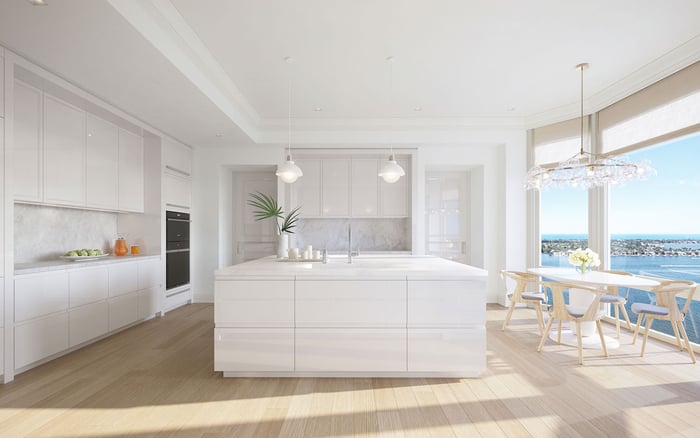
A discreet buyer framework for comparing Shore Club Private Collections Miami Beach and South Flagler House West Palm Beach through pre-construction confidence, deposit discipline, timing, and developer execution in 2026.

For a high-net-worth buyer weighing Shore Club Private Collections Miami Beach against South Flagler House West Palm Beach, the question is not simply which address feels more compelling. The sharper 2026 test is whether the buyer has sufficient confidence in the pre-construction path: the contract, the deposit structure, the delivery narrative, the developer’s record, and the personal use case that makes patience rational.
In South Florida’s ultra-prime market, pre-construction is often framed through renderings, hospitality language, private amenities, and lifestyle cues. Those cues matter, but they are not the underwriting. A sophisticated buyer should treat the purchase as a layered commitment. First comes the emotional pull of place. Then comes the legal and financial shape of the reservation or contract. Finally comes the question that matters most: who is responsible for execution, and how comfortable are you with their ability to carry the promise from sales gallery to closing table?
This is why the 2026 buyer test is less about choosing a winner and more about defining the buyer’s own standard. Shore Club Private Collections Miami Beach speaks to one type of coastal identity. South Flagler House West Palm Beach speaks to another. The right answer depends on whether the buyer wants a Miami Beach posture, a West Palm Beach posture, or a portfolio position that can tolerate the timing and complexity of new construction.
The first decision is geographic, but not superficially so. Miami Beach is an established global luxury shorthand, associated with ocean proximity, design culture, hospitality, privacy demands, and an international owner base. A buyer considering Shore Club Private Collections Miami Beach is likely evaluating the social and lifestyle value of Miami Beach as much as the residence itself.
West Palm Beach offers a different reading of permanence. A buyer looking at South Flagler House West Palm Beach may be responding to a calmer rhythm, a more residential sense of arrival, and the growing conviction that Palm Beach County can hold ultra-prime demand without copying Miami. The appeal is not necessarily louder. It may be more settled, more discreet, and more aligned with family offices, seasonal residents, and buyers who prefer refinement without constant spectacle.
For internal discipline, many buyers will frame the decision as Miami Beach versus West Palm Beach, pre-construction versus completed inventory, and investment versus personal use. Those labels are useful only if they lead to sharper questions. Which location will you actually use? Which market feels most natural to your lifestyle over the next five to seven years? Which setting will make the waiting period feel rational rather than inconvenient?
Deposit structure is where pre-construction enthusiasm becomes real. A beautiful residence can feel compelling in a presentation, but the buyer’s confidence is tested when capital is staged over time. The key is not whether the deposit is large or small in isolation. The key is whether the schedule is understandable, whether it aligns with construction milestones, and whether the buyer is comfortable with the liquidity profile.
A disciplined buyer should review the timing of each deposit, the conditions attached to the contract, the handling of funds, and the remedies available if timelines or obligations change. The review should be unemotional. A deposit is not merely a placeholder. It is a statement that the buyer is willing to tie capital to a future asset before the finished residence can be experienced.
For buyers comparing Shore Club Private Collections Miami Beach and South Flagler House West Palm Beach, the question is not which one sounds more exclusive. The question is which deposit structure feels more defensible after legal review, tax review, and portfolio review. If the buyer would feel strained by the timing of payments, the purchase may not be right, even if the project is beautiful. Ultra-luxury buyers do not need to force conviction. They need to structure it.
Developer track record should sit beside architecture, service, and location as a primary decision factor. In pre-construction, buyers are not buying only a residence. They are buying an execution promise. That promise includes entitlement discipline, construction management, capital coordination, sales integrity, communication standards, and the capacity to resolve problems without making them the buyer’s burden.
A strong developer record does not eliminate risk, but it can make risk more intelligible. Buyers should ask how prior projects were delivered, how communication was handled, whether design intent survived construction, and how the finished product compared with the original promise. The most important questions are often quiet ones: Did buyers feel respected after signing? Were changes explained clearly? Was the closing process orderly? Did the building feel complete, or merely delivered?
This matters for both projects because the ultra-prime buyer is rarely purchasing out of necessity. Optional buyers can afford to wait, switch, or walk away. That gives them leverage, but only if they use it early. The strongest buyers press for clarity before signing, not after uncertainty appears.
In the 2026 market, contract confidence should precede design preference. A buyer may love a floor plan, a view corridor, or a hospitality concept, but those preferences should not obscure the underlying obligations. The contract determines what is promised, what may change, what happens if timing shifts, and how much flexibility the developer retains.
This is especially important in the upper tier, where customization expectations can be high. Buyers should distinguish between what is contractually guaranteed and what belongs to the broader sales narrative. Renderings, mood, and presentation language may be persuasive, but the contract is the operative document.
For a buyer choosing between Miami Beach and West Palm Beach, the contract review should include personal questions as well as legal ones. Will the family use the residence during season, on weekends, for holidays, or as a longer-term base? Is the purchase meant to be held generationally, kept as a second home, or evaluated for future resale? A different use case can lead to a different tolerance for timing, interim uncertainty, and deposit exposure.
Pre-construction buyers often focus on entry. The better question is exit, even when the intention is to hold. A residence that feels irresistible today should still make sense to the next buyer tomorrow. That does not mean purchasing generically. Ultra-prime property is rarely generic. It means thinking carefully about scarcity, privacy, location identity, service quality, and the emotional clarity of the offering.
Shore Club Private Collections Miami Beach may appeal to a buyer who wants the global recognition of Miami Beach and the immediacy of a coastal lifestyle. South Flagler House West Palm Beach may appeal to a buyer who wants a Palm Beach County position with a different social cadence. Neither logic is automatically superior. The correct choice is the one that remains coherent when the market is less forgiving.
A 2026 buyer should ask: if I had to explain this acquisition to my family office in three sentences, would the rationale be clear? If the answer depends only on excitement, pause. If the answer combines location, contract comfort, developer conviction, and personal use, the decision is becoming more durable.
Begin with lifestyle. If Miami Beach is central to how you live, dine, host, travel, and entertain, that should carry real weight. If West Palm Beach feels more aligned with your private life, daily rhythm, and long-term family planning, that should carry equal weight. Luxury is not universal. It is personal fit expressed through rare real estate.
Then move to capital. Review deposit timing, liquidity impact, and opportunity cost. A pre-construction purchase should not require the buyer to become emotionally defensive about the money committed. The schedule should be clear enough that the buyer can remain calm through the development period.
Finally, evaluate execution. The right developer relationship should feel professional before it feels glamorous. Communication should be precise. Answers should be consistent. The buyer should feel that questions are welcomed, not managed. In the best pre-construction purchases, confidence accumulates through details.
The choice between Shore Club Private Collections Miami Beach and South Flagler House West Palm Beach is best understood as a confidence exercise. One may feel more emotionally magnetic. The other may feel more strategically aligned. The winning choice is the one where the buyer can underwrite the lifestyle, accept the deposit structure, respect the contract, and believe in the developer’s ability to execute.
In an ultra-prime market, the smartest buyers do not rush to be persuaded. They build conviction carefully. They compare not only residences, but obligations. They evaluate not only design, but delivery. They treat pre-construction as both opportunity and discipline.
Which project is better for a 2026 buyer? The better choice depends on lifestyle fit, contract comfort, deposit timing, and confidence in execution rather than a simple market preference.
Is Miami Beach automatically more liquid than West Palm Beach? Not automatically. Liquidity depends on the specific residence, pricing, scarcity, condition at delivery, and buyer demand at the time of resale.
Why does deposit structure matter so much in pre-construction? Deposit structure determines how much capital is committed before completion and how comfortable the buyer must be with timing and execution risk.
Should a buyer choose based on amenities? Amenities matter, but they should come after contract review, location fit, developer confidence, and the buyer’s real pattern of use.
What should buyers ask before signing? Buyers should ask what is guaranteed, what can change, how deposits are handled, and how the developer communicates through construction.
Is developer track record more important than branding? For pre-construction, developer execution is often more important because it affects delivery, communication, quality control, and closing confidence.
Can pre-construction work for a second-home buyer? Yes, if the buyer is comfortable with the timeline, has clear intended use, and can tolerate capital being committed before completion.
How should investors evaluate these projects? Investors should focus on basis, scarcity, future buyer depth, carrying costs, contract terms, and the realism of the exit strategy.
Should buyers wait for resale instead? Resale may suit buyers who need certainty and immediate use, while pre-construction may suit buyers seeking choice, freshness, and a future position.
What is the most important 2026 takeaway? The strongest purchase is not the most persuasive presentation; it is the one that remains defensible after legal, financial, and lifestyle review.
For a tailored shortlist and next-step guidance, connect with MILLION.
If branded residences are on your mind — as a home or as an allocation — we would be glad to share what we are seeing, privately.
Begin a quiet conversation