In Coconut Grove, lifestyle can hinge on scale. OPUS Coconut Grove is planned as a six-story boutique with just 14 residences, positioned for buyers who value privacy, fewer neighbors, and a highly curated amenity mix. Park Grove Coconut Grove, by contrast, is a three-tower bayfront community with 276 residences across a multi-acre garden setting, designed for those who want a larger, resort-like environment and the social cadence that comes with it. This MILLION Luxury comparison focuses on what is verifiable: building scale, design teams, residence sizing, amenity positioning, and buyer mechanics such as pricing guidance and deposits where publicly marketed. The result is a practical decision framework for primary residents and second-home owners weighing boutique discretion against a fuller-service campus on South Bayshore Drive.

Coconut Grove has matured into a neighborhood where two distinct expressions of luxury can coexist within minutes of each other: the hush of a boutique address and the rhythm of a larger bayfront community. For many buyers, the most consequential choice isn’t the finish level or the view line-it’s how many neighbors you’ll share elevators, lounges, and pool decks with.
OPUS Coconut Grove is planned as a six-story boutique building with just 14 residences. Park Grove Coconut Grove is a three-tower luxury condo development on South Bayshore Drive, totaling 276 residences across One Park Grove, Two Park Grove, and the Club Residences. Both pursue a high-design, high-comfort buyer; the lifestyle diverges quickly once you account for density, amenity cadence, and the social temperature you want at home.
OPUS Coconut Grove is positioned as an intentionally limited collection: a six-story building with 14 residences, described in marketing as 12 residences plus 2 penthouses. That scale shifts the day-to-day experience-from how quiet the lobby feels to how often you cross paths with neighbors. A building this small often appeals to buyers who want discretion, a clean routine, and the ease that comes with fewer variables.
The design team is part of the story. Architecture is by Kobi Karp, with interiors by João Armentano. Inside the residences, marketing emphasizes 12-foot ceilings and floor-to-ceiling windows-an approach that prioritizes light, volume, and expansive wall space. Layouts are described as 3 to 4 bedrooms, with sizes publicly marketed at roughly 1,905 to 3,884 square feet.
Specifications, as marketed, lean contemporary and international: Italian cabinetry and a suite of Miele and Sub-Zero appliances. For an end user, this reads less like a checklist and more like a promise-the kitchen is intended to feel quietly capable rather than performative.
Amenities follow the same boutique logic. The program is marketed with a rooftop pool and rooftop fitness center, plus a spa concept that includes sauna, steam, and massage rooms. A business lounge, children’s playroom, concierge, valet, and security round out a set designed to cover real life without turning the building into an internal “destination” for hundreds of residents.
From a buyer-mechanics standpoint, pricing is marketed from the mid-$2M range. Deposit terms are also clearly published: 20% at contract, 10% at groundbreaking, 10% at top-off, and 60% at closing. For some buyers, that schedule isn’t just financial-it’s psychological, allowing liquidity events and planning to align to a defined cadence.
For additional perspective on boutique Grove living and how it fits into the broader new-construction landscape, buyers often compare adjacent concepts such as Arbor Coconut Grove and Mr. C Tigertail Coconut Grove, which each interpret “Grove luxury” through a slightly different lens.
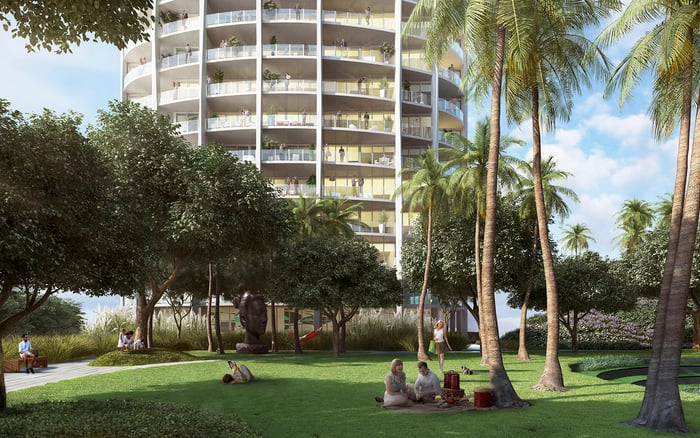
Park Grove Coconut Grove is the opposite of intimate-by design. It is a three-tower development on South Bayshore Drive, commonly associated with addresses 2811, 2821, and 2831 S Bayshore Dr, Miami, FL 33133. Across the three towers, the total unit count is described as 276. One Park Grove alone is described as a 66-unit tower.
The architectural signature is global: OMA / Rem Koolhaas is credited as architect. Landscape is a defining feature, credited to Enzo Enea and described as a multi-acre (5-acre) garden concept. Interiors, including kitchens and baths, are credited to William Sofield.
This combination of architecture, landscape, and interiors tends to appeal to a buyer who wants more than a condominium. Here, the grounds and amenity moments are central to the identity-and the social possibilities expand as the resident count increases.
Park Grove marketing emphasizes bayfront living and expansive Biscayne Bay views from the towers along South Bayshore Drive. The day-to-day implication is straightforward: arrivals feel like entering a larger domain, and the amenity environment is naturally more active. The “Club Residences” positioning reinforces a members-style atmosphere, a cue many owners value not only for service, but for a sense of place.
In Coconut Grove, that matters because the neighborhood’s lifestyle toggles between serenity and sociability depending on your radius. A walkable retail core centered on CocoWalk can bring energy to an otherwise residential day. Park Grove’s scale can echo that energy internally; OPUS’s scale tends to buffer it.
Buyers shopping OPUS Coconut Grove and Park Grove Coconut Grove are often choosing between two right answers.
With 14 residences, OPUS is designed to feel like a private address, where the building stays in the background. With 276 residences across three towers, Park Grove functions more like a community, where shared spaces-and shared rhythms-are part of the proposition.
If you travel frequently, a boutique building can feel simpler: fewer faces, fewer moving parts, and the sense that your home is waiting quietly. If you’re in residence more often, a larger environment can feel more complete, with more reasons to use amenities and linger.
OPUS leans into rooftop living: a rooftop pool and rooftop fitness center, supported by spa elements such as sauna, steam, and massage rooms. It’s a modern, vertical interpretation of wellness.
Park Grove is defined by its landscape and campus feel. The 5-acre garden concept isn’t an amenity add-on-it’s part of the architecture of daily life. If your version of luxury includes an extended stroll through a designed garden before dinner, Park Grove is likely to read as more complete.
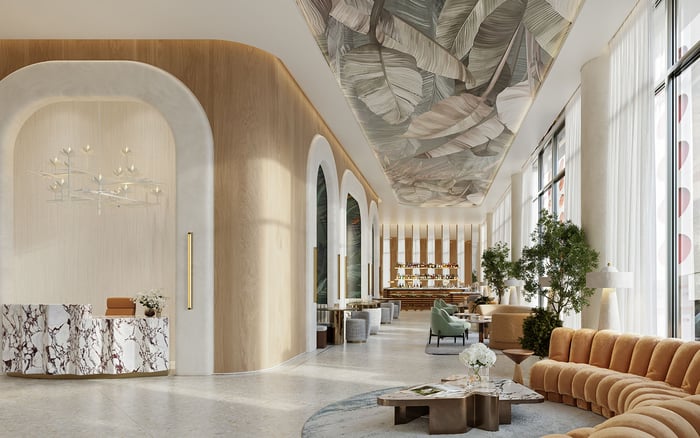
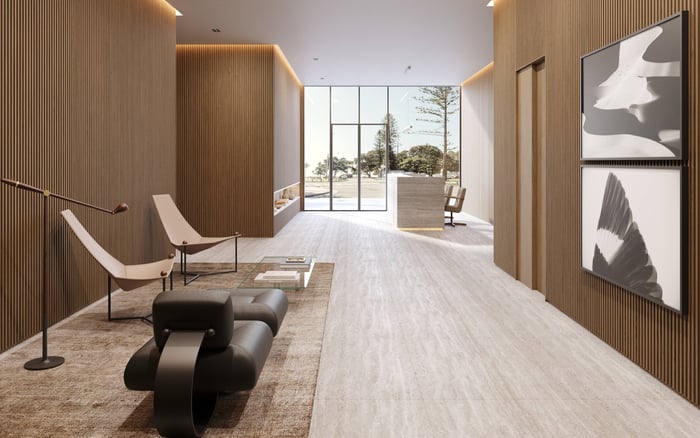
OPUS’s combination of Kobi Karp architecture and João Armentano interiors signals tailored residential warmth with contemporary clarity. The published emphasis on 12-foot ceilings and floor-to-ceiling windows reinforces a preference for volume and light.
Park Grove’s OMA authorship reads more overtly architectural, with a strong identity that can matter to design-forward buyers. William Sofield’s interior credits point to a refined, controlled palette, while the Enzo Enea landscape frames the project as a designed environment rather than a single building.
OPUS’s marketed entry pricing from the mid-$2M range and its published deposit structure (20% at contract, then 10% at groundbreaking, 10% at top-off, and 60% at closing) may suit buyers who want clarity on timing.
Park Grove, as a larger established community, often fits buyers who prioritize the lived experience: how the grounds feel, how the amenity flow works, and how a bayfront address on South Bayshore integrates into their schedule.
To see how other South Florida buyers weigh boutique discretion versus an amenity campus, it can be instructive to look beyond Coconut Grove. For example, the more resort-forward beachfront proposition at 2000 Ocean Hallandale Beach often attracts a different cadence of living, while more skyline-urban options like 2200 Brickell emphasize a city-forward daily routine.
OPUS is most compelling for buyers who want:
If your ideal luxury is coming and going unnoticed-and you value a controlled environment more than a social scene-OPUS Coconut Grove can align exceptionally well.
Park Grove is most compelling for buyers who want:
If you like the idea that your building is also your setting-and you enjoy a more activated residential ecosystem-Park Grove Coconut Grove is the clearer fit.
If you’re evaluating both, structure your tours around moments rather than rooms.
Start with arrival. Do you want a lobby that feels like a private threshold, or a lobby that feels like the front door to a broader campus? Then test vertical circulation: in a 14-residence building, elevators tend to feel calmer by nature. In a larger property, pay attention to flow at peak times.
Finally, spend time with the amenity concept. OPUS’s rooftop pool and rooftop fitness center concentrate your “third space” above the city. Park Grove’s multi-acre landscape disperses it, which can feel more resort-like and more alive.
Is OPUS Coconut Grove a boutique building? Yes. It is planned as a six-story boutique with just 14 residences.
How many residences are planned at OPUS? The unit mix is described as 12 residences plus 2 penthouses, totaling 14.
What are the published residence sizes at OPUS? Residences are marketed at roughly 1,905 to 3,884 square feet with 3 to 4 bedrooms.
What interior features are emphasized at OPUS? Marketing highlights include 12-foot ceilings and floor-to-ceiling windows.
What appliances are marketed for OPUS residences? The published specs include Miele and Sub-Zero appliances alongside Italian cabinetry.
What amenities are marketed at OPUS? A rooftop pool and rooftop fitness center are featured, along with a spa concept.
What is Park Grove Coconut Grove’s overall scale? It is a three-tower community on South Bayshore Drive with 276 total units.
Who designed Park Grove’s architecture and interiors? The architect is OMA / Rem Koolhaas, and interiors are credited to William Sofield.
What makes Park Grove’s setting distinctive? The landscape is credited to Enzo Enea and described as a multi-acre (5-acre) garden concept.
What neighborhood context should buyers consider in Coconut Grove? The walkable retail core is centered on CocoWalk, which can shape day-to-day energy.
To compare the best-fit options with clarity, connect with MILLION Luxury.
If branded residences are on your mind — as a home or as an allocation — we would be glad to share what we are seeing, privately.
Begin a quiet conversation