A buyer-oriented comparison of three Coconut Grove condo options through a single lens: views. This editorial ranks Arbor, OPUS Coconut Grove, and Park Grove by how their siting, height, and architecture shape daily outlooks, from canopy-forward village scenes to true bayfront panoramas.
Coconut Grove has the rare ability to read as two neighborhoods at once. One is the bayfront: bright, expansive, and horizon-led. The other is the village: shaded, intimate, and layered with mature trees and low-rise streetscapes. In luxury real estate, “views” can mean either world-but the decision gets far clearer when you separate marketing poetry from the physics of location.
A view is ultimately a product of siting (bayfront versus inland), height (a handful of floors versus a true tower), and architecture (how many corners, how much glass, and how outdoor space is positioned). With that framework, three projects capture the Grove’s primary view archetypes: Arbor in the village, OPUS Coconut Grove as an ultra-boutique mid-rise with selectively marketed bayward sightlines, and Park Grove as the area’s most direct answer to “I want Biscayne Bay outside my windows.”
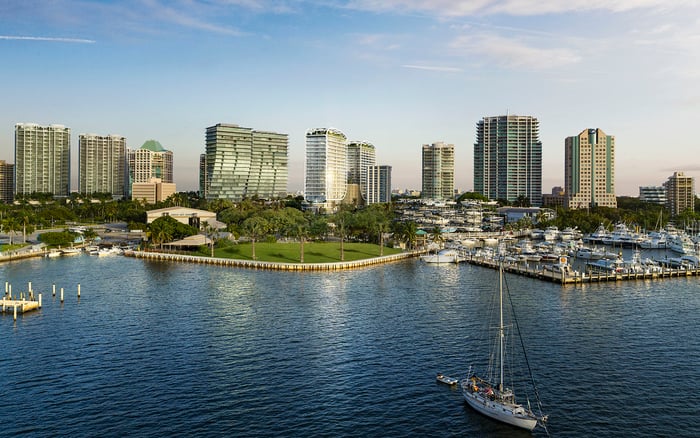
1. Park Grove - true bayfront placement on South Bayshore Drive Park Grove holds the most dependable advantage in any view conversation because it sits directly on Biscayne Bay along South Bayshore Drive. That waterfront position typically delivers immediate water presence across more directions-and at more elevations-than inland addresses can.
The architecture adds a second edge. The towers are widely described as “peanut-shaped,” a figure-eight concept intended to increase façade perimeter. In practical terms, that geometry can create more edge conditions, more corner moments, and more opportunities for terraces to turn toward water, skyline, and Grove canopy-rather than locking into a single flat exposure.
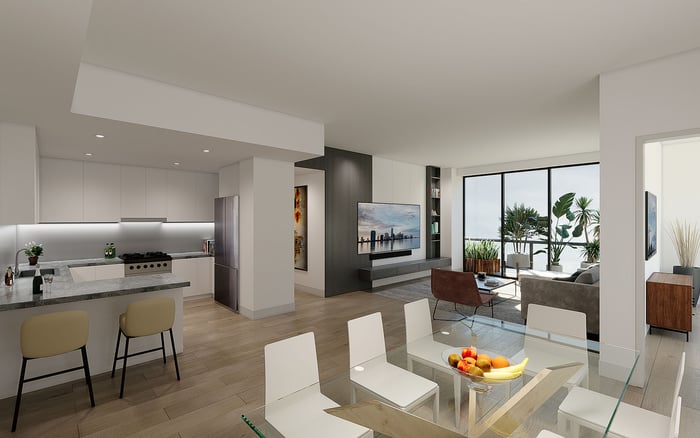
2. OPUS Coconut Grove - selective bayward corridors, amplified by volume OPUS Coconut Grove is a six-story, 14-residence property that approaches “views” with a boutique sensibility: fewer homes, more intention per residence. It is marketed with 12-foot ceilings and floor-to-ceiling windows-a combination that can materially change how far the eye travels and how daylight moves through the interior.
OPUS is also marketed as offering views toward Biscayne Bay and Key Biscayne, though outcomes are inherently unit-specific in an inland Grove location. The buyer translation is simple: choose OPUS when you value architectural volume and glass-forward living-and you’re prepared to shop the line, floor, and orientation to secure a true bayward corridor.
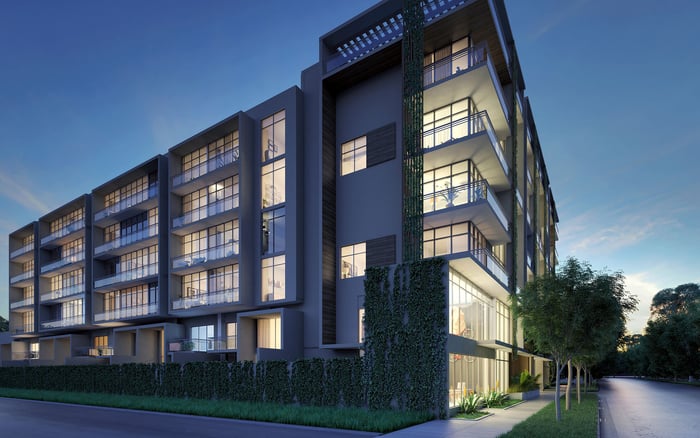
3. Arbor - a village-core outlook defined by trees and neighborhood texture Arbor is a five-story, 45-residence boutique condominium at 3034 Oak Avenue in Coconut Grove. It sits inland in the Village of Coconut Grove-and that’s the point. Views here are more likely to be framed by tree canopy and the neighborhood’s residential character than by direct Biscayne Bay frontage.
Residences are designed with floor-to-ceiling, impact-resistant glass, emphasizing natural light and a visually open perimeter. For many buyers, this is the most authentic Grove view: a quieter, greener outlook that trades horizon drama for privacy and daily calm.
In Coconut Grove, the fastest way to evaluate view potential is to start with two questions.
First: is the building bayfront or inland? Bayfront siting tends to produce more consistent water exposure across more stacks and elevations. Inland siting can still deliver water glimpses or directional corridors, but those outcomes are far more dependent on floor level and the exact unit line.
Second: how much vertical gain do you need? A six-story boutique can feel luminous and open, but it rarely competes with a taller waterfront community for horizon breadth. If “views” means a wide, uninterrupted waterline, height and bayfront placement typically win. If “views” means layered greenery, rooftops, and the sensation of living inside the Grove’s canopy, village-core buildings can feel more personal and grounded.
Architecture is the third lever. A sculpted plan that creates corners can widen view variety, while floor-to-ceiling glazing can increase perceived width and depth-even when the scene is closer and more neighborhood-scaled.
Buyers who treat views as a daily ritual tend to prefer bayfront siting because it minimizes uncertainty. Park Grove, a three-tower waterfront community with 276 residences, is positioned to do exactly that. Even before you compare floorplans or finishes, the location alongside Biscayne Bay frames the experience: morning light off the water, late-day color across the horizon, and an openness inland streets simply cannot replicate.
The towers’ OMA design, with its figure-eight “peanut” form, isn’t an abstract flourish-it’s a view strategy. More perimeter can mean more angles and more nuanced exposure, giving certain residences the ability to hold multiple scenes at once: bay, skyline, and greenery. For buyers who want a view that never feels static, that sculptural approach matters.
For readers exploring the broader bayfront conversation in the Grove, Park Grove Coconut Grove is the reference point because it embodies the area’s most direct relationship to the water.
OPUS Coconut Grove lands in a different emotional register. With only 14 residences across six stories, it delivers a level of discreteness larger communities can’t replicate. The defining view feature is the pairing of 12-foot ceilings with floor-to-ceiling windows. In practice, that can make even an inland outlook feel elevated, because the window wall reads as a true architectural surface-not a standard opening.
OPUS is designed by Kobi Karp, with interiors by João Armentano, and its view proposition is best understood as “selective.” The building is marketed as having views toward Biscayne Bay and Key Biscayne, but the buyer’s task is to translate that promise into a specific orientation and elevation that matches expectations.
For view-driven purchasers, OPUS can be compelling when the goal isn’t only what you see, but how you see it. Tall ceiling volume can make the horizon feel closer, and a glass-first perimeter can turn city lights or canopy texture into atmosphere-not just backdrop.
For those comparing boutique new-construction options in the neighborhood, Opus Coconut Grove is a natural benchmark for “ultra-limited inventory, high-design volume.”
Arbor’s advantage is clarity. It sits in the Village of Coconut Grove, inland rather than directly bayfront, and it performs accordingly. You’re buying the Grove as a lived neighborhood: filtered sunlight through mature trees, a more intimate street relationship, and a calmer visual field than an open-water panorama.
With 45 residences across five stories, Arbor stays in a boutique scale that often appeals to buyers seeking privacy and a residential cadence. Floor-to-ceiling, impact-resistant glass is central to the concept, bringing in natural light and framing the neighborhood-facing outlook as something intentional-not secondary.
If your personal definition of “best view” includes greenery, distance from the bayfront traffic rhythm, and a sense of being tucked into the Grove’s texture, Arbor can be the most satisfying choice of the three.
For readers evaluating village-core living, Arbor Coconut Grove represents the canopy-forward lifestyle that makes Coconut Grove unlike anywhere else in Miami.
If you tour these three projects back-to-back, the mistake is chasing a single universal “best.” The smarter move is to match view type to how you actually live.
Choose Park Grove if the view is non-negotiable and you want bayfront placement to do the heavy lifting. The building’s relationship to water is the defining feature, and the sculpted tower form supports variety in exposure.
Choose OPUS if you want a quiet, ultra-boutique environment and you care about interior volume as much as the scenery. Here, a view may be a corridor rather than a full panorama, but the experience can feel more curated because the glass and ceiling height do so much work.
Choose Arbor if you want a residential, village-core outlook where canopy becomes the luxury. These views can feel emotionally restorative, especially for buyers who spend their days in higher-intensity environments.
As a counterpoint, some buyers cross-shop the Grove’s village and bayfront lifestyles with other branded, design-forward options in the area. In that broader Coconut Grove set, Mr. C Tigertail Coconut Grove is often considered by buyers who want a distinct aesthetic identity paired with the Grove’s walkable energy.
Which building is most likely to deliver direct Biscayne Bay views? Park Grove, because it is directly bayfront, tends to provide more consistent water exposure.
Are OPUS bay views guaranteed? No. OPUS is inland, so bayward views depend on the specific residence’s floor and orientation.
Is Arbor a bayfront condominium? No. Arbor is in the Village of Coconut Grove and is positioned inland rather than on the bay.
Which project is the most boutique by residence count? OPUS Coconut Grove, with 14 residences, is the smallest of the three.
Which project has the largest overall community feel? Park Grove, with 276 residences across three towers, reads as a larger multi-building community.
What architectural feature at Park Grove supports more varied exposures? The towers use a figure-eight “peanut” plan that increases perimeter and corner conditions.
What is a signature “view feature” at OPUS? The combination of 12-foot ceilings and floor-to-ceiling windows is central to its view experience.
What kind of views should Arbor buyers expect? Arbor tends to emphasize canopy and neighborhood outlooks rather than direct open-water frontage.
Which projects emphasize floor-to-ceiling glass? Both Arbor and OPUS are marketed with floor-to-ceiling windows designed to maximize light.
How should a buyer verify view quality before committing? Prioritize the exact line, floor, and direction of the residence, since outcomes are unit-specific.
For a tailored shortlist and next-step guidance, connect with MILLION Luxury.
If branded residences are on your mind — as a home or as an allocation — we would be glad to share what we are seeing, privately.
Begin a quiet conversation