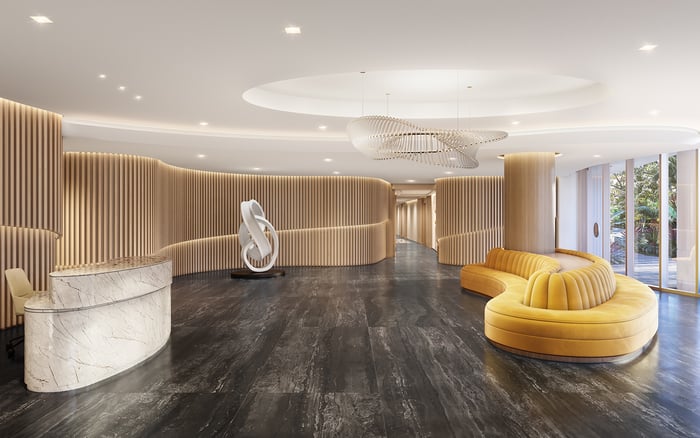
A discreet buyer’s framework for comparing two West Palm Beach branded residences through acoustic comfort, technology infrastructure, and private work-from-home usability rather than brand prestige alone.

For a certain West Palm Beach buyer, the most important room in a new residence may no longer be the primary suite, the kitchen, or the terrace. It may be the quiet room where a board call can proceed without interruption, where a video conference does not freeze, and where confidential work does not carry acoustically into the living area.
That is the more useful lens for comparing Mr. C Residences West Palm Beach and The Ritz-Carlton Residences® West Palm Beach. Both belong to the branded-residence universe, but the decision should not begin with hospitality mythology. It should begin with building performance.
The strongest comparison is practical: which building can demonstrate better acoustic control, more resilient digital infrastructure, and more convincing work-from-home privacy? Until detailed technical documents are reviewed, the answer should be treated as a disciplined due-diligence exercise rather than a declaration of superiority.
For buyers tracking West Palm Beach and Palm Beach opportunities, this is especially relevant in the new-construction and pre-construction segment, where presentation galleries can be polished long before every technical specification is fully understood.
Luxury sales language often leans on atmosphere: serene, private, calm, retreat-like. Those words have value, but they are not a substitute for acoustic documentation. A buyer comparing Mr. C Residences West Palm Beach with The Ritz-Carlton Residences® West Palm Beach should ask for the same information from both teams and judge the answers by the same standard.
The first category is façade performance. In an urban coastal setting, exterior sound can come from road exposure, waterfront activity, nearby urban movement, and aviation-related noise where relevant. The façade, windows, balcony doors, seals, and glazing specifications become part of the owner’s daily experience. A residence can have beautiful views and still require careful acoustic engineering to feel composed.
The second category is vertical and horizontal isolation. Serious buyers should request STC ratings, IIC ratings, floor-assembly data, ceiling details, and any available information about demising walls. STC relates broadly to airborne sound, while IIC relates to impact sound. Neither number should be treated casually. A high-design interior can feel compromised if footsteps, furniture movement, or voices transfer too easily from adjacent or overhead spaces.
For Mr. C Residences West Palm Beach, proper diligence should extend beyond finishes, views, or service culture. It should include façade acoustics, floor and ceiling isolation, glazing specifications, and the infrastructure that supports daily remote work. For The Ritz-Carlton Residences® West Palm Beach, the same lens should apply: acoustic isolation, privacy, network reliability, and genuinely usable work zones.
In the ultra-premium market, technology is often discussed after materials and amenities, yet it may matter more to a finance, legal, technology, or family-office buyer than a dramatic lobby. Remote work depends on systems that are rarely visible during a tour.
The essential questions are straightforward. What internet provider options are expected or available? Is there meaningful network redundancy? How is in-unit wiring planned? How will Wi-Fi coverage be handled across larger floor plans, terraces, enclosed rooms, and den areas? Can the building support high-bandwidth video conferencing without requiring residents to improvise their own solutions after closing?
A buyer should also ask how mechanical, electrical, and low-voltage planning will interact with furniture placement. A so-called office nook may be elegant in a rendering but inadequate if data access, power placement, lighting, and background privacy do not support actual executive work. The best remote-work residence feels effortless because the infrastructure was anticipated before move-in.
The comparison between these two projects should therefore reward clarity. If one building team can provide stronger answers about wiring pathways, provider choice, redundancy planning, and in-residence connectivity, that may matter more than a better-known brand name. At this level, digital resilience is not a convenience. It is part of the asset.
Remote-work privacy is not only about soundproofing. It is also about whether a floor plan allows different parts of life to happen at once. A buyer hosting guests, managing children, taking confidential calls, and entertaining in the evening needs real separation between public and private zones.
The most convincing layouts provide a dedicated office, den, or flexible room that is not simply a leftover corner. The work zone should be removed from the main entertaining path, buffered from the kitchen and living room, and capable of supporting a door that closes. If confidential calls are routine, buyers should pay close attention to sound bleed into corridors, bedrooms, and shared living spaces.
A large residence does not automatically solve this problem. Square footage can be distributed beautifully and still fail the executive-use test if every room opens toward the social core. Conversely, a more compact plan can function exceptionally well if it creates acoustic separation, visual privacy, and a professional background for calls.
Amenity workspaces should be evaluated carefully. Shared lounges, libraries, and business rooms can be useful, but they should not be assumed to replace a private office unless they are genuinely quiet, bookable, secure, and designed for confidential use. For many buyers, a building amenity is supplemental. The primary office still has to work inside the residence.
The fairest way to compare Mr. C Residences West Palm Beach and The Ritz-Carlton Residences® West Palm Beach is to build a scorecard before falling in love with either presentation. The scorecard should separate emotional appeal from measurable suitability.
Start with the acoustic package. Ask each sales team for any available documentation regarding glazing, façade assemblies, STC ratings, IIC ratings, floor assemblies, and partition construction. If the information is not yet publicly detailed, the buyer can still ask when it will be available and whether a technical consultant can review it before key contractual milestones.
Then review the technology package. The questions should include internet options, redundancy, low-voltage wiring, Wi-Fi design, in-unit equipment locations, support for high-bandwidth calls, and the ability to accommodate future upgrades. A buyer who works from home several days a week should treat these items as core residential infrastructure.
Finally, test the floor plan against real life. Where does the first call of the day happen? Where does a spouse or guest pass during that call? Can a private meeting occur while someone else uses the kitchen or terrace? Is there a quiet background for video? Can files, monitors, and equipment be concealed when entertaining resumes?
This process does not diminish the value of branding. It simply puts branding in its proper place. Service, design identity, and hospitality culture matter, but they should not obscure the practical performance of the residence itself.
An internationally mobile buyer who spends only portions of the year in West Palm Beach may prioritize turnkey service and lifestyle ease, but even that buyer should not ignore acoustics and connectivity. A second home that cannot support a secure video call is less flexible than it appears.
A full-time resident or principal who works from home regularly should be more demanding. For that buyer, the strongest residence is the one that supports concentration, privacy, and digital consistency on ordinary weekdays, not just the one that impresses during a showing.
A family buyer should study circulation and sound separation with equal care. The issue is not only whether the owner can work privately, but whether school calls, staff movement, guests, and entertainment can coexist without constant friction.
An investor or future resale-minded buyer should also understand this shift. As remote and hybrid work become embedded in luxury living patterns, acoustic comfort and technology infrastructure may increasingly influence desirability. Buyers may remember the brand, but they live with the walls, windows, wiring, and plan.
Before choosing between the two projects, a buyer should request the most specific information available and avoid relying on generalized promises. The questions should include: what acoustic ratings are available, what glazing details can be reviewed, what floor and ceiling assemblies are planned, what exterior noise conditions have been considered, what internet and wiring infrastructure is anticipated, and how the floor plan supports confidential work.
The strongest answer may not be the most glamorous one. It may be the clearest, most documented, and most technically reassuring. In that sense, the right residence is the one that can make luxury feel quiet, connected, and private when the laptop opens.
Is this comparison about which brand is more prestigious? No. The more useful comparison is which residence can prove stronger acoustic comfort, technology infrastructure, and remote-work privacy.
What should buyers ask about acoustic comfort first? Ask for STC ratings, IIC ratings, glazing details, façade information, and floor or ceiling assembly data where available.
Why are glazing specifications important? Glazing helps shape how exterior sound is controlled, especially in settings with road, waterfront, urban, or aviation-related noise.
Can shared amenity workspaces replace a private office? Only if they are quiet, secure, bookable, and suitable for confidential calls. Many buyers will still need a private in-residence office.
What technology questions matter most for remote work? Buyers should ask about provider options, redundancy, in-unit wiring, Wi-Fi planning, and support for high-bandwidth video conferencing.
Should buyers rely on renderings to judge work-from-home suitability? No. Renderings can show atmosphere, but floor-plan separation, wiring, acoustics, and privacy determine daily usability.
Does a larger residence automatically mean better privacy? Not necessarily. A smaller plan with a well-separated office can outperform a larger plan where every room connects to the social core.
Why is pre-construction diligence different? Public technical details can be limited before completion, so buyers should frame decisions around specific questions and document review.
What is the ideal remote-work layout feature? A dedicated room or den with a closable door, good connectivity, appropriate power access, and separation from entertaining areas.
What is the best way to choose between these two residences? Compare the evidence each project can provide on acoustics, technology, and privacy, then weigh the brand experience after performance.
For a tailored shortlist and next-step guidance, connect with MILLION.
If branded residences are on your mind — as a home or as an allocation — we would be glad to share what we are seeing, privately.
Begin a quiet conversation