South Florida’s $10M-plus segment stayed historically active in 2025, even as headline medians softened and condo supply tilted negotiating power toward buyers. With cash still a defining feature, and foreign capital heavily concentrated in Miami-Dade, the region’s luxury playbook is evolving: less impulse, more due diligence, and sharper differentiation between trophy scarcity and commoditized inventory.
At the same time, monthly results pointed to a more familiar cadence returning to everyday transactions. In December 2025, Miami-Dade recorded 1,869 total home sales, up 5.9% year over year, while single-family transactions rose to 860-marking the fourth consecutive monthly increase. Broward posted 2,036 total home sales in the same month, up 7.9% year over year, with single-family sales up 10.63% to 1,051. The pace improved, but buyer behavior sharpened: fewer assumptions, tighter underwriting, and more selective decision-making.
The planning thesis for 2026 is clear. South Florida luxury is no longer a simple “up and to the right” narrative. It is a two-track market-trophy assets trading on rarity and privacy, while certain condo segments trade on supply, terms, and a buyer’s willingness to wait.
The $1 million-plus tier is the cleanest bridge between affluent move-up demand and the rarefied $10M-plus segment. In December 2025, Miami-Dade single-family $1M-plus sales rose 12% year over year to 233, while $1M-plus condo sales increased 2.45% to 167. Broward leaned even more heavily toward single-family: $1M-plus single-family sales rose 16% to 180, while $1M-plus condo sales were flat at 39.
For luxury buyers, that split matters because it signals where aspirational demand is most forceful. Miami-Dade remains a global condo destination, yet at the $1M-plus level, single-family is accelerating more than many anticipate. Broward-supported by comparatively lower median pricing-shows an even clearer tilt toward higher-end single-family activity, a practical cue for buyers who prioritize land, privacy, and lifestyle flexibility.
In practical terms, sustained $1M-plus single-family momentum also supports a deep ecosystem of contractors, architects, and design talent-an underappreciated advantage for buyers renovating legacy properties or tailoring a residence for long-term use.
In December 2025, Miami-Dade’s median single-family price was $660,000, down 2.22% year over year, and the median condo price was $420,000, down 2.33%. Broward’s median single-family price was $614,500, down 0.89%, while the median condo price was $257,000, down 9.27%.
Those declines matter-especially for buyers negotiating in segments where choice is plentiful. But a longer lens reframes the conversation. Over the decade from December 2015 to December 2025, Miami-Dade condo prices rose 102%, and Broward condo prices rose 95%. Broward single-family prices rose 103% over the same period, from $302,250 to $614,500.
For sophisticated households, the takeaway isn’t simply that “prices fell.” It’s that South Florida luxury is shifting from a frothy, speed-driven market to a more fundamentals-driven one. That environment rewards buyers who underwrite a residence as a long-lived asset-livability, resiliency planning, carrying costs, and the ability to hold through cycles.
Negotiating leverage in South Florida is highly dependent on property type. As of December 2025, Miami-Dade single-family inventory stood at 5,251 active listings, up 12.1% year over year and still 17.3% below December 2019. Condo inventory was 12,015 active listings, up 6.7% year over year and about 18% below December 2019.
The more actionable metric is months of supply. Miami-Dade single-family sat at 6.2 months-near balanced-while condos reached 13.2 months, a decisively buyer-favorable condition. That divergence explains why certain condo buyers can negotiate more confidently on price, concessions, and timing, while high-quality single-family offerings still command urgency when they pair location, condition, and privacy.
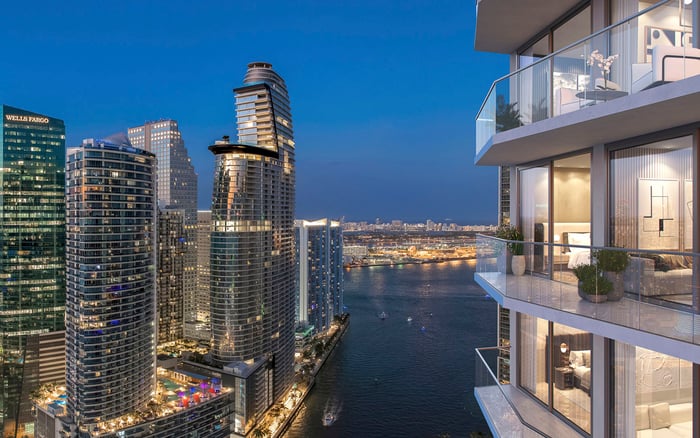
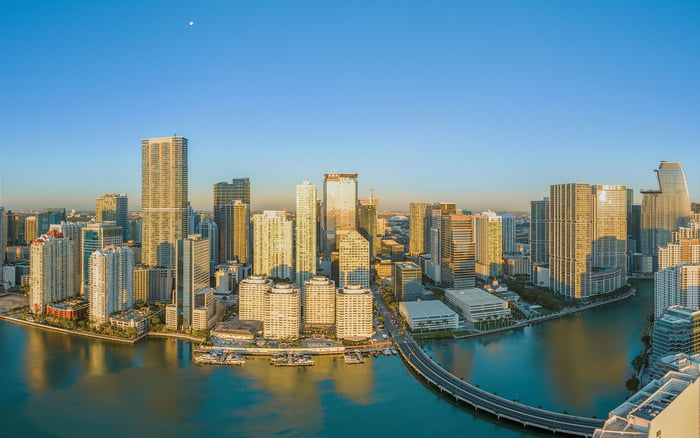
In this context, new luxury towers function as curated alternatives to the broader resale stack. A buyer seeking a modern, service-forward lifestyle in Brickell may weigh resale options against 2200 Brickell or brand-driven vertical living such as 888 Brickell by Dolce & Gabbana-evaluating not only finish levels, but also the long-term signaling value of the address.
South Florida luxury remains unusually cash-intensive. In Miami-Dade, cash sales represented 40% of all closings in December 2025, and condo cash sales reached 50.5%. In Broward, cash sales were 37.2% of all closings as of October 2025.
Here, cash is more than a financing preference. It’s a negotiating instrument-one that compresses timelines and reduces appraisal friction, particularly for unique residences where comparables can be thin. For sellers of premium properties, the strongest offer is often the one with the fewest moving parts.
For buyers who prefer leverage, the play is to compete on certainty: substantial deposits, clean contract terms, and a due-diligence calendar that respects the seller’s timeline. In a market where many counterparties can close without a loan, execution becomes its own currency.
In 2025, Miami-Dade drew $3.2 billion in foreign-buyer residential purchases, representing about 73% of South Florida’s international-buyer dollar volume. Broward captured $785 million, and Palm Beach $123 million. The top origin countries by share for South Florida foreign buyers were Colombia (15%) and Argentina (12%), followed by Mexico (7%) and Brazil (7%).
Foreign buyers in South Florida also purchased condos at a notably higher rate, with condos accounting for 51% of purchases-well above the U.S. foreign-buyer condo share of 15%. That dynamic helps explain why Miami’s premium condo market retains global depth even as domestic affordability constraints shift.
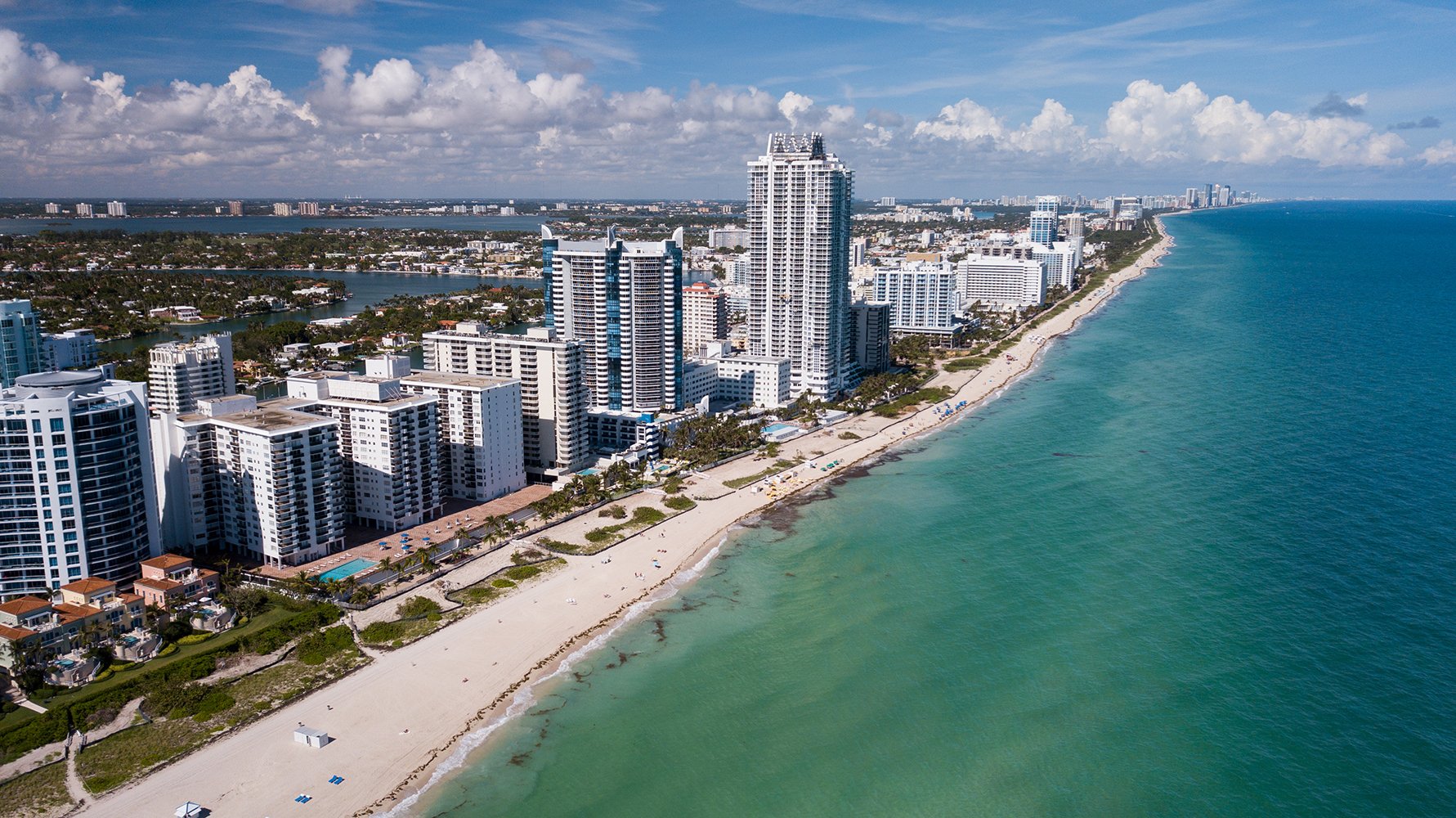
When this capital concentrates around lifestyle districts, it reinforces the premium attached to frictionless living: walkability, service culture, and the ability to arrive and use a residence immediately. In Miami Beach, that preference can translate into newer, architecturally distinct inventory such as 57 Ocean Miami Beach, where the product is built for low-maintenance ownership.
Some addresses trade less like real estate and more like membership. Indian Creek Island is often described as a roughly 300-acre private island with 41 homes and its own police force-a level of controlled scarcity that is effectively impossible to replicate.
This is where the $10M-plus segment draws its most durable pricing power: limited supply, limited turnover, and a buyer pool that values privacy over optionality. Even when broader condo supply turns buyer-favorable, these enclaves can remain tight because their inventory is structurally constrained.
For buyers operating at the top tier, the diligence lens shifts from “is this priced correctly?” to “will I ever have another chance at this specific combination of security, frontage, and discretion?”
For many high-net-worth households, the most meaningful financial lever isn’t a negotiated discount-it’s aligning the property with the right residency strategy.
Florida’s homestead exemption can reduce a primary residence’s taxable assessed value by up to $50,000. Florida also provides strong homestead creditor protections for qualifying primary residences. Neither point replaces professional advice, but both influence the long-term calculus for buyers deciding whether South Florida is a seasonal base or their center of gravity.
This is also where luxury buyers often separate into two profiles. The first prioritizes a “forever” residence and values stability in carrying costs and planning. The second prioritizes flexibility and may choose a condo with a lock-and-leave posture-accepting more market sensitivity in exchange for lifestyle simplicity.
The most accurate way to read South Florida in 2026 is neighborhood-by-neighborhood, with property type as the second filter.
In Fort Lauderdale, buyers seeking a service-rich, design-forward condominium experience often gravitate toward newer branded or heavily amenitized offerings such as Four Seasons Hotel & Private Residences Fort Lauderdale, particularly as standards rise around building quality and ongoing operations.
In Hallandale, ultra-luxury buyers who want a more private oceanfront posture may compare traditional Miami Beach options against newer inventory like 2000 Ocean Hallandale Beach, where the appeal is often a quieter daily rhythm without leaving the South Florida ecosystem.
Across Miami-Dade and Broward, the meta-trend is discernment. Buyers aren’t simply buying “South Florida.” They’re buying a precise blend of liquidity, privacy, and lifestyle-and they are increasingly willing to wait for the right combination.
How active was the $10M+ market in South Florida in 2025? There were 361 closed sales of $10M-plus properties in 2025, the second-highest annual total on record.
Did overall sales improve at the end of 2025 in Miami-Dade? Yes. December 2025 total home sales rose 5.9% year over year to 1,869 transactions.
How did Broward perform in December 2025? Broward’s total home sales rose 7.9% year over year to 2,036, with single-family sales up 10.63% to 1,051.
What happened to Miami-Dade median prices in December 2025? The median single-family price was $660,000 and the median condo price was $420,000, both down modestly year over year.
Are condos or single-family homes more buyer-favorable in Miami-Dade right now? Condos are more buyer-favorable, with 13.2 months of supply versus 6.2 months for single-family homes.
How cash-heavy is the Miami-Dade market? Cash sales were 40% of all closings in December 2025, and 50.5% of condo closings.
How concentrated is foreign-buyer demand in Miami-Dade? Miami-Dade drew $3.2B in foreign-buyer residential purchases in 2025, about 73% of South Florida’s total.
Which countries accounted for the largest share of South Florida foreign buyers in 2025? Colombia led with 15% and Argentina followed with 12%, with Mexico and Brazil at 7% each.
Why do private enclaves command premium pricing? Their scarcity is structural. Indian Creek Island is described as a roughly 300-acre private island with 41 homes and its own police force.
What is the Florida homestead exemption in simple terms? It can reduce a primary residence’s taxable assessed value by up to $50,000, and Florida offers strong creditor protections for qualifying homesteads.
When you're ready to tour or underwrite the options, connect with MILLION Luxury.
If branded residences are on your mind — as a home or as an allocation — we would be glad to share what we are seeing, privately.
Begin a quiet conversation