Ultra-luxury home security is evolving from conspicuous panic rooms into discreet, design-led sanctuary spaces. For South Florida buyers, the smartest plans layer building, neighborhood, and in-residence protections while preserving beauty, wellness, and daily ease.

The most consequential shift in ultra-luxury residential design is not a new slab of marble or another angle on the water. It is the way safety is being integrated into the home’s identity. What once showed up as a stark, sealed “panic room” is now more often framed as a serenity zone or sanctuary space: a room that presents as a library, media lounge, dressing room, or wellness retreat, while quietly carrying meaningful layers of protection.
The change is aesthetic, but it is also tactical. High-net-worth households want security that supports everyday life, not a feature that only makes sense in a worst-case moment. The contemporary brief is a protected space that does not announce itself to guests, staff, or even casual vendors. The goal is discretion, not drama.
Industry reporting also reflects how far these plans can go. Bespoke, integrated residential security is frequently discussed at budgets that can reach into the millions when owners pursue ballistic protection, hardened doors and glazing, secure communications, and specialized access control designed to disappear into the architecture. At the ultra-premium level, the “security package” is rarely one product. It is a tailored system that has to work with the home’s layout, staffing routines, and aesthetic standards.
A luxury sanctuary space works when it is engineered around three realities: time, communication, and control.
Time is the first requirement. The practical objective is to buy minutes, sometimes hours, while keeping the experience calm and functional. That calls for more than a lockset. It can include hardened partitions, reinforced doors, and details that are easy to overlook but critical in performance, such as protected hinges, concealed frames, and robust hardware that still reads as residential rather than industrial.
Communication is the second requirement. A protected space should assume that normal household connectivity could be disrupted. In practice, owners tend to prioritize redundant ways to call for help, communicate internally, and coordinate with building security or private protection teams. The point is not gadgetry for its own sake. It is reliability, even when the rest of the home is not behaving normally.
Control is the third requirement. Many modern sanctuaries connect to home automation so lighting, cameras, and access can be managed quickly from within the space. This aligns with broader luxury-home trend reporting that identifies smart home integration as an expectation for 2025 and beyond.
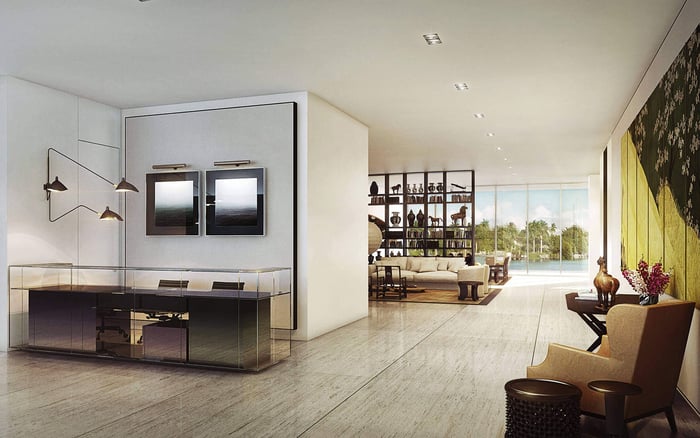
Across all three, the most consistent request among elite buyers is “hidden in plain sight.” The room should feel native to the home’s daily rhythm. It needs to be an office you genuinely use, a meditation room you actually enter, or a wine room that does not read like a bunker. If the space only makes sense as an emergency measure, it will never be lived in correctly, and it may not be reached efficiently when it matters.
In South Florida, the strongest security narrative is rarely a single room. It is layers working together.
At the neighborhood level, security is often delivered through governance and infrastructure. Indian Creek Island, often described as a high-security enclave, is widely profiled for tightly controlled access, intensive policing, surveillance, and marine patrol capabilities. Not every buyer needs that exact model. The takeaway is broader: neighborhood design and entry control can lower exposure before a concern ever reaches your front door.
At the building level, luxury residential towers and branded projects can add another layer through controlled lobbies, staffed entries, monitored back-of-house circulation, and elevator programming that reduces unnecessary exposure. Even for buyers who ultimately prefer a single-family home, the condominium ecosystem has normalized sophisticated access management and protocol-driven operations.
At the residence level, a sanctuary space functions as the final layer, not the first. It should be designed to integrate with household staffing, delivery patterns, and the reality that many vulnerabilities are operational: who has access, when, and under what oversight. A well-designed sanctuary cannot compensate for loosely managed access throughout the rest of the home.
This is also where “gated community” becomes more than a headline. True layered security is about predictable perimeters, controlled points of entry, and reliable protocols supported by design, staffing, and day-to-day discipline.
In the luxury market, the word “ballistic” is sometimes used casually. Performance, however, is not a vibe. Safe-room and fortified-room planning is commonly discussed with reference to standardized ratings such as UL 752 levels for ballistic resistance, paired with explicit material specifications for walls, doors, and glazing.
For buyers, the practical takeaway is straightforward: demand clarity. If a protected space is being presented as hardened, its protective elements should be defined in a way that can be specified, installed, and evaluated. Vague language does not translate into reliable performance.
Wall systems in the high-end market are frequently described across a spectrum of approaches, including steel and composite panel systems, along with specialized composite solutions promoted for continuous protection while preserving high-end finishes. As ambitions increase, it becomes more important to treat the sanctuary as an architectural assembly, not a collection of aftermarket add-ons. Doors, frames, walls, glazing, hardware, and anchors have to work as one.
South Florida adds a real-world constraint that luxury projects cannot ignore. This is a coastal, humidity-forward environment where corrosion risk, salt air, and maintenance realities shape long-term performance. A sanctuary space that degrades visually or mechanically becomes a liability in the moment it is supposed to be dependable.
At the top of the market, keys and basic codes can feel surprisingly outdated. Biometric access control, including facial recognition, is increasingly positioned as a luxury-home upgrade because it can let owners grant and revoke access with precision while reducing reliance on shared credentials.
The most compelling benefit is operational simplicity. High-net-worth households often coordinate rotating staff, vendors, visiting family, and seasonal occupancy. Access systems that can be managed centrally, audited, and adjusted in real time better match how luxury homes are actually used.
The best implementations stay visually quiet. The design should lead, with security integrated underneath it. Think concealed readers, refined hardware, and automation that feels like hospitality rather than enforcement.
This is where the sanctuary concept expands beyond one fortified room. It becomes an ecosystem: the entry, the perimeter, the elevator, the garage, the private corridor, and then the protected interior space. Each layer reduces friction and uncertainty for the next.
A common failure of older panic rooms is emotional hostility. They were designed to be endured, not inhabited.
Protected-space marketing now leans toward features meant to reduce the psychological burden of sheltering, including simulated daylight or digital window systems, along with wellness-style amenities such as fitness, pool, and leisure components in larger compounds. The intent is clear: if a family ever needs to shelter, the environment should support calm rather than intensify fear.
That same logic can apply at smaller scale. Within a high-rise residence, a sanctuary that doubles as a media room should deliver real acoustic comfort, not just a screen and a lock. If it functions as an office, it should have ergonomic lighting and reliable ventilation. If it is a wellness space, it should feel like wellness, not a disguised utility room.
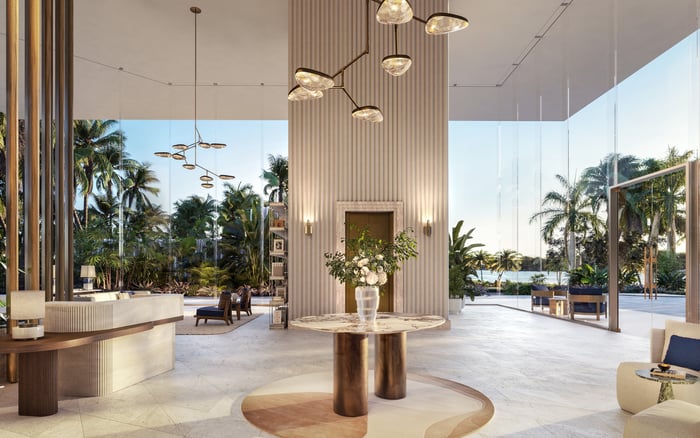
In South Florida, where the lifestyle is outdoors-forward and the home often serves as a resort-grade retreat, the most elegant sanctuary spaces tend to prioritize restoration: quiet, privacy, controlled light, and a sense of retreat that is consistent with the rest of the interior design language.
Beyond private residences, the uppermost tier is watching security become a club concept. Aerie has been reported as a planned underground refuge near Washington, DC, with development costs described around $300 million and a membership model reported to be capped at 625, with a reported buy-in of $20 million. Whether or not concepts like this ultimately shape mainstream buying, they signal something important: for some households, security is being packaged with the logic of luxury hospitality.
Other widely profiled examples include Survival Condo in Kansas, which repurposes a decommissioned Atlas missile silo into luxury residences, with marketing that describes full-floor units designed for long-term underground living. At the campus scale, Vivos Europa One in Germany is promoted as a hardened shelter environment with customizable private suites.
For South Florida buyers, these stories are less a directive to move underground than a reflection of mindset. Affluent consumers increasingly want planning, redundancy, and optionality. They want a safety posture that is curated, not improvised, and a home that does not rely on a single point of failure.
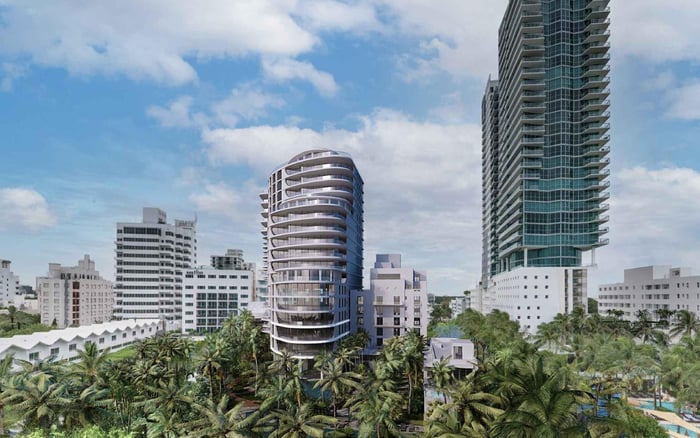
In Miami Beach, the most persuasive security is the kind that never interrupts the day. Buyers drawn to branded or hospitality-influenced living often respond to the idea that building operations, staffing, and controlled access can support in-residence privacy. That worldview aligns naturally with residences such as Shore Club Private Collections Miami Beach and Setai Residences Miami Beach, where buyers tend to value a polished arrival experience alongside discretion.
For owners who prefer a more residential, low-density feel while staying close to the ocean, newer oceanfront offerings can also support a sanctuary-first approach. A home already planned for quiet, privacy, and thoughtful circulation is simply easier to harden without telegraphing why. The same philosophy can be applied in projects like 57 Ocean Miami Beach, where an owner’s interior program can prioritize private retreat spaces as part of the everyday plan.
And for buyers who respond to service, predictability, and operational excellence, The Ritz-Carlton Residences® Miami Beach underscores a broader truth of this category: well-run buildings are part of risk management. Lighting, controlled entries, staff training, and consistent protocols often matter as much as any single fortified room, because they reduce the number of situations that ever reach that final layer.
A sanctuary space delivers its best value when it is treated as a design brief from day one, not an add-on after the interiors are complete.
Start with use-case honesty. If the room is meant to be occupied under stress, it should be located where your household can reach it quickly and intuitively. Avoid layouts that require passing through highly public areas, exposed corridors, or glass-heavy transitions that feel beautiful in daylight but vulnerable in practice.
Design for invisibility. The more your protected space resembles a normal room, the less it becomes a point of curiosity. This is where concealed hardware, seamless wall assemblies, and high-quality finishes do real work. A sanctuary should read like intentional design, not an interruption of it.
Demand performance definitions. If ballistic protection is part of the program, insist on clear rating language and transparent specifications rather than generic claims. Your team should be able to describe what is being installed, how it performs, and how it is maintained.
Plan for operations. Access control should account for staff, vendors, and seasonal patterns. Redundant communications should be treated as core infrastructure, not a last-minute accessory. And the sanctuary should be psychologically comfortable, because comfort is what makes a space usable. A room that feels punishing will not be used correctly, even if it is technically strong.
Luxury safety is not fear-driven. At its best, it is stewardship: protection of family, privacy, and the ability to live beautifully without feeling exposed.
What is the difference between a panic room and a serenity zone?
A panic room is typically a stark, standalone safe space. A serenity zone is designed to look and function like a normal room while quietly integrating protection, communications, and access control.
Do I need ballistic ratings to build a safe room?
Not always. However, if protection is a goal, standardized ratings like UL 752 levels help define performance in a way that can be specified and evaluated.
Is biometric access worth it in a luxury home?
For many households, yes. Biometrics can simplify entry management, support auditability, and reduce the risk associated with shared keys or codes.
Are private bunkers replacing in-home safe rooms?
They are more of a parallel trend. High-profile concepts show demand for redundancy, but most buyers still focus on discreet, integrated protection within a primary residence.
Explore how discreet design and prime addresses converge with MILLION Luxury.
If branded residences are on your mind — as a home or as an allocation — we would be glad to share what we are seeing, privately.
Begin a quiet conversation