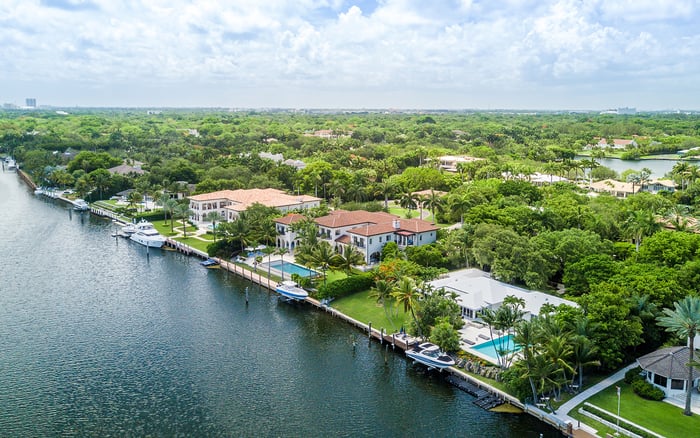
For South Florida buyers, “condo versus house” is rarely just a floor plan preference. It’s a negotiation about time, autonomy, and risk: what you want to outsource, what you want to control, and how much volatility you are willing to carry in monthly costs. This MILLION Luxury editorial lays out a practical way for couples to compare true monthly ownership costs, understand HOA and assessment exposure, and choose a product type that fits both lifestyle and financial priorities in today’s market.

In South Florida, the best purchase decisions rarely sound like “condo or house?” and more like “What do we want to outsource?” Luxury buyers are not simply paying for square footage. They are buying time, privacy, walkability, and predictability, then deciding which responsibilities they want handled by a building and which they want to manage directly.
A condominium can be an accessible entry point relative to a single-family home, but the real cost of ownership does not stop at the mortgage. HOA dues, property taxes, insurance, and ongoing maintenance shape the monthly reality. A house can deliver autonomy and private outdoor space, but it concentrates responsibility. Roofs, landscaping, HVAC, storm preparation, and capital repairs are not bundled; they arrive on their own schedule.
For couples, this is usually a values conversation. One partner may optimize for lock-and-leave ease and amenities, while the other is optimizing for privacy, control, and fewer rules. Both positions are rational. The goal is to translate preferences into numbers and non-negotiables so the decision becomes practical, not personal.
Before you debate skyline versus backyard, build a shared “all-in monthly carry” model for each property you tour. Keep it simple, but complete enough to be honest.
For a condo, couples should underwrite:
For a house, underwrite:
This lowers friction because it reframes the debate. If the condo wins on monthly carry after realistic assumptions, the convenience argument becomes easier to accept. If the house wins after you price maintenance and insurance with discipline, the autonomy argument stops reading like an indulgence and starts reading like value.
Condo ownership includes mandatory HOA fees, and they can rise even if your mortgage payment is fixed. In Miami-Dade County, reporting in 2025 noted that average HOA fees for high-rise condos exceeded $1,900 per month, up about 26% year over year. That number matters because it changes affordability quickly.
Still, the range is the point. Fees vary by neighborhood, building age, amenities, staffing model, and insurance profile. A doorman-and-spa lifestyle is built on a different cost structure than a boutique building with leaner services.
As you compare options in Miami Beach, insist on seeing the budget summary. Ask what is included in dues versus billed separately, and what has changed over the last few years. This is also where luxury becomes more nuanced. In a building like Faena House Miami Beach, the amenity and service stack can feel like an extension of the home. The question is not whether the experience is compelling. It is whether that experience aligns with your spending priorities for the next five to ten years.
The biggest surprise in condo ownership is often not monthly dues. It is the potential for special assessments, one-time charges to owners when reserves are insufficient for major repairs or building-wide projects. In practice, this is a governance and balance-sheet issue.
Treat special-assessment exposure as a stress test. Ask for clarity on reserves, recent capital work, and any future projects being discussed publicly. A well-run association can still face rising costs, but planning and transparency reduce the odds of owners being asked to fund urgent work on short notice.
Insurance is the second lever. Condo unit policies can be less expensive than standard homeowners policies because a master policy may cover portions of the structure, but this is not universal. Confirm what the master policy covers, what your HO-6 must cover, and how insurance costs are reflected in dues.
In amenity-forward properties such as Shore Club Private Collections Miami Beach, the operating model can include hospitality-like staffing and services. That can be ideal for frequent travelers. The underwriting task is to decide whether you prefer bundled lifestyle costs through dues or direct control through a house budget.
Condo financing can be more complex than single-family financing. Lenders may review HOA financials, reserves, and building condition, and some buildings may be ineligible for certain loan programs depending on those factors. Even for cash buyers, financing friction matters because it can influence resale liquidity.
Market structure matters as well. In Florida, recent market commentary described single-family inventory at roughly five months of supply (more balanced), while condos and townhomes were above roughly nine months (more buyer-leaning). This does not mean every building is negotiable. It means leverage is more property-specific, and disciplined buyers can be selective.
Nationally, many metro condo markets have seen notable price declines from peaks in recent cycles, underscoring that condo-heavy urban cores can be volatile. At the same time, Miami’s luxury condo segment has remained active, with reporting showing $2M+ condo sales up 15.2% year over year in Q3 2025. The takeaway is not to time the market. It is to buy the asset you can hold comfortably through multiple cycles.
A product like Setai Residences Miami Beach tends to appeal to buyers who value service, location, and ease. If that is your use case, prioritize quality of management and durability of demand, not just the last 12 months of price movement.
Many couples do not need to choose between a vertical lifestyle and a fully detached home. Townhouses can be a middle path, often offering more space and some private outdoor area than condos, while still sharing walls and, sometimes, HOA rules and dues. For some households, that trade delivers a house feel without the full maintenance load.
Another option for couples still negotiating is a high-end rental phase with intention. Build-to-rent communities aim to deliver single-family-style rentals with shared amenities, and industry commentary has noted they can command a 10% to 20% rent premium over conventional apartments. The premium can be worth it if it buys time to align on neighborhoods, commute patterns, schools, and daily routines before committing to ownership.
Luxury real estate performs best when it mirrors your schedule.
If your calendar is full, you travel often, and the home is a second home rather than a daily headquarters, a condo’s lock-and-leave logic is hard to beat. In that scenario, focus on buildings with stable operations, rules that match your lifestyle, and amenities you will actually use.
If you want a quieter, more residential rhythm, take rules seriously. Condo associations can restrict renovations, rentals, pets, and other personal preferences. That is not inherently negative. It is simply a different form of living, closer to a private club than a standalone estate.
For buyers who want the Miami Beach address with a refined service experience, The Ritz-Carlton Residences® Miami Beach often enters the conversation. For those who prioritize an oceanfront, design-forward feel with a more intimate residential cadence, 57 Ocean Miami Beach can represent a different expression of the Miami Beach lifestyle.
Couple conflict around housing choices is often “perpetual” in the sense that it reflects deeper preferences, not a simple misunderstanding. Progress usually comes from moving out of gridlock and into an ongoing process.
Use a structured, two-meeting protocol:
Zillow-style compromise tactics tend to work in practice: share priorities explicitly, trade features instead of arguing on every tour, and narrow the search to options that protect both partners’ core needs. Once you agree on two or three non-negotiables, the rest becomes design preference, and design is easier to negotiate than values.
Luxury buyers benefit from a checklist that protects lifestyle as much as capital.
For condos, focus on:
For houses, focus on:
Finally, keep expectations grounded. Economists cited by the National Association of Realtors projected relatively modest home-price gains in 2026, roughly in the 2% to 3% range, which reduces the case for buying primarily for appreciation. In other words, buy for fit first, then structure the deal intelligently.
Are condos always cheaper than houses in South Florida? Not necessarily. Condos can come with a lower purchase price, but HOA dues, taxes, and insurance can narrow or erase the gap.
What is the biggest hidden cost of condo ownership? Special assessments. They can be significant one-time charges if reserves are insufficient for major repairs.
How high can HOA fees go in Miami-Dade? They vary by building, but 2025 reporting noted average high-rise HOA fees exceeding $1,900 per month.
Why do lenders sometimes avoid certain condos? Lenders may scrutinize building condition, reserves, and HOA financial health, which can affect loan eligibility.
Is a condo a good idea for a second home? Often, yes. Lock-and-leave living and bundled maintenance can suit frequent travelers.
Are condo-hotel style amenities worth it? They can be, if you will actually use the services and you are comfortable paying for hospitality-like staffing through dues.
How is today’s condo market different from the single-family market in Florida? Recent commentary suggested condos and townhomes carried more inventory, creating a more buyer-leaning environment than single-family homes.
Should we buy for appreciation in 2026? Most outlooks point to modest gains, so prioritize lifestyle fit and long-term holding comfort over short-term appreciation.
What is a practical compromise if one partner wants a house and the other wants a condo? Consider a townhouse or a phased plan: rent first, then buy once neighborhood and daily routines are clearer.
What documents should we review before buying a condo? Review the HOA budget, reserve information, recent meeting notes where major projects are discussed, rules on rentals and pets, and insurance details.
For discreet guidance tailored to your lifestyle and risk profile, connect with MILLION Luxury.
If branded residences are on your mind — as a home or as an allocation — we would be glad to share what we are seeing, privately.
Begin a quiet conversation