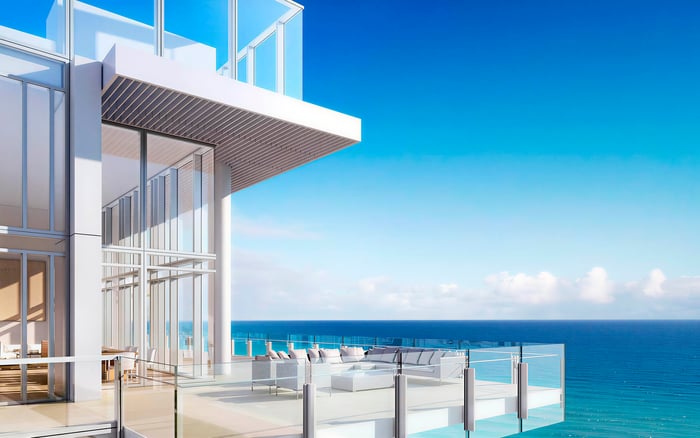
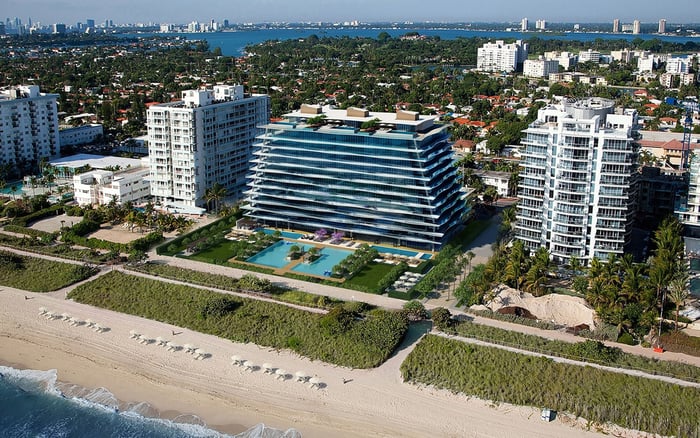
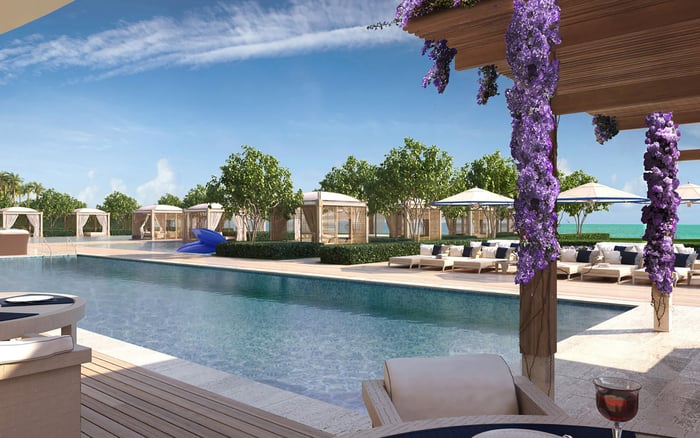
A buyer-focused look at why Surfside’s most compelling luxury residences treat arrival as architecture: measured lobby volume, sheltered porte-cochère privacy, and valet choreography that feels calm rather than theatrical.
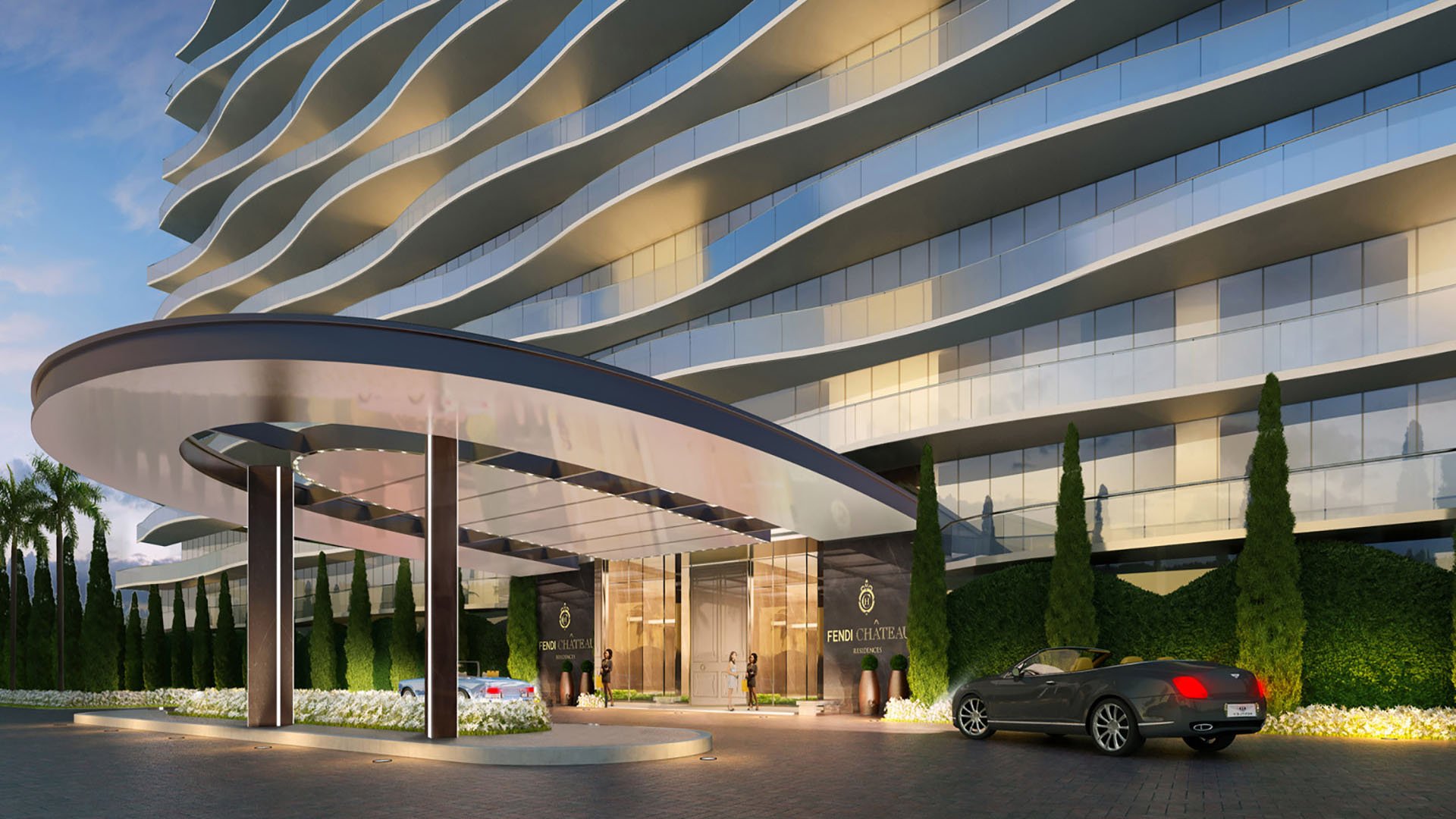
In South Florida luxury real estate, the arrival sequence is no longer a secondary design decision. It is the first test of whether a residence understands its buyer. A dramatic facade may command attention from the street, but a composed lobby, discreet porte-cochère, and intuitive valet sequence determine how daily life actually feels.
Surfside is especially instructive because it occupies a narrow emotional lane. It is coastal, polished, and residential in mood, with proximity to Miami Beach and Bal Harbour, yet it does not try to perform like a large resort district. Buyers drawn here often want oceanfront presence without unnecessary exposure. They want service, not ceremony. They want arrival to feel protected, not public.
That is where Surfside answers a broader South Florida question: how can a building feel important without becoming loud? The answer lies in proportion, privacy, and choreography.
A luxury lobby does not need to overwhelm. In a boutique environment, too much volume can feel oddly impersonal. The better solution is not simply a taller room, but a room that controls tempo. Ceiling height, sightlines, lighting, and material continuity should slow the resident down after the transition from street, valet, or garage.
In Surfside, the most successful lobby idea is closer to a private gallery than a hotel concourse. The resident should understand the room quickly: where to enter, where to pause, where staff will receive a guest, and where circulation becomes private. When that sequence is clear, volume becomes reassurance rather than display.
This matters for buyers because lobby scale influences more than first impressions. It affects acoustics, social exposure, staffing rhythm, and the way guests experience the building. A tall lobby with poor transitions can make residents feel observed. A more measured lobby, composed with warm materials and controlled entries, can make the same level of service feel quieter and more personal.
The porte-cochère is one of the least discussed and most revealing elements in a residential building. It is where weather, visibility, service, and security converge. In South Florida, it must handle sun, rain, luggage, guests, deliveries, and evening arrivals without turning the resident experience into a curbside performance.
Surfside benefits from an architectural culture that favors discretion. A porte-cochère here should not feel like a stage set. It should be legible from the driver’s seat, generous enough for comfortable movement, and separated enough from pedestrian curiosity to preserve privacy. At its best, it allows a resident to step out, exchange a few words, and disappear into the building without interruption.
This is particularly important for seasonal owners, families, and buyers who host often. A private arrival protects the mood of the home before the elevator is even reached. It also gives staff a calmer environment for managing luggage, packages, and guest transitions.
Valet is often discussed as a service, but in a true luxury context it is also choreography. The question is not simply whether a vehicle can be handled. The question is whether the handoff feels effortless during peak social hours, after dinner, in the rain, or when multiple residents arrive at once.
A strong valet sequence separates movements that should not compete. Resident drop-off, guest arrival, service access, and vehicle retrieval each need their own logic, even when they share the same architectural envelope. When this is solved well, the resident never has to consider the underlying complexity. That invisibility is the luxury.
In Surfside, where the mood is quieter than in many larger South Florida corridors, valet choreography should reinforce restraint. Staff presence should be attentive but not crowded. Waiting areas should feel natural rather than improvised. The experience should protect the sense that the building is intimate, even when the operational demands are significant.
The broader Surfside conversation often includes names such as Arte Surfside and Fendi Château Residences Surfside because they signal a market that understands design as part of privacy, not merely aesthetics. Their relevance is not only in architectural identity, but in the expectation they create for how residents move from arrival to residence with composure.
For a buyer, the lesson is to look beyond finishes. The most persuasive buildings make arrival feel inevitable. The drive court, lobby threshold, reception point, elevator path, and private corridor should read as one continuous sentence. If any part of that sentence feels confused, the luxury promise weakens.
This is why Surfside remains compelling for buyers who want coastal presence without surrendering to spectacle. The neighborhood’s appeal does not depend on constant visual drama. Its strength is the ability to make privacy feel natural, not defensive.
A serious buyer should study arrival at different speeds. First, approach the property as a passenger and notice whether the entry announces itself calmly. Then observe the walk from car door to lobby. Is there enough cover? Is the route intuitive? Does the staff have room to operate without stepping into the resident’s path?
Inside, listen as much as you look. A lobby that photographs beautifully may still feel echoing, exposed, or socially awkward. Notice whether seating is placed for comfort or display. Notice whether guests can be received without becoming part of the main circulation. Notice whether the elevator transition feels private or abrupt.
Finally, think about real life. A perfect arrival at noon may behave differently during a storm, a dinner rush, or a holiday weekend. In the most refined Surfside residences, the answer should remain the same: calm, protected, and quietly efficient.
Surfside shows that luxury arrival is not about maximum volume or maximum visibility. It is about removing friction. The lobby should settle the senses. The porte-cochère should protect the resident from weather and audience. The valet sequence should work so well that it nearly disappears.
For South Florida buyers, this is a useful filter across the market. The most valuable buildings are not always those with the loudest entry statement. They are often the ones where architecture, staffing, and circulation have been edited into a single private experience. In Surfside, that editing is the point.
Why does lobby volume matter in a Surfside residence? Lobby volume shapes acoustics, privacy, and the emotional tempo of arrival, so it should feel composed rather than theatrical.
Is a larger lobby always better for luxury buyers? Not necessarily. A well-proportioned lobby can feel more refined than an oversized room if it supports privacy and intuitive movement.
What makes a porte-cochère feel private? Privacy comes from covered access, controlled sightlines, comfortable vehicle movement, and a clear transition into the lobby.
Why is valet choreography important? Valet choreography determines whether arrivals and departures feel effortless, especially during rain, evening hours, or guest-heavy moments.
How should buyers evaluate valet during a showing? Buyers should watch how vehicles, staff, guests, and residents move through the same space without confusion or crowding.
Why is Surfside different from larger South Florida corridors? Surfside tends to reward discretion, making arrival design feel more residential and less performative than in busier districts.
How does boutique scale affect the arrival experience? Boutique scale can make service feel more personal, provided the lobby and porte-cochère are designed with enough operational room.
Does oceanfront living change arrival priorities? Oceanfront living increases the importance of weather protection, privacy, and calm transitions from exterior exposure to interior quiet.
Should project names influence how buyers think about arrival? Names can set expectations, but buyers should still judge the actual sequence from vehicle approach to lobby and elevator.
What is the best way to shortlist comparable options for touring? Start with location fit, delivery status, and daily lifestyle priorities, then compare stacks and elevations to validate views and privacy.
To compare the best-fit options with clarity, connect with MILLION.
If branded residences are on your mind — as a home or as an allocation — we would be glad to share what we are seeing, privately.
Begin a quiet conversation