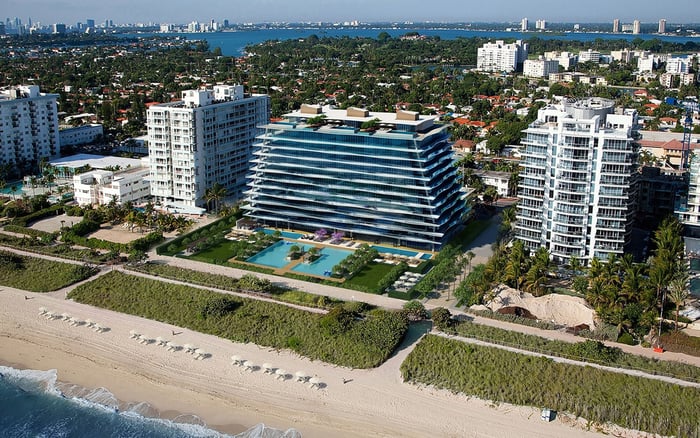
An editorial look at how Fendi Château Residences Surfside translates fashion-house identity into daily residential service, from arrival and concierge rhythm to beach setup and in-residence discretion.
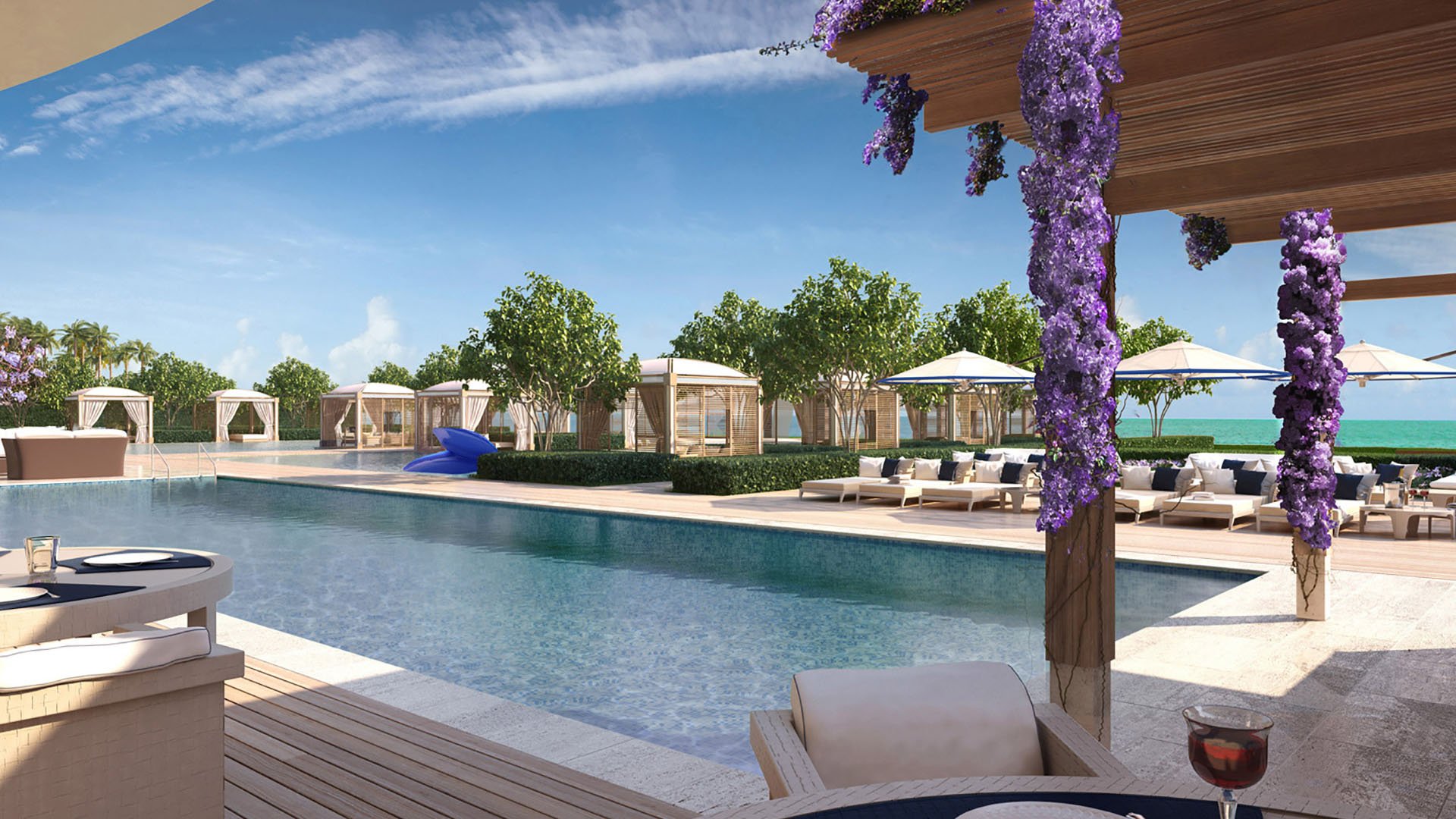
At Fendi Château Residences Surfside, the most revealing luxury may not be a finish, a view, or a lobby composition. It may be the way a resident is received. Fashion-branded residences are often judged first by their visual language, yet the stronger test comes later, through the recurring gestures that make a private building feel consistently considered.
That is why Fendi Château matters in the South Florida conversation. Set in Surfside along the Collins Avenue oceanfront corridor, just south of Bal Harbour and north of the denser Miami Beach condominium spine, it occupies a setting that naturally favors discretion over spectacle. The building’s identity is tied to the Italian fashion house Fendi, but the brand promise cannot stop at decorative cues. It has to be translated through conduct: valet arrival, concierge response, beach service, and the careful choreography of maintenance inside private residences.
For buyers accustomed to ultra-luxury hospitality, the question is not whether a property carries a name. The question is whether daily life feels edited with the same discipline as the name itself.
Oceanfront living in South Florida can easily become generic: a porte cochere, a desk, a pool deck, a beach attendant, and a maintenance request system. At the high end, those elements are only the baseline. The difference is pacing, tone, memory, and consistency.
At Fendi Château, the service proposition is positioned around ultra-luxury expectations rather than conventional condominium operations. That distinction matters because a fashion maison carries a specific burden. Residents are not only buying access to the Atlantic; they are buying an atmosphere associated with Roman heritage, craftsmanship, disciplined playfulness, material richness, and personalized luxury. Those values have to appear in the way staff anticipate a return from dinner, receive a guest, prepare beach seating, or enter a home for a repair.
In this sense, service becomes a form of brand stewardship. The staff is not a background function. It is part of the residence’s identity system.
Boutique scale is one of the quiet advantages in a property such as Fendi Château. Smaller residential environments can support a more choreographed form of service because fewer daily interactions are anonymous. The resident is not one of hundreds moving through a busy lobby sequence. The home can feel more like a private club, where preferences are remembered and transitions are softened.
That is especially relevant in Surfside, a market that draws buyers who want proximity to Bal Harbour without adopting the pace of the more crowded Miami Beach corridor. Nearby addresses such as Arte Surfside and Eighty Seven Park Surfside reinforce the appeal of a more residential, design-conscious coastal enclave. Fendi Château adds a fashion-branded lens to that context, one where the brand is most persuasive when it is felt in small operational details.
The best luxury service rarely announces itself. It reduces friction. It protects privacy. It makes a complex day feel composed.
Valet arrival is one of the most important service touchpoints because it frames the entire return home. In a conventional condominium, it can feel transactional: car received, ticket exchanged, movement completed. In a branded ultra-luxury residence, arrival should feel more like a controlled threshold between public Miami and private life.
For Fendi Château, the arrival experience is where the maison sensibility can become legible without becoming theatrical. The cues are subtle: recognition, timing, discretion, the absence of confusion, and the ability to manage guests without disturbing residents. This is where Roman polish becomes a behavioral standard rather than an aesthetic theme.
Buyers should pay attention to this moment during any visit. Is the approach calm? Are handoffs intuitive? Does the staff seem trained to protect privacy as much as to provide convenience? The answers often reveal more than a brochure.
Concierge service is another place where the brand promise either strengthens or weakens. In a fashion-branded residence, personalization cannot be reduced to politeness. It requires judgment: knowing when to be visible, when to be invisible, when to solve directly, and when to make an introduction feel effortless.
Fendi’s identity is rooted in craft and detail, so the residential equivalent is precision in response. A request should not feel passed through a generic system. It should feel handled. That does not mean every desire is extravagant. It may be as simple as coordinating a delivery, preparing for visiting family, or smoothing a resident’s return from travel. The measure is not drama. It is confidence.
This is where Fendi Château differs from a standard oceanfront condominium. The service is not only functional; it is brand-coded through restraint, consistency, and a sense of occasion.
Beach access is one of Surfside’s great privileges, but private beach living depends heavily on execution. A chair and umbrella can be provided anywhere. The luxury question is how they are prepared, where they are placed, how resident preferences are remembered, and whether the experience feels seamless from elevator to sand.
At Fendi Château, beach service is part of the daily residential experience, including the way staff set up resident seating. That simple act is more important than it sounds. It is where material comfort, privacy, and choreography meet the natural informality of the ocean. A fashion-branded building has to preserve ease without losing polish.
The same principle applies across the Surfside coastal set. The Surf Club Four Seasons Surfside brings a hospitality-inflected presence to the area, while Ocean House Surfside underscores the appeal of quieter beachfront residential life. Fendi Château’s particular proposition is the translation of fashion-house codes into the everyday service of that beachfront rhythm.
In-residence maintenance is often overlooked in luxury marketing, yet it is one of the most revealing operational categories. It requires entry into the most private part of a resident’s life. At this level, technical competence is assumed. The differentiator is discretion, minimal disruption, and respect for the home as a personal interior, not merely a unit to be serviced.
For Fendi Château, this aligns naturally with the language of craftsmanship. A residence associated with material richness and design discipline cannot tolerate clumsy handling of repairs, scheduling, or follow-through. The resident should not have to manage the process like a project manager. The building should absorb the complexity.
This is one of the clearest differences between a branded residence and a conventional condominium. In the former, the unseen work matters because it sustains the promise.
Social, culinary, and cultural programming can further extend the maison sensibility into daily life, provided it remains selective and aligned with the building’s scale. For Fendi Château, programming should not feel like a calendar filled for its own sake. It should feel curated, intimate, and consistent with the brand’s blend of heritage, material sophistication, and disciplined playfulness.
For buyers, this matters because programming influences whether a building becomes a true residential community or simply a collection of private apartments. The right events can create recognition among neighbors without compromising privacy. The wrong ones can dilute the atmosphere. In the best version, resident life feels enriched but never crowded.
The lesson of Fendi Château is that branded residential value is not fully visible at first glance. Interiors and architecture establish the stage, but staff behavior determines whether the performance holds over time. A buyer evaluating the property should look beyond surface beauty and ask how the building behaves on an ordinary Tuesday.
Does arrival feel composed? Does the concierge understand nuance? Is beach service consistent? Is maintenance discreet? Does boutique scale allow staff to know residents without becoming familiar in the wrong way? These are practical questions, but in the ultra-premium market, they are also financial ones. The strongest branded residences protect value by protecting experience.
Fendi Château Residences Surfside remains compelling because it frames luxury as a daily discipline. Its setting in Surfside gives it restraint. Its fashion association gives it vocabulary. Its service model is where that vocabulary has to become life.
What is Fendi Château Residences Surfside? It is a fashion-branded luxury residential property in Surfside associated with the Italian fashion house Fendi.
Where is Fendi Château located? The property is in Surfside, Florida, along the Collins Avenue oceanfront corridor.
Why is Surfside important to the building’s appeal? Surfside offers a quieter coastal setting just south of Bal Harbour and north of the denser Miami Beach condominium corridor.
How does the Fendi brand show up beyond design? The brand promise is expressed through daily service, including arrival, concierge response, beach setup, and in-residence discretion.
Why does boutique scale matter here? A smaller residential environment can support more personal, choreographed service and a stronger sense of recognition.
What should buyers observe during arrival? Buyers should look for calm pacing, privacy awareness, smooth guest handling, and staff confidence.
Why is concierge service central to the experience? Concierge response is where personalization becomes practical, turning resident requests into quietly handled outcomes.
How does beach service influence luxury living? Beach service shapes the everyday oceanfront routine, especially through seating preparation, timing, and discretion.
Why is in-residence maintenance a luxury issue? Maintenance inside the home requires privacy sensitivity, minimal disruption, and careful follow-through.
Is Fendi Château only about fashion branding? No. Its stronger proposition is how fashion-house identity can be carried into the daily rhythm of residential service.
If you'd like a private walkthrough and a curated shortlist, connect with MILLION.
If branded residences are on your mind — as a home or as an allocation — we would be glad to share what we are seeing, privately.
Begin a quiet conversation