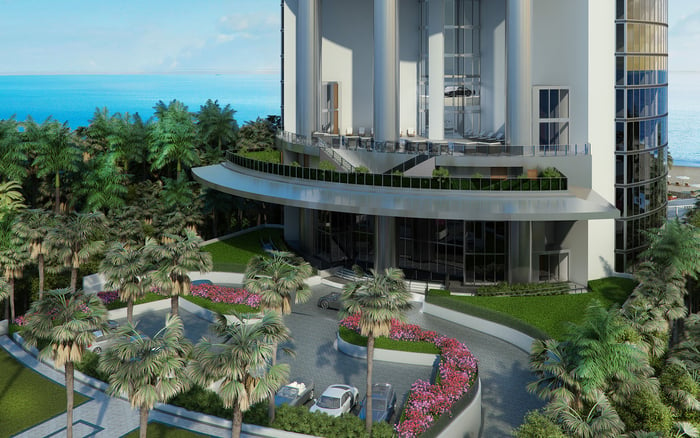
Guest parking is not a minor operating detail in a South Florida full-service tower. It can shape daily convenience, hosting flexibility, service access, ownership friction, and long-term buyer confidence.

In South Florida luxury real estate, the most expensive ownership surprises are not always dramatic. They often sit in the fine print of building operations. Guest parking is one of them. In a full-service tower, parking policy can shape how often family visits, how easily a private chef arrives, whether a house manager can coordinate vendors, and how graciously the building receives an evening of dinner guests.
For many buyers, the initial focus is predictable: view corridor, ceiling height, terrace depth, lobby arrival, wellness programming, and service culture. Yet the practical choreography of the porte cochère, valet desk, garage, visitor spaces, and overnight rules can become just as important after move-in. A residence may feel effortless on a private tour, then feel less fluid if every guest arrival requires advance registration, repeated validation, or a valet queue that builds during peak hours.
This is why sophisticated buyers now treat parking rules as part of total cost. The monthly association line item is only one measure. The real cost also includes inconvenience, staff time, social friction, and resale perception.
A luxury condominium may offer deeded spaces, assigned spaces, limited common element spaces, valet-managed access, or some combination of these arrangements. Buyers should understand the distinction. A deeded or appurtenant space may carry different implications than a revocable assignment controlled by the association. Guest parking, meanwhile, may be handled through self-parking, valet parking, a validation system, a limited pool of visitor spaces, or a reservation protocol.
The important question is not simply, “How many spaces come with the residence?” It is, “How does the building handle the people who support and visit the residence?” In a primary home, that may include relatives, tutors, trainers, physicians, stylists, drivers, chefs, security personnel, contractors, and close friends. In a second-home pattern, it may include seasonal guests, family arriving from the airport, and service providers preparing the residence before the owner arrives.
When comparing a Brickell address such as The Residences at 1428 Brickell with a beach or bayfront lifestyle, the parking question changes with the setting. Dense urban towers often place a premium on controlled access and efficient valet movement. Waterfront and resort-style buildings may place more emphasis on weekend visitor volume, event evenings, and family hospitality.
Guest parking rules can create direct and indirect costs. Direct costs may include valet charges, guest parking fees, overnight fees, lost validations, or charges triggered by extended stays. Indirect costs are harder to see but often more meaningful. A resident may need staff to coordinate arrivals. Guests may circle the building while waiting for instructions. Vendors may charge for time spent loading, unloading, or navigating access points.
The highest-end buildings understand that arrival is part of the amenity. A seamless guest experience protects privacy, reduces lobby congestion, and preserves the tone of the property. A weak system does the opposite. It turns hospitality into administration.
For pricing and trends, buyers should also think about liquidity. A future buyer may ask whether the residence is easy to live in for multigenerational families, frequent entertainers, or seasonal owners. If the answer depends on exceptions or informal favors, that uncertainty may weigh on perceived value.
Valet service is often treated as a luxury marker, but its quality depends on staffing, capacity, procedures, and culture. A polished valet team can make a tower feel private, secure, and effortless. A strained valet operation can become the most visible bottleneck in the building.
Ask how guests are logged, how keys are handled, whether overnight vehicles are permitted, how late service runs, and what happens during storms, holidays, private events, or high-traffic weekends. In South Florida, the rhythms of season matter. A tower that feels calm on a Tuesday morning may operate differently during peak social hours.
In Miami Beach, for example, the relationship between traffic patterns, restaurant reservations, beach access, and event calendars can make arrival choreography especially important. A residence at Five Park Miami Beach may be evaluated in a different lifestyle context than a quieter inland building, not because one is better than the other, but because the daily movement pattern is different.
The best parking due diligence is practical. Buyers should ask for the governing documents, rules and regulations, parking policies, and any current fee schedule. They should confirm whether guest parking is first-come, reserved, valet-only, or limited by time. They should ask whether vendors use the same entry as guests, whether commercial vehicles are restricted, and whether overnight guests require prior approval.
It is also worth asking how often policies can change. Parking is typically governed by condominium documents, board rules, management practices, or a combination of the three. A buyer should understand which rules are fixed and which can be revised by the association or operator.
A building with generous policies today may tighten access later if demand exceeds capacity. Conversely, a building with careful controls may preserve value by preventing misuse. The goal is not necessarily unlimited parking. The goal is clarity, fairness, and a service standard aligned with the price point.
The guest parking issue becomes more visible for buyers who entertain. A dinner for eight is not only a dining room question. It is also an arrival-court question. Can multiple vehicles be received gracefully? Are guests asked to pay? Are validations provided? Is there a limit on how long visitors may remain? Does the valet team know how to handle private drivers or security vehicles?
Household staffing adds another layer. A full-service residence often depends on people who do not live in the building but make the home function. If trainers, chefs, assistants, nurses, or housekeepers face inconsistent parking access, the owner may absorb that inconvenience through higher scheduling costs or daily frustration.
In Sunny Isles Beach, a buyer comparing oceanfront living at St. Regis® Residences Sunny Isles with other coastal options should examine how guest and service access supports the intended lifestyle. The same is true in Fort Lauderdale, where yachting, beach, and downtown patterns may converge around buildings such as Four Seasons Hotel & Private Residences Fort Lauderdale.
Resale value is shaped by more than finishes and views. It is shaped by confidence. Buyers want to know that a tower functions elegantly, especially in categories that affect daily life. Parking policy is one of those categories because it touches privacy, security, hospitality, and convenience.
A strict policy is not automatically negative. In certain buildings, strict access protects residents from overcrowding and preserves a calm arrival sequence. A loose policy is not automatically positive either. If guest spaces are routinely occupied by unauthorized vehicles, the experience may deteriorate quickly.
The most attractive buildings tend to offer a balanced approach: enough structure to protect residents, enough flexibility to support real life, and enough staffing to keep the experience discreet. That balance is often what separates a merely expensive tower from a truly full-service one.
Visit the property at different times if possible. Observe the arrival court, valet rhythm, garage entry, signage, loading areas, and lobby handoff. Ask management to walk through a realistic scenario: two guests for lunch, a private chef for dinner, an overnight family member, and a contractor arriving for service. The answers will reveal whether the building thinks operationally or improvises under pressure.
Buyers should also ask their counsel to review parking language carefully. The most elegant sales presentation cannot replace the controlling documents. If guest parking is essential to your lifestyle, it should be treated as a core due-diligence item, not a courtesy question at the end of a showing.
Why does guest parking matter in a luxury condo purchase? It affects how easily visitors, family, vendors, and household staff can access the residence. In a full-service tower, that daily ease is part of the value proposition.
Is valet parking always better than self-parking? Not always. Valet can feel seamless when well staffed, but self-parking may offer more predictability in certain buildings.
What should buyers ask before signing a contract? Ask how guest parking works, whether fees apply, whether overnight guests are allowed, and who can change the rules.
Can guest parking rules change after purchase? They may, depending on the governing documents and association authority. Buyers should review the documents with counsel.
Do guest parking fees affect real ownership cost? Yes. Even modest fees can matter when a household entertains often or relies on regular service providers.
How do parking rules affect entertaining? They determine whether guests arrive smoothly or encounter delays, fees, limits, or confusion at the entrance.
Should second-home buyers care about guest parking? Absolutely. Seasonal use often depends on family visits, airport arrivals, and vendors preparing the residence before occupancy.
Are stricter parking rules a negative sign? Not necessarily. Clear rules can protect privacy, security, and the overall arrival experience when they are well managed.
Can parking policy influence resale? Yes. Future buyers often value buildings that combine service, clarity, and convenience in everyday operations.
What is the best first step for due diligence? Request the parking rules, fee schedule, and governing documents, then test them against your actual lifestyle.
To compare the best-fit options with clarity, connect with MILLION.
If branded residences are on your mind — as a home or as an allocation — we would be glad to share what we are seeing, privately.
Begin a quiet conversation