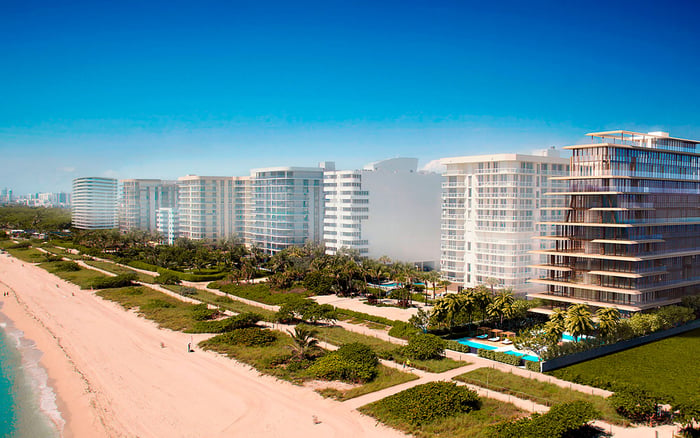
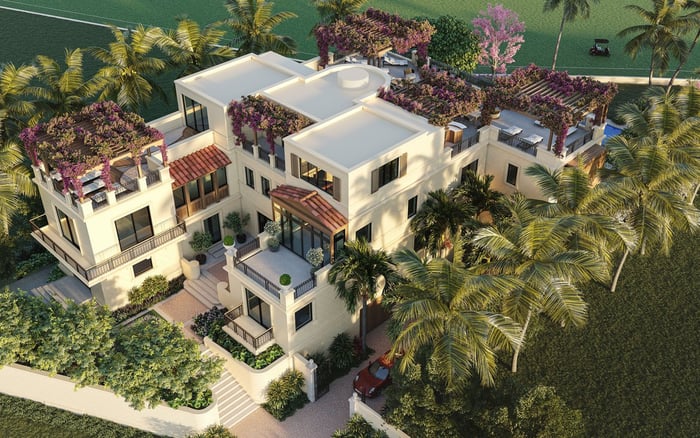
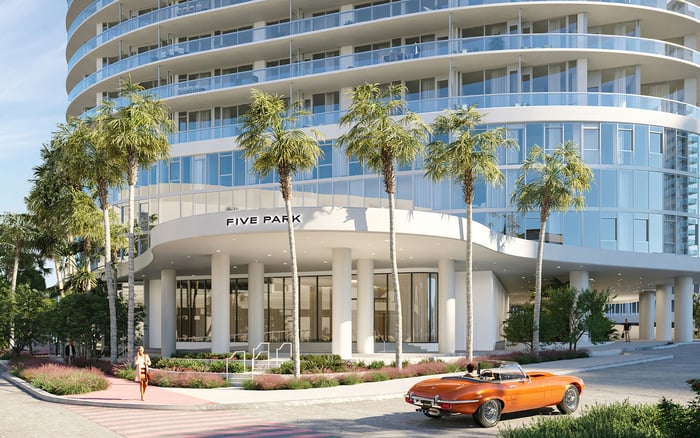
An editorial look at how Fendi Château Residences Surfside helps define Surfside’s move toward fashion-branded, full-service private oceanfront living.
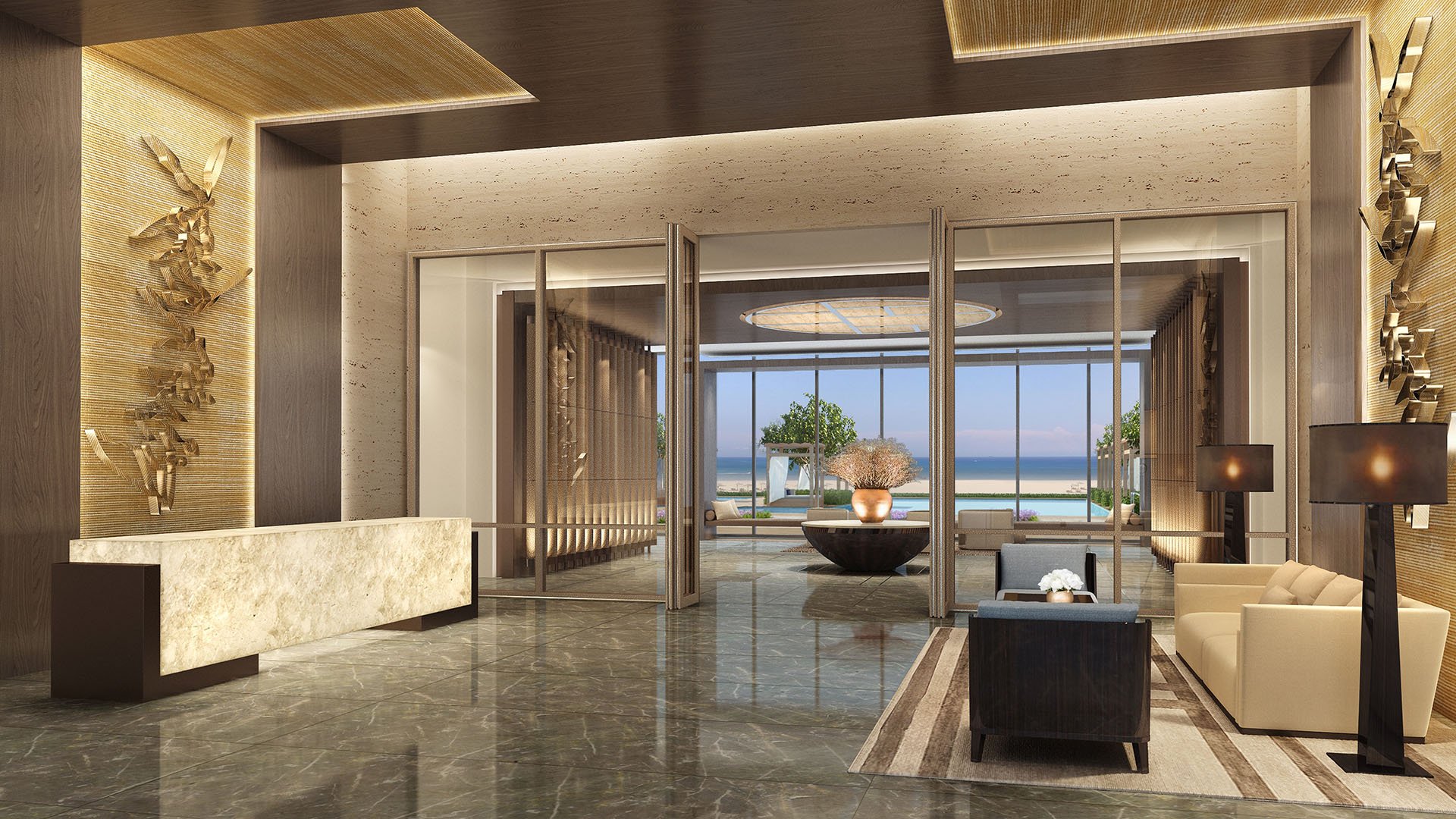
In Surfside, luxury is no longer defined by a wide terrace, a blue-water view, and a recognizable address alone. Those elements still matter, but they no longer complete the picture for the most selective buyers. The more revealing question is how a building behaves once the owner is inside it: how private the arrival feels, how consistently the staff understands residential rhythms, and how gracefully service appears without making the property feel like a hotel.
That is where Fendi Château Residences Surfside becomes relevant. It is not simply a Fendi-branded residential project on the oceanfront. It is a useful lens for understanding how Surfside’s ultra-luxury condominium market is increasingly judged by service culture, discretion, and the ability to translate global luxury identity into everyday private life.
The project’s central proposition is residential rather than resort-driven. That distinction matters. A hotel-resort environment can bring energy, dining, guests, and circulation. A private condominium, by contrast, is designed around control. For buyers who see the home as a sanctuary, the most valuable service is often the kind that reduces friction while preserving quiet.
Fendi Château Residences Surfside sits squarely in the conversation around branded residences, but its identity differs from a hospitality flag attached to transient use. Its appeal comes from pairing a fashion-house design language with a residential-only luxury model. The brand association is visual, cultural, and experiential, while the living pattern remains private.
That combination gives the project its editorial significance. Fendi brings a European luxury-house sensibility to Surfside’s condominium market, creating a bridge between fashion, interiors, and oceanfront ownership. The result is not merely a logo on a façade. At this level, branding is expected to shape atmosphere: materiality, tone, restraint, and the sense that every visible detail belongs to a curated whole.
For Surfside, this is part of a broader move away from the conventional beach condo. The most refined buildings in the northern Miami Beach, Surfside, and Bal Harbour corridor now compete on experience as much as architecture or views. Fendi Château helps define that standard because its value proposition depends on how residents are served inside a controlled private building environment.
Oceanfront living has always carried emotional weight in South Florida. The view, the light, and the immediate relationship with the beach remain powerful. Yet in Surfside, oceanfront privacy has become its own category of luxury. Buyers are not only asking what they can see from the residence. They are asking who moves through the building, how access is managed, and whether daily service can be delivered without sacrificing calm.
That is the critical distinction between private residential service and resort-style hospitality. Both may aspire to polish, but they serve different audiences. Resort hospitality is designed for guests and turnover. Private residential service is designed for owners, continuity, and recognition over time. In a non-hotel residential address, service can become more personal because it is not competing with the rhythms of transient activity.
This is why Fendi Château’s position matters in Surfside. It gives buyers a framework for reading service not as an amenity checklist, but as an operating philosophy. The building is positioned around privacy, exclusivity, and full-service living on the oceanfront, which means the true luxury is not only what is provided. It is how quietly and consistently it is provided.
Fashion branding changes the emotional register of a residence. In a hospitality-branded property, the buyer may expect service standards shaped by a hotel tradition. In a fashion-branded residence, the expectation is more closely tied to taste, detail, proportion, and atmosphere. Fendi Château’s relevance lies in that distinction.
The project connects Surfside to European fashion and luxury-house aesthetics, adding another layer to the neighborhood’s design conversation. For a buyer, that can make the residence read less as a commodity and more as a composed environment. The brand is expected to communicate a lifestyle of restraint and finish, not theatricality.
This point is especially important in Surfside, where discretion is part of the appeal. The best private residential service does not need to announce itself. It should feel present, capable, and exacting, but never intrusive. Fendi Château’s fashion-house identity reinforces that idea: the residence is meant to be experienced as a private world with a defined point of view.
Surfside’s luxury corridor has become a study in nuance. Buildings may share the same coastal light and proximity to Bal Harbour, but their service identities can differ sharply. A buyer considering Fendi Château may also look at The Delmore Surfside for another expression of high-end residential positioning, or Ocean House Surfside for a Surfside address that keeps the conversation focused on private coastal living.
The comparison is not only about architecture. It is about mood, density of experience, and the degree to which the building feels like a private club, a design object, or a quiet oceanfront home. Arte Surfside also belongs in that buyer conversation because Surfside’s most notable residences are increasingly evaluated through the lens of privacy, design identity, and service expectations.
Nearby, The Surf Club Four Seasons Surfside adds another important reference point, particularly because the Surfside area contains both hotel-associated luxury and private residential models. Fendi Château’s contrast is that its service emphasis is attached to private residential life, not transient hotel activity. For buyers who prize discretion, that difference may be decisive.
For a buyer, the lesson of Fendi Château Residences Surfside is to look beyond the familiar vocabulary of luxury. Amenities matter, but the more sophisticated question is whether the building’s service model supports the way the owner actually lives. A residence used as a primary home has different needs from a seasonal retreat. A family seeking privacy has different expectations from an owner who wants constant social energy.
The strongest private residential buildings tend to make service feel inevitable. Arrivals are handled without ceremony. Requests are understood without repetition. Common areas feel composed rather than busy. Staff presence supports the resident without becoming the story. This is the kind of experience Surfside buyers increasingly expect at the top end of the market.
Fendi Château is useful as a benchmark because it packages branding, amenities, staffing, and privacy into a single residential proposition. That does not mean every buyer will want the same tone. It means the evaluation of luxury in Surfside has become more precise. The question is no longer simply whether a building is full-service. The question is whether its service culture aligns with the owner’s desired level of visibility, access, and ease.
Lifestyle in Surfside is defined by quiet proximity. The neighborhood offers oceanfront living with a more controlled residential feeling than larger urban districts nearby. That makes it especially compelling for buyers who want access to South Florida’s dining, culture, shopping, and private networks while preserving a calmer daily base.
Fendi Château’s role in that setting is experiential. It helps show how a building can function as a refined buffer between the energy of South Florida and the privacy of home. The brand may attract attention, but the ownership model points toward discretion. That tension is part of its appeal.
For today’s ultra-premium buyer, service is no longer an add-on. It is part of the asset’s identity. A building that can deliver privacy, recognition, design coherence, and full-service living in one oceanfront setting is participating in the most important luxury conversation in Surfside.
What is Fendi Château Residences Surfside? It is a Fendi-branded ultra-luxury oceanfront condominium project in Surfside, Florida, positioned around private residential living.
Why is it important to the private service conversation? It pairs fashion-house branding with a residential-only model, making service part of private ownership rather than hotel activity.
Is Fendi Château a hotel-resort residence? It is framed as a private condominium experience, which supports a more discreet ownership environment than a transient resort setting.
What makes Surfside appealing to this buyer profile? Surfside offers oceanfront living, privacy, exclusivity, and proximity to the northern Miami Beach and Bal Harbour luxury corridor.
How does fashion branding affect the residence experience? Fashion branding can shape the design mood, material expectations, and overall sense of curated luxury inside the building.
Does private service mean less hospitality? Not necessarily. It means hospitality is adapted to residents, continuity, and discretion rather than guest turnover.
How should buyers evaluate service in Surfside condos? They should consider access control, staff culture, privacy, daily ease, and whether the building supports their personal rhythm.
Why does oceanfront privacy matter so much? At the top end, the value of the view is strengthened by controlled access, quiet arrivals, and a calm residential environment.
Is Fendi Château mainly an architectural story? Its relevance is also experiential because the value proposition depends on how residents are served inside a private building.
Who is the likely audience for this type of residence? It suits buyers seeking a branded oceanfront address with privacy, design identity, and full-service residential support.
To compare the best-fit options with clarity, connect with MILLION.
If branded residences are on your mind — as a home or as an allocation — we would be glad to share what we are seeing, privately.
Begin a quiet conversation