In South Florida’s uppermost tier, the real comparison is not house versus condo in the abstract. It is private land control versus managed convenience. Gables Estates represents the purest expression of the first model: a tightly held Coral Gables enclave of sprawling waterfront parcels, custom residences, and exceptionally low supply. Luxury condominiums, by contrast, excel at service, walkability, amenity depth, and lock-and-leave ease. For buyers deciding where long-term value truly resides, the answer often comes down to whether they prize autonomy, privacy, and scarcity more than operational simplicity.

At the highest end of South Florida real estate, the choice is rarely about whether one residence is more luxurious than another. Both estate homes and premier condominiums can be beautifully designed, fully staffed, and finished to extraordinary standards. The more meaningful distinction is control versus convenience.
Gables Estates style living represents the land thesis in its most refined form. Within roughly 75 acres in Coral Gables, only about 29 estate homes occupy one of the region’s most tightly held residential settings. Typical lots range from about 1.5 acres to more than 5 acres, and residences often span 10,000 to 20,000-plus square feet. In a built-out coastal market where new trophy parcels are nearly impossible to create, that scale matters.
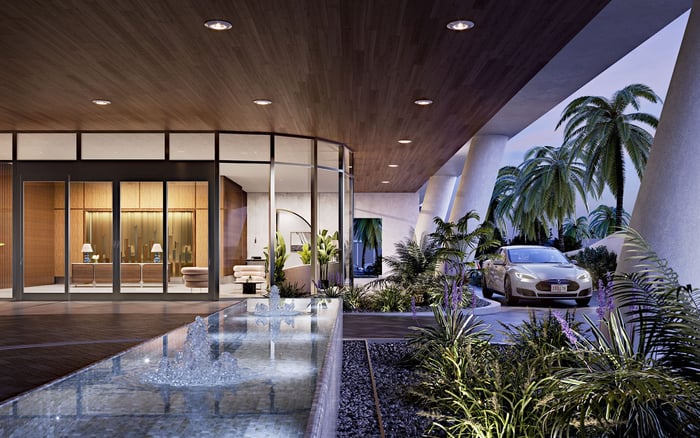
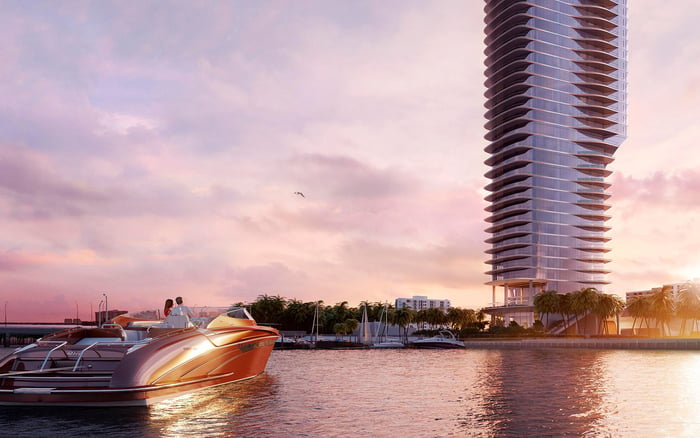
Luxury condos solve a different problem. In neighborhoods such as Brickell, Downtown, and parts of Miami Beach, the appeal is immediate: staffed arrivals, amenity programs, wellness spaces, pools, and close proximity to restaurants, marinas, and business districts. A buyer comparing estate life with a residence at The Residences at 1428 Brickell or Baccarat Residences Brickell is not choosing between luxury and non-luxury. That buyer is choosing between private domain and curated ease.
Ultra-high-net-worth buyers do not pursue rare land simply for yard size. They are buying the freedom that comes with it. In an estate setting, the owner controls the lived environment in a way condo ownership cannot fully replicate. Guest houses, pool programs, outdoor kitchens, landscaping plans, family recreation space, and broader multigenerational layouts all exist on privately controlled land rather than within a shared governance structure.
That distinction becomes more meaningful as values rise. Publicly disclosed Gables Estates transactions have reached roughly $25 million to $40 million-plus, reflecting more than architecture alone. Buyers are paying for scarce waterfront land, deep setbacks, privacy, and the impossibility of meaningful replacement.
This helps explain why single-family trophy enclaves often show resilience differently from the broader luxury market. In a tower, there may be multiple competing listings, shifting inventory conditions, and the constant presence of comparable units in the same building or district. In an enclave with very few annual sales, replacement opportunities are rare. Scarcity itself becomes part of the asset.
For families focused on long-horizon wealth planning, land can also carry a different psychological and strategic weight. Direct ownership of appreciating residential land is often seen as a cleaner form of control, especially for buyers thinking in generational terms. That does not eliminate the need for legal and tax advice, but it helps explain why certain buyers remain deeply committed to estate neighborhoods in Coral Gables and similar trophy markets.
None of this diminishes the strength of the best condominiums. In fact, luxury condos are often the superior format for buyers who value immediacy, service, and flexibility over acreage.
A well-run building can remove daily operational friction almost entirely. There is no private grounds crew to supervise, no extensive landscape program to maintain, and no need to think about the many systems a large estate requires. For seasonal owners, frequent travelers, and downsizers, lock-and-leave simplicity is a genuine luxury.
That is precisely why neighborhoods like Brickell, Downtown, Edgewater, and Miami Beach continue to attract global capital. A residence at Una Residences Brickell, Villa Miami, or The Perigon Miami Beach offers a sophisticated lifestyle package that extends well beyond the unit itself. Service culture, wellness programming, concierge access, and urban adjacency are not add-ons. They are the product.
For some buyers, especially those using South Florida as one stop within a global residential portfolio, that proposition is more compelling than a multi-acre estate. If the home is meant to function as an elegant base rather than a private compound, a top-tier condominium can be the more precise choice.
Convenience, however, is never free. In the condo category, many responsibilities are centralized rather than eliminated. Groundskeeping becomes HOA dues. Building operations become shared obligations. Capital improvements can become special assessments. In the luxury segment, monthly dues can run from roughly $3,000 to $12,000-plus, depending on the product and service level.
That matters because the owner is not only buying a residence. The owner is buying into a collective operating structure with rules, reserve needs, staffing costs, and governance. A stand-alone estate home has maintenance demands of its own, but those demands are directly controlled by the owner rather than mediated through a building-wide decision-making process.
Financing can also differ. Jumbo lending remains essential across the high-end market, yet condo underwriting often extends beyond the borrower to the project itself. The building, its financials, and broader project-level factors may influence terms in ways detached single-family homes do not face in the same way. For cash buyers, this may be less central, but for financed acquisitions it can shape both timing and flexibility.
One of the easiest mistakes in South Florida luxury real estate is treating price per square foot as the final measure of value. In condos above $5 million, pricing can reach roughly $2,500 to $4,000-plus per square foot. Trophy estates may sometimes trade at lower per-square-foot figures, but that comparison can obscure what is actually being acquired.
A condominium buyer is often paying a premium for elevation, views, services, architecture, and brand-driven amenity value. An estate buyer is paying for land control, privacy buffers, setbacks, and future optionality. The denominator may look more favorable in a large estate home, but the true premium is often embedded in the parcel itself.
This is the essence of the land-still-wins argument. In a region with finite waterfront edges and heavily constrained zoning, a rare estate parcel combines residence, privacy, and scarcity in one asset. Condo convenience depends partly on the health, rules, and costs of the larger building. Land-backed ownership is more self-contained.
The estate buyer is usually seeking insulation. That may mean privacy from neighbors, room for multigenerational living, or the ability to personalize every part of the property with minimal compromise. These buyers often prioritize autonomy over walkability and regard outdoor space as essential rather than decorative. They may also prefer the social discretion of a gated-community environment over a vertical building with frequent arrivals and departures.
The condo buyer is usually optimizing lifestyle efficiency. That can mean proximity to the financial core in Brickell, easy departure for extended travel, or immediate access to beach clubs, dining, and wellness programming. These buyers may care less about acreage than about service depth, architectural pedigree, and the ability to arrive with very little friction.
For many affluent households, the real answer is not either-or but sequence. A condo may serve an urban chapter of life, while a land-rich estate becomes the long-term family hold. Yet if the question is purely which format offers the strongest combination of scarcity, privacy, and physical control, the answer remains clear: land still has no true substitute.
Why does Gables Estates style living appeal to ultra-wealthy buyers? It offers rare privacy, large private parcels, and physical control that a shared building cannot fully replicate.
What makes Gables Estates different from a luxury condo? The neighborhood is defined by detached estate homes with substantial setbacks rather than shared walls, elevators, and common corridors.
Are condos still attractive in South Florida’s luxury market? Yes. They remain highly appealing for buyers who value services, amenities, walkability, and lock-and-leave convenience.
Do estate homes always cost more than luxury condos? Not necessarily. Condos can command higher per-square-foot pricing, while estate buyers are often paying for scarce land as much as for the house itself.
What is a key financial difference between the two ownership styles? Condo ownership usually includes recurring HOA dues and potential special assessment exposure, while estate ownership centers on directly managed property costs.
Is financing different for condos and detached estates? Often, yes. Condo financing can involve project-level underwriting factors beyond the borrower’s individual profile.
Why is land considered more resilient in trophy markets? Because ultra-prime estate enclaves have very limited supply and few replacement opportunities when properties trade.
Who is the ideal condo buyer? Seasonal residents, downsizers, and globally mobile owners often prefer the convenience and staffing of a luxury tower.
Who is the ideal estate buyer? Buyers seeking privacy, multigenerational space, and long-term control over their environment are typically better matched to estate ownership.
How should a buyer think about the final choice? The decision usually comes down to whether autonomy, privacy, and land control matter more than services, walkability, and operational simplicity.
When you're ready to tour or underwrite the options, connect with MILLION Luxury.
If branded residences are on your mind — as a home or as an allocation — we would be glad to share what we are seeing, privately.
Begin a quiet conversation