Luxury real estate can serve as a sophisticated portfolio diversifier when buyers distinguish between lifestyle ownership and investment intent. In South Florida, that discipline often means balancing income potential, appreciation prospects, tax efficiency, and submarket exposure rather than concentrating capital in a single trophy asset.

For sophisticated buyers, diversification is not simply a matter of owning more assets. It is a matter of owning assets that behave differently. That is where U.S. luxury real estate can become compelling. Private residential property often moves to a different rhythm than public equities and bonds, giving it strategic value for investors seeking resilience rather than repetition.
Real estate also offers a rare hybrid profile. It can provide current income through leasing, long-term upside through appreciation, and a measure of inflation sensitivity when replacement costs and rents rise. For families accustomed to liquid portfolios, that combination can be attractive because it introduces a hard asset with both utility and financial character.
The caveat is equally important. A waterfront residence acquired primarily for personal enjoyment is not the same as an income-producing holding structured for long-term portfolio performance. The most successful buyers separate those objectives early. Lifestyle use, legacy planning, income generation, and tax efficiency each call for a different acquisition strategy.
South Florida holds a distinct place in the American luxury landscape. It attracts domestic capital, international buyers, and owners who view premier residential property as both refuge and reserve. Yet the region is not a single market. A disciplined portfolio approach requires understanding how one neighborhood differs from another in product type, supply pipeline, carrying cost, and renter or resale profile.
According to MIAMI Realtors, Miami-Dade total residential sales rose 6.6% year over year in March 2026, and $1 million-plus single-family and condo sales both increased. That is constructive, but not uniform. The same report showed 5.7 months of single-family supply and 13 months of existing condominium supply. For portfolio construction, that split is useful: single-family waterfront exposure, new-construction condo exposure, and stabilized resale exposure may each behave differently.
Brickell, for example, offers a more urban, condo-driven expression of luxury, often favored by buyers who want newer inventory and proximity to the financial core. A residence at The Residences at 1428 Brickell or 888 Brickell by Dolce & Gabbana represents a very different form of exposure than an oceanfront holding in Miami Beach.
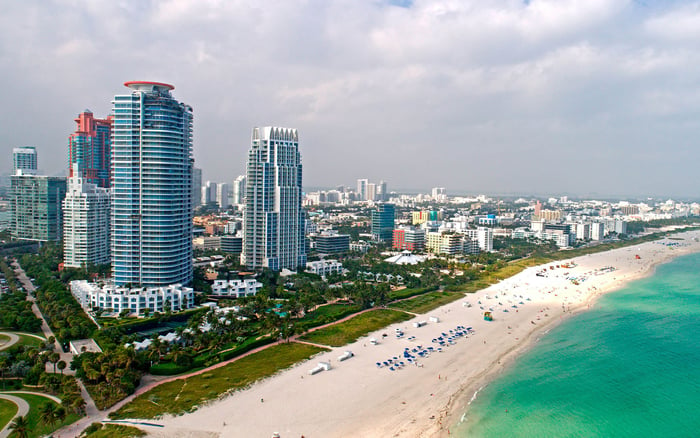
That coastal profile can look different again in Miami Beach, where beachfront scarcity and lifestyle positioning often shape buyer demand. In Coral Gables, the investment thesis can shift toward estate character, architectural pedigree, and a lower-density environment, which is why buyers often compare that market with villages such as Ponce Park Coral Gables rather than with the vertical core.
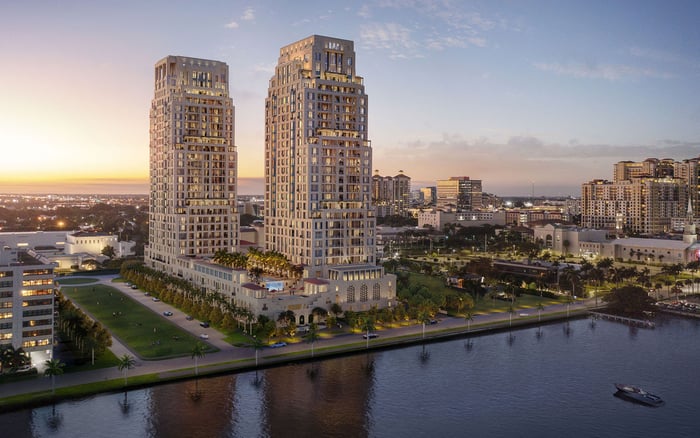
Further north, areas like West Palm Beach add another layer of diversification. A property such as Alba West Palm Beach can offer a different balance of waterfront access, urbanity, and supply dynamics than Miami-Dade neighborhoods. This is why true diversification in luxury real estate is often geographic, even within the same region.
When buyers say they want real estate exposure, they may be referring to several different things at once. Some want income. Others want capital preservation in a tangible asset. Some want optionality: a residence that can serve private use today and become an investment property later. In practice, these are separate mandates.
An investment-oriented purchase is usually evaluated through cash-flow potential, carrying costs, market depth, insurance, association obligations, and future resale demand. A second-home purchase, by contrast, may justify lower near-term income if it delivers personal use and long-term holding value. In South Florida, that distinction matters because the same asset can look exceptional under one objective and inefficient under another.
For many families, the strongest approach is not to seek one perfect property but to blend formats. That can mean pairing a condo in Brickell with a more lifestyle-driven residence in Miami Beach, or balancing a pre-construction purchase with a stabilized resale. It can also mean diversifying between condo product and single-family homes rather than concentrating entirely in one vertical segment.
For buyers treating luxury real estate as part of a broader allocation, access and comparison discipline matter. MILLION functions as a private search partner for South Florida’s most limited luxury and trophy inventory, helping buyers compare buildings, estates, submarkets, view corridors, delivery timelines, and ownership structures before capital is committed. The value is not simply finding a beautiful residence; it is narrowing the field to assets that fit the intended role in the portfolio.
Direct ownership has advantages that are often overlooked when buyers compare real estate with securities. According to IRS Publication 527, residential rental property buildings and structural components are generally depreciated over 27.5 years under the General Depreciation System. Rental owners may also deduct ordinary and necessary expenses related to producing rental income, subject to the taxpayer’s specific facts.
There is also the potential to defer gain through a Section 1031 exchange when qualifying real property held for investment or business use is exchanged for other qualifying real property. The IRS is clear that Section 1031 applies to real property used in a business or held for investment, and that property held primarily for sale does not qualify. Personal-use residences generally require separate analysis and should not be treated as automatic exchange assets.
Still, discipline matters. A luxury residence held purely as a personal home does not offer the same exchange treatment as investment property. The legal and tax distinctions are technical, and buyers should confirm structure, intended use, rental history, and timing with a CPA or tax attorney before acquisition. In luxury real estate, the tax wrapper can materially shape the net result.
Luxury property is elegant, but it is not frictionless. It is less liquid than publicly traded securities, and that matters. Entering or exiting a position can require financing, diligence, negotiation, and a longer resale horizon than many buyers initially assume.
Leverage deserves equal caution. Financing can enhance returns, but it can also magnify risk when values soften or carrying costs move higher. In a high-ticket acquisition, even modest shifts in borrowing costs, association fees, insurance, reserves, property taxes, or lease-up timing can alter performance.
This is why local analysis is indispensable. A broad view of Miami is not enough. Conditions in Brickell may diverge sharply from Miami Beach, and Coral Gables can behave differently again because its luxury inventory mix is not the same. Supply pipelines matter as much as prestige. New development can reshape pricing power and rental competition even in favored enclaves.
Condominium diligence also deserves special focus. Florida DBPR confirms that many condominium and cooperative buildings with three or more habitable stories are subject to milestone-inspection and structural-integrity reserve-study requirements. A strong building balance sheet, clear reserve planning, and transparent engineering documentation can be as important as views and finishes.
A thoughtful luxury real estate sleeve begins with role definition. Is the asset meant to preserve capital, generate rent, hedge inflation, host family use, or support estate planning? Once that answer is clear, buyers can decide where concentration is justified and where diversification is prudent.
In South Florida, many investors use a three-part lens. First, compare submarkets rather than headline cities. Second, compare product types rather than marketing narratives. Third, verify underwriting through parcel data, tax records, ownership history, insurance quotes, association documents, reserve studies, and neighborhood-level supply conditions.
International demand can strengthen the diversification case, but it should be grounded in data. According to MIAMI Realtors’ 2025 International Report, foreign buyers purchased $4.4 billion of South Florida residential property in 2025, and 51% of international transactions were all-cash. According to MIAMI Realtors’ November 2025 New Construction Global Report, global buyers accounted for 52% of new South Florida construction, pre-construction, and condo-conversion sales over the prior 22 months. Those figures support the depth of the buyer pool, while still requiring property-level discipline.
The point is not to own every format. It is to avoid accidental concentration. A buyer who already has heavy exposure to urban condos may benefit from a different expression of luxury in Coral Gables or Palm Beach. Another who already owns an oceanfront residence may prefer the relative diversification of Brickell or Coconut Grove.
This article is general editorial information, not tax, legal, or investment advice. Portfolio decisions should be reviewed with qualified advisors.
Why can luxury real estate help diversify a portfolio? It can behave differently from stocks and bonds while offering a blend of potential income, appreciation, and tangible asset exposure.
Is all luxury property an investment property? No. A personal residence and an income-producing asset can have very different financial and tax characteristics.
Why does South Florida matter for diversification? The region offers multiple distinct submarkets, allowing buyers to spread exposure across different demand drivers and property formats.
What is the main drawback of direct ownership? Liquidity is the clearest tradeoff, since buying and selling luxury real estate typically takes far more time than trading securities.
Can rental ownership offer tax advantages? In many cases, owners of residential rental property may deduct certain expenses and depreciate the building, subject to professional guidance.
Does a second home qualify for a 1031 exchange? A residence used purely as a personal home generally does not receive the same exchange treatment as qualifying investment or business-use property.
Why should buyers compare neighborhoods instead of just cities? Inventory, pricing power, renter demand, insurance exposure, and supply pipelines can differ sharply from one luxury enclave to another.
Is leverage always beneficial in luxury real estate? No. Debt can improve returns, but it also increases risk if values soften or carrying costs rise.
Should one buyer own only condos or only estates? Not necessarily. Diversifying across product types can reduce overexposure to a single segment of the luxury market.
What is the first step before acquiring a luxury asset? Define the asset’s purpose clearly, then align location, holding structure, financing, insurance, and underwriting with that objective.
For a confidential, portfolio-aware search across South Florida’s scarce luxury and trophy inventory, connect with MILLION for tailored guidance and access to select listings not broadly circulated.
If branded residences are on your mind — as a home or as an allocation — we would be glad to share what we are seeing, privately.
Begin a quiet conversation