A buyer-oriented, engineering-minded look at what separates a truly private, high-performance padel court from a decorative amenity, with special attention to integration in a Coral Gables luxury setting.
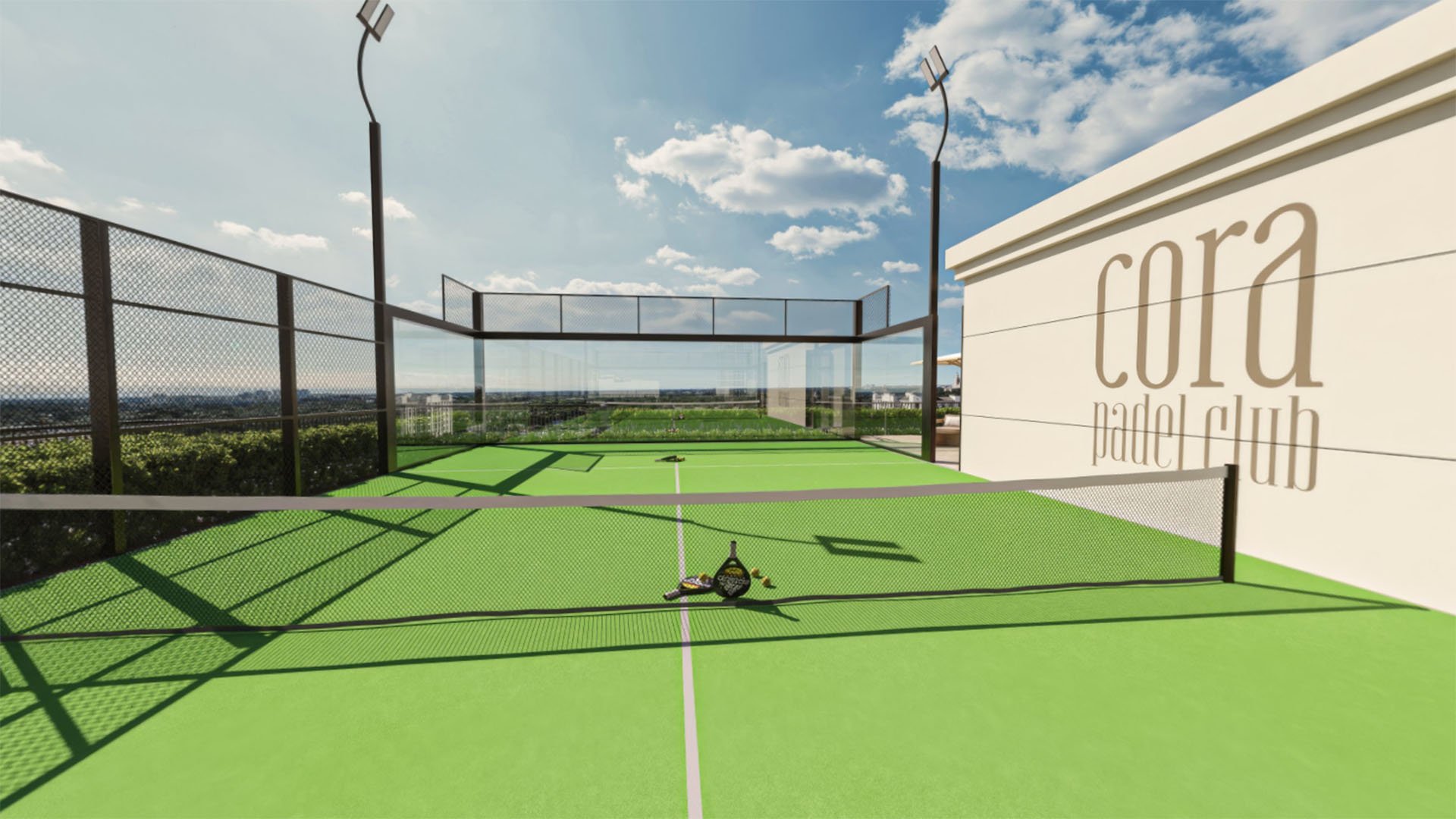
Padel has moved from niche sport to social ritual, and that shift is changing what sophisticated buyers notice. A court can look pristine in renderings and still play poorly in real life if the fundamentals are compromised: slab flatness, drainage strategy, wind behavior, glare control, and acoustic containment. In a luxury environment, those fundamentals also need to be integrated discreetly, so the court doesn’t read as a loud, industrial insert.
At Cora Merrick Park, the conversation becomes especially architectural. Coral Gables buyers tend to value restraint, proportion, and long-term durability. A custom court-whether private or shared-is not just a “sport feature.” It is engineered infrastructure, positioned alongside landscaping, façades, pools, and outdoor rooms that are expected to age gracefully.
Padel is unusually sensitive to enclosure accuracy because the walls are part of play. In practice, quality begins with the box itself: consistent wall alignment, predictable rebound, and safe, comfortable sightlines. “Custom” should not mean improvisational. It should mean the enclosure, access gates, and surrounding clearances are designed to fit the site, circulation patterns, and aesthetic language of the property.
From an engineering standpoint, the enclosure has three priorities:
The glass and steel should feel inert under impact and wind loads. Vibrations read as cheap, and they also undermine rebound consistency.
The court performs best when surfaces are true and joints are precise. Small deviations show up as strange bounces, especially at the junction between floor and wall.
Door hardware, edge protections, and transitions to adjacent paving should feel seamless. In a luxury setting, the best safety solutions don’t look like safety solutions.
In South Florida, a court’s long-term quality is anchored below the surface. Drainage and subbase design aren’t glamorous, but they determine whether the court stays flat, drains quickly, and avoids recurring surface repairs.
A premium build typically treats the court as a small civil project: subgrade preparation, compaction strategy, a slab designed for movement and settlement realities, and a drainage plan that performs in hard rain. That means thinking beyond the court footprint and accounting for adjacent landscaping, irrigation overspray, and how water moves across the broader deck or terrace.
In Coral Gables, where properties often blend lush planting with hardscape, drainage is also about protecting the surrounding environment. A well-engineered padel court should avoid creating new puddle zones near planters or building thresholds. The owner experience is straightforward: after rain, you want a predictable return to play-without slippery perimeter bands or persistent dampness that invites mildew and staining.
Buyers often focus on the visible layer, but the right surface system is a performance decision as much as a styling one. Under South Florida sun, surface temperature can become the hidden limiter of usability. Comfort matters because padel is social; people linger courtside, and the microclimate should feel welcoming.
The most successful specifications balance:
reliable grip without feeling sticky underfoot.
enough comfort for joints while still offering crisp movement.
the ability to keep the surface clean and true without constant closures.
Humidity and salt air also reward materials specified for this climate rather than selected by default. Corrosion resistance in fasteners and framing, coatings that hold up under UV, and detailing that avoids trapped moisture all extend the time between major refurbishments.
Padel’s signature glass walls are where luxury projects can either shine or stumble. High-clarity glass reads refined-but only if it stays clear and well-aligned. In coastal-adjacent environments, metal selection and protective finishes become critical. A court that looks pristine at delivery can look tired quickly if hardware corrodes, coatings chalk, or joints begin to discolor.
From a buyer’s lens, the question is not “Is it glass?” It is “Is it detailed like a permanent exterior building element?” That includes thoughtful water shedding, durable sealants, and hardware that can be maintained without turning every service visit into a construction event.
For context, many South Florida luxury buildings now treat outdoor amenity hardware with the same seriousness as balcony railings and façade components. It’s the same mindset you see in places where buyers expect a cohesive, long-lived outdoor environment, whether in Brickell at 2200 Brickell or in other design-led towers where exterior durability is part of the luxury promise.
Lighting is often the easiest line item to under-specify-and one of the fastest ways a discerning buyer can feel the difference. Padel demands even illumination, minimal glare on glass, and a layout that respects both players and neighbors.
A truly custom approach considers:
so light stays on-court rather than spilling into residences.
comfortable visibility for fast ball tracking.
fixtures that can be serviced without disrupting the entire amenity deck.
In luxury buildings, the social life of an amenity often peaks in the evening. A court that plays well at night increases real-world usage, which is what ultimately justifies the square footage.
South Florida breezes are part of the lifestyle, but they can also make play inconsistent. Custom engineering can reduce wind issues through thoughtful placement, shielding, and landscape coordination. The goal is not to erase outdoor character, but to avoid gust patterns that turn casual play into frustration.
Acoustics are equally important. Padel is percussive: ball impact, player movement, and social energy create a distinct sound profile. In a luxury residential setting, the court needs to coexist with terraces, pools, and quiet rooms. That is where enclosure detailing, acoustic strategies, and operating rules intersect.
This is also why amenity planning increasingly resembles hospitality planning. At Five Park Miami Beach, for example, the broader market expectation is that amenities support lifestyle without becoming a nuisance. Engineering and governance have to work in tandem.
The best padel courts aren’t isolated boxes. They function as part of a small club environment with a natural rhythm: arrival, warm-up, storage, hydration, and a place to watch without crowding players. In a custom court at a luxury residence, that rhythm should feel inevitable, not forced.
Key design cues include clear entry sequences, controlled sightlines, and perimeter space that reads as intentional lounge rather than leftover clearance. Done well, the court becomes a social anchor that supports the property’s identity and helps residents actually meet one another.
In Coral Gables, that social energy tends to be curated rather than loud. A custom padel court can respect that by prioritizing comfort and discretion: thoughtful landscape buffering, refined materials at touchpoints, and a courtside experience that feels closer to a private club than a public park.
For condo buyers, the amenity is only as good as the building’s ability to maintain it. Padel courts involve specialized cleaning, periodic inspection of hardware, surface upkeep, and lighting maintenance. The most sophisticated approach is to treat the court as an asset with an operating plan.
Buyer-oriented questions include:
Who is responsible for routine inspections and what is the cadence?
How are reservations managed to prevent friction among residents?
Are there quiet hours or use policies to protect adjacent residences?
Is there a plan for long-term surface replacement, not just touch-ups?
In other words, “engineering” includes operations. A well-executed padel amenity should feel consistent year after year, even as resident turnover occurs.
Padel is now part of a wider recalibration: buyers increasingly compare amenity quality across neighborhoods, from Coral Gables to Miami Beach to the waterfront corridors further north. What stands out is not simply having the sport, but having it executed with restraint and longevity.
In the same way that wellness programming has influenced developments like The Well Coconut Grove, padel is pushing projects to think more like clubs. That means more attention to microclimate, acoustic comfort, and the quiet mechanics that keep everything functioning elegantly.
For a buyer evaluating Cora Merrick Park, the most useful lens is to treat the court as a built system: structure, surface, enclosure, light, drainage, and governance. When those pieces are aligned, padel becomes a daily, frictionless luxury-not a novelty.
What makes a padel court “custom” in a luxury residential setting? Custom typically means the court is tailored to the site, aesthetics, and operations, not simply installed as a standard kit.
Is drainage really the biggest issue in South Florida? It is one of the most consequential factors, because heavy rain and humidity can quickly expose weak subbase work and poor detailing.
How can a buyer judge build quality during a tour? Look for flatness, clean joints, a rigid enclosure feel, and lighting that avoids glare on glass.
Do glass walls require special upkeep? Yes. Maintaining clarity, alignment, and corrosion-resistant hardware is part of long-term performance.
What lighting qualities matter most for padel? Even illumination, low glare, and controllable spill light are key for playability and neighbor comfort.
How important is wind protection on an outdoor court? Very, because gusts can change ball behavior; good placement and buffering improve consistency.
Will a padel court increase noise concerns for residents? It can, which is why enclosure detailing, landscape buffering, and operating rules matter.
What questions should condo buyers ask about operations? Ask about reservation systems, maintenance cadence, quiet hours, and long-term refurbishment planning.
Is surface choice mostly about aesthetics? No. It affects traction, comfort, heat behavior, and the frequency of maintenance closures.
How does padel compare to tennis for amenity value? Padel often supports more social, time-efficient play, but it requires precise enclosure engineering.
For a discreet conversation and a curated building-by-building shortlist, connect with MILLION Luxury.
If branded residences are on your mind — as a home or as an allocation — we would be glad to share what we are seeing, privately.
Begin a quiet conversation