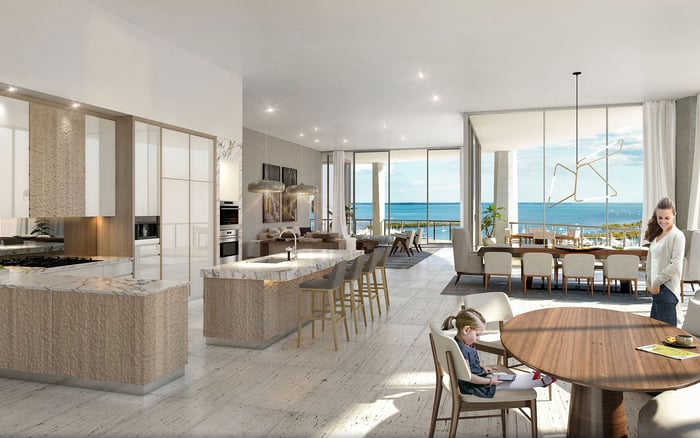
In Coconut Grove, two landmark residential statements express luxury through radically different architectural languages: Grove at Grand Bay’s tropical modernism and Park Grove’s disciplined minimalism. For buyers weighing lifestyle, light, privacy, and long-term design relevance, the choice is less about which is “better” and more about which philosophy matches how you live.
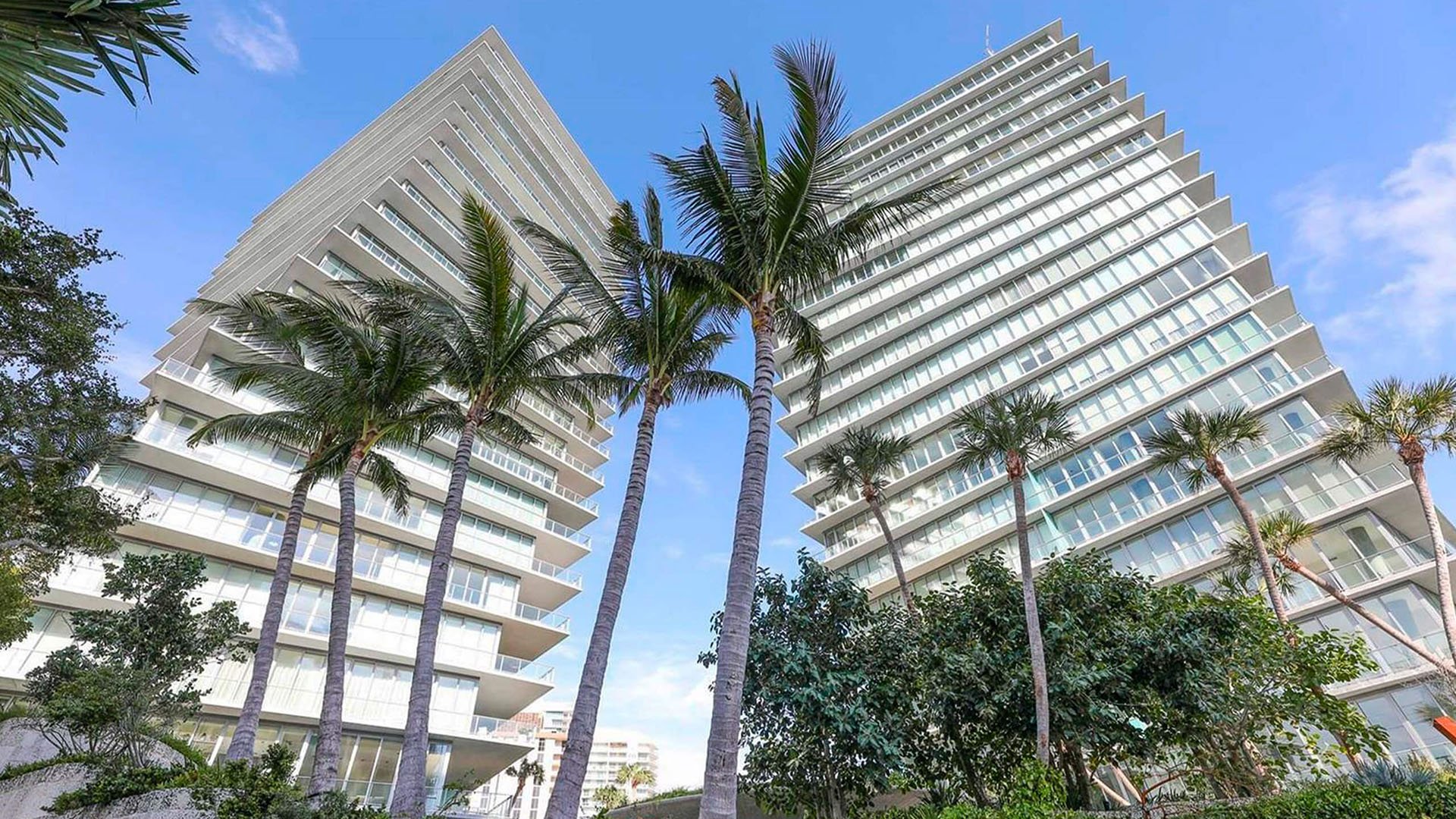
Coconut Grove is one of Miami’s rare neighborhoods where the walk from street to lobby can feel like a transition between climates. Canopy, breezes, and bay-glint shape expectations before you even reach the front door. In that context, the contrast between Grove at Grand Bay and Park Grove Coconut Grove is immediately clear: one leans into tropical modernism with cultivated lushness; the other expresses luxury through minimalist lines and disciplined composition.
For the buyer, this distinction is practical, not theoretical. Architecture determines how a home performs over time-how it filters sun, frames privacy, supports entertaining, and sets the emotional temperature of everyday living. If you are deciding between these two addresses, the most useful question is not which feels more impressive on day one, but which remains quietly satisfying on an ordinary Tuesday.
Tropical modernism is often described as “relaxed,” but the best examples are rigorously intentional. The goal is comfort through modulation: shade layered over light, greenery used as an architectural element, and surfaces that invite touch. You experience it as a sequence of thresholds-bright exterior into cooler, protected space, then back out to air and view.
Minimalism makes a different promise. It reduces visual noise so proportion, geometry, and negative space do the work. Instead of layered thresholds, you get a cleaner, more immediate read of volume and view. The sensation is calm and edited, with details designed to recede so the home feels like an extension of horizon and sky.
In Coconut Grove, where the atmosphere itself is a luxury, these approaches can change how you perceive the neighborhood. Tropical modernism emphasizes intimacy with the landscape; minimalist lines emphasize order within it.
The most revealing moment in any residential tower is arrival. Tropical modernism tends to use landscape and screening to create discretion. The path from street to elevator can feel buffered, as if you are being drawn into a private garden before you reach your front door. This is the architecture of soft boundaries-often preferred when owners want their home to feel separate from the city’s tempo.
Minimalist architecture often makes privacy feel sharper and more defined. Rather than being concealed by foliage and layered shadow, you are protected by clarity: controlled sightlines, precise separations, and a sense that every element has been deliberately placed. The result can feel more gallery-like, with a quieter kind of drama.
If you routinely entertain, ask yourself which form of privacy you prefer. Do you want discretion that reads as natural, or privacy that reads as engineered? Neither is more luxurious; they are simply different expressions of control.
In South Florida, light is not simply a design feature. It is a performance condition that affects art, finishes, and even how long you can comfortably occupy a terrace. Tropical modernism typically responds by creating shade without sacrificing openness. Think of it as comfort through gradients: bright, then filtered, then bright again.
Minimalist lines often treat light as the primary material. Clean planes and careful apertures turn the day into a slow-moving composition. The advantage is visual clarity: the home can feel exceptionally serene, with fewer competing textures. The tradeoff, for some, is that minimalism can be less forgiving when you want the space to feel casual. The architecture asks you to curate.
For buyers with significant art, collections, or sensitive finishes, both approaches can work. The practical difference is how much the building’s baseline condition already moderates glare, heat, and direct exposure. Your best proxy is not marketing imagery, but a site visit at two times of day-ideally including late afternoon.
Coconut Grove living is terrace living. Yet what a terrace feels like shifts depending on whether the building’s language is tropical modernism or minimalism.
In a tropical modern framework, a terrace often reads like an outdoor room. Edges tend to feel softened by curvature, planting, and the perception of shelter. You are encouraged to linger, host, and move between interior and exterior without a hard boundary. It pairs naturally with furniture that feels residential rather than staged.
In a minimalist framework, the terrace can feel like a continuation of the architecture’s geometry. The line of the slab and railing becomes part of the composition, and the view is treated as the focal point. Entertaining still works beautifully, but it often feels more structured: fewer objects, clearer circulation, and stronger emphasis on the table, the skyline, and the horizon.
If your lifestyle leans toward long lunches, casual evenings, and barefoot transitions from living room to outdoors, tropical modernism may feel more intuitive. If your lifestyle leans toward clean hosting, artful restraint, and a home that always feels “ready,” minimalist lines may be the better match.
Discreet luxury often shows up as reduced friction. While specific material schedules vary by residence and renovation choices, the architectural intent still shapes daily maintenance.
Tropical modernism’s layered textures and lush adjacencies can feel warmer, but they may also invite more interaction with the elements: humidity, salt air, and the simple reality that greenery is alive. Owners who value the sensorial quality of a home integrated with landscape may gladly accept that it is not a sterile environment.
Minimalism tends to favor surfaces and detailing that read crisp and continuous. That can feel effortless when executed well, but it can also make imperfections more visible. Minimalist interiors reward precision in furniture selection and finishes, and they can feel less forgiving if you prefer a home that disguises life’s messier moments.
A useful self-test: do you want your home to patina gracefully, or to stay visually pristine? Your answer points toward the architectural language that will feel most natural over time.
Coconut Grove is not a district of anonymous towers. It is a place of established streets, mature trees, and a social life that favors low-key excellence over spectacle. That’s why these two projects resonate: each translates that ethos in a distinct way.
Grove at Grand Bay leans into a “resort-in-a-garden” sensibility aligned with the Grove’s tropical identity. Park Grove’s minimalist lines read as a modern counterpoint, offering visual quiet in a neighborhood known for organic texture.
This is also why adjacent choices matter. Buyers considering the Grove often cross-shop newer or more boutique offerings where the language shifts again, such as Mr. C Tigertail Coconut Grove for a more hospitality-inflected experience, or Four Seasons Residences Coconut Grove for a service-forward interpretation of modern luxury. Even if you return to Grove at Grand Bay or Park Grove, seeing these alternatives can clarify your preferences.
Tropical modernism at this level tends to suit buyers who want a home that feels inherently lived-in, even when impeccably finished. They value shade and softness, the sensation of a private retreat, and a design language that treats nature as a partner.
Minimalist lines tend to suit buyers who want their home to feel edited and composed. They value clean geometry, quiet backdrops for art and views, and a sense of architectural discipline that reads as timeless through restraint.
Both profiles can be deeply luxury-minded. The difference is whether your definition of luxury is closer to ease or to precision.
When you tour, take notes on lived experience rather than declarations of style.
First, track acoustic comfort. Notice how sound behaves in corridors, lobbies, and inside the residence with balcony doors open and closed.
Second, pay attention to where you instinctively place your body. Do you gravitate toward corners and sheltered zones, or toward open spans and direct view corridors? That instinct often reveals whether you want tropical enclosure or minimalist openness.
Third, study how the building frames everyday objects: the coat-hook moment, the entry console, the kitchen sightline from the front door. Minimalism can make these moments feel immaculate; tropical modernism can make them feel welcoming.
Finally, consider how you will use the neighborhood. Coconut Grove rewards walking, marina life, and spontaneous dinners. The building that supports your rituals-not your mood in the sales gallery-is usually the right one.
Grove at Grand Bay and Park Grove Coconut Grove offer two sophisticated answers to the same question: how should luxury feel in a tropical, bay-adjacent neighborhood with a deep sense of place?
If you want an experience that blends architecture and landscape into a continuous retreat, tropical modernism can feel like the more natural extension of Coconut Grove. If you want a home that functions like a calm, precise instrument for light and view, minimalist lines may feel more enduring.
Either way, the smartest decision comes from aligning the building’s philosophy with your daily life: how you arrive, how you host, how you rest, and how you want the day’s light to move across your space.
Is Grove at Grand Bay more “tropical” in feel than Park Grove? Generally, yes: its aesthetic reads softer and more landscape-driven, while Park Grove reads more minimal.
Does minimalist architecture feel colder in South Florida? Not necessarily; it can feel serene, but it does require a more intentional approach to furnishing and finishes.
Which style is better for indoor-outdoor living? Both support it, but tropical modernism tends to blur the boundary more, while minimalism feels more defined.
Will one style date faster than the other? Both can age well; minimalism relies on proportion and detailing, while tropical modernism relies on comfort and shade.
Which tends to feel more private? Tropical modernism often creates privacy through layered buffers; minimalism often creates it through controlled sightlines.
Is one better for art collections? Minimalist interiors can be excellent backdrops, while tropical modernism can work beautifully with thoughtful lighting and placement.
Do terraces function differently between the two approaches? Yes; tropical modern terraces often feel like outdoor rooms, while minimalist terraces emphasize geometry and view.
Should I tour at a specific time of day? Tour once in bright midday light and again late afternoon to understand glare, shade, and how views read.
How do I compare lifestyle beyond the buildings themselves? Walk the immediate area, note your preferred routes, and picture daily rituals like coffee runs and evening strolls.
What’s the simplest way to choose between them? Choose the one whose arrival sequence and light quality immediately make you exhale.
To compare the best-fit options with clarity, connect with MILLION Luxury.
If branded residences are on your mind — as a home or as an allocation — we would be glad to share what we are seeing, privately.
Begin a quiet conversation