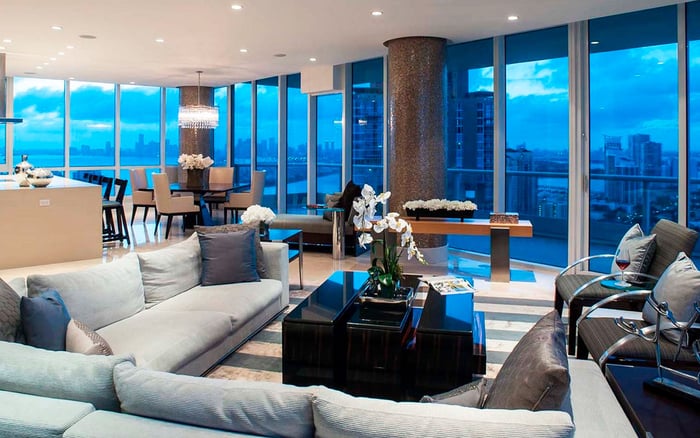
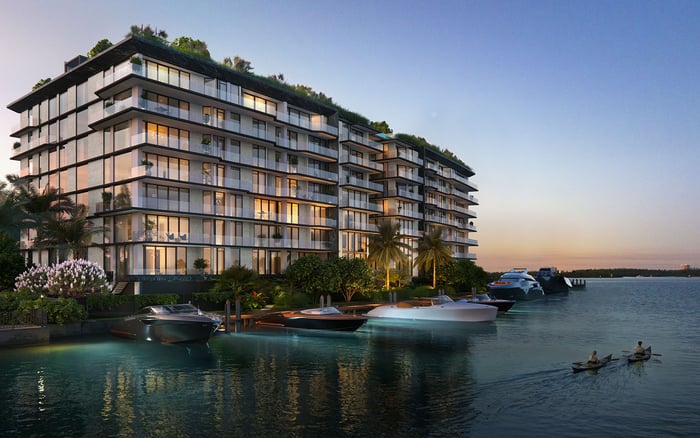
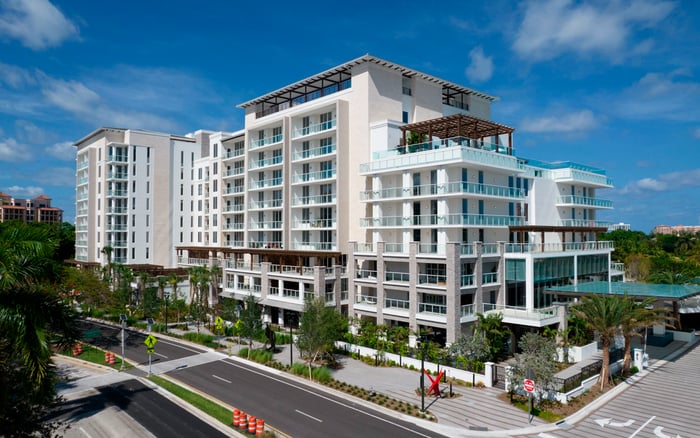
For buyers who prioritize privacy, operational ease, and a polished household rhythm, South Florida’s best-fit residences are those designed with true separation between owner arrival and staff movement. In Palm Beach estates, Coral Gables compounds, Coconut Grove houses, and newer ultra-luxury towers from Miami Beach to Brickell, discreet service circulation has become one of the clearest markers of top-tier planning.
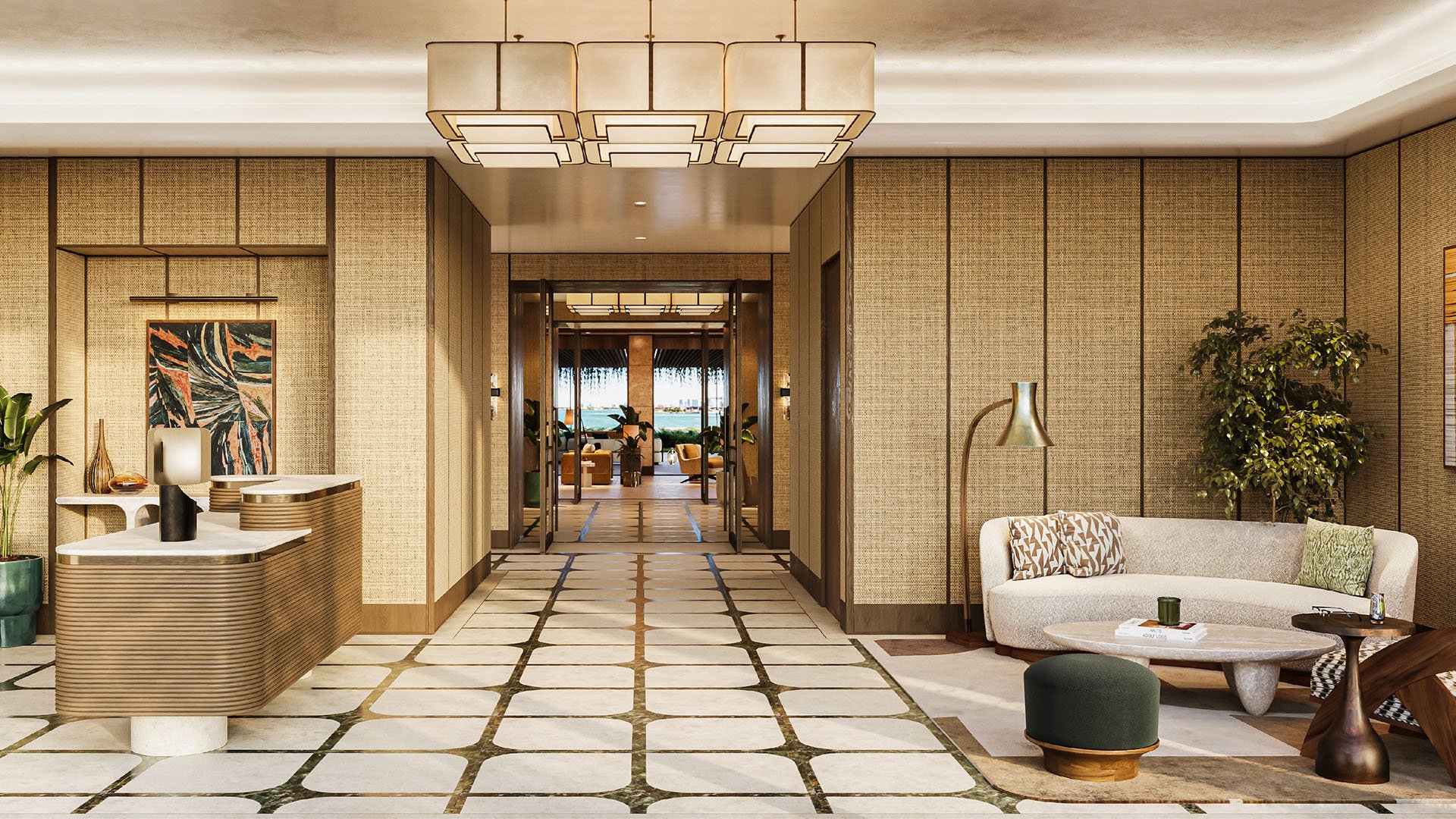
In South Florida’s uppermost residential tier, separate staff circulation is not a minor convenience. It is a planning principle. Buyers who run homes with house managers, chefs, drivers, nannies, security personnel, or frequent event support tend to value an interior sequence that keeps household operations efficient while preserving the calm of the primary living spaces.
That preference is especially visible across Palm Beach estates, Coral Gables compounds, Coconut Grove houses, and newer condominium towers in Miami Beach, Brickell, Aventura, and Sunny Isles. In each of these markets, the appeal is essentially the same: owners want a residence that can function like a private home and a finely run hospitality environment at once, without making either role feel exposed.
The strongest residences for this buyer profile typically separate principal arrival from deliveries, housekeeping, catering, and daily staff movement. In practice, that can mean service elevators distinct from resident lifts, concealed utility corridors, a secondary entry adjacent to the kitchen, in-unit staff quarters, separate loading access, hidden pantry routes, or estate-style service drives and courtyards.
1. Palm Beach and West Palm Beach estate-style residences - legacy dual-entry planning
For buyers who want the purest expression of discreet household circulation, Palm Beach remains one of the most compelling settings. The local residential tradition is rooted in estate planning that has long separated formal arrival from service movement, often through dual entrance systems, service corridors, and support access designed to stay outside the entertaining sequence.
That legacy still shapes what sophisticated buyers seek today: homes or residences where household logistics can unfold quietly in the background. Newer branded offerings such as The Ritz-Carlton Residences® West Palm Beach and Alba West Palm Beach sit naturally within that conversation because the market increasingly rewards privacy-centered planning rather than sheer square footage alone.
2. Coral Gables and Coconut Grove houses - the service wing tradition reinterpreted
Coral Gables established an enduring local precedent for servant halls, kitchen wings, and discreet garden or staff entries. In contemporary terms, that translates into buyers favoring properties where staff can support daily life and entertaining without passing through principal family spaces.
Coconut Grove shares much of that appeal, especially for buyers who prefer lower-density living and estate logic over tower living. Projects like Ponce Park Coral Gables and Vita at Grove Isle resonate with this audience because the broader submarkets themselves are associated with a more residential, more controlled rhythm of arrival and service.
3. Miami Beach ultra-luxury towers - split circulation with hospitality discipline
Miami Beach towers completed in the modern ultra-luxury era increasingly emphasize fuller separation between private resident circulation and operational flow. This is where service elevators, hidden support routes, and staff-oriented spaces become especially important for owners who entertain often or maintain regular domestic teams.
The market has long associated resort-residential planning with this kind of discretion, and buyers drawn to hospitality-style living often start with addresses such as Setai Residences Miami Beach or The Ritz-Carlton Residences® Miami Beach. The point is not simply service, but service that remains largely invisible to the private household experience.
4. Brickell’s newest super-prime condominiums - vertical privacy engineering
In Brickell, separate circulation is now one of the clearest dividing lines between luxury and ultra-luxury. At the highest price bands, buyers increasingly expect concealed back-of-house routes, dedicated service-elevator access, and floor plans that allow provisioning, housekeeping, and catering to happen without interrupting the formal living sequence.
That is why the neighborhood’s most ambitious new offerings, including The Residences at 1428 Brickell and St. Regis® Residences Brickell, are best understood through operations as much as aesthetics. For a buyer with full-time staff, the real luxury is often not the finish palette. It is the ability to maintain order, privacy, and timing within a highly public skyline address.
5. Sunny Isles, Aventura, and North Bay-adjacent towers - service banks and controlled logistics
In the northern coastal condominium belt, newer luxury towers increasingly standardize service elevator banks, private support corridors, and distinct loading arrangements. This is especially relevant for buyers who use their residences seasonally yet still maintain year-round household support, security oversight, or regular provisioning.
The appeal of places such as The Estates at Acqualina Sunny Isles lies in that controlled operational structure. Even where individual floor plan details differ, the broader product type is increasingly tailored to residents who want white-glove living without collapsing household operations into the owner’s day-to-day circulation.
Buyers often focus on a separate service entry as a headline amenity, but the stronger test is whether the entire plan supports discreet movement from arrival to cleanup. A service door that opens into a visible hallway is not the same as a truly resolved back-of-house sequence.
The best residences usually answer several questions well. Can staff reach the kitchen or prep area without crossing the formal foyer? Can deliveries move from loading to pantry or utility area with minimal exposure? If the residence is used for entertaining, can event staff circulate without interrupting guest arrival? If there is live-in help, is there a proper support zone rather than an improvised extra bedroom?
In tower residences, buyers should ask whether service circulation is limited to a nominal secondary entrance or whether the building itself includes dedicated elevator programming, controlled loading, and restricted support corridors. In single-family homes, the focus often shifts to service drives, secondary gates, utility courtyards, and whether the architecture keeps operational traffic away from pool terraces, formal salons, and family rooms.
This is one of the few luxury features that is difficult to retrofit elegantly. Finishes can be updated. Smart-home systems can be replaced. Even kitchens can be reworked. But circulation logic is structural. If a plan was not conceived with separate movement patterns in mind, redesigning it later usually requires disproportionate compromise.
That is why this feature often carries unusual weight with entrepreneurs, executives, and international buyers accustomed to fully staffed homes. They are not simply buying prestige. They are buying predictability. The residence must function smoothly on ordinary mornings, during holiday occupancy, and on nights when a formal dinner requires caterers, housekeeping, and security to operate in parallel.
This is also why mid-market homes rarely satisfy the same standard. They may offer a secondary door or a large kitchen, but they typically lack the complete ecosystem of service circulation, concealed support space, and dedicated access that defines a truly upper-tier residence.
South Florida offers an unusually rich mix of historical precedent and contemporary product. Palm Beach and Coral Gables contribute the estate tradition: service wings, dual entries, and household planning rooted in classic formal architecture. Miami Beach and Brickell contribute the modern tower solution: split-entry layouts, hidden support routes, and high-security vertical circulation. Coconut Grove sits elegantly between those worlds, while Sunny Isles and Aventura continue to expand the condo inventory suited to staff-supported living.
For the right buyer, the best residence is not necessarily the one with the most dramatic lobby or the highest floor. It is the one where private life remains serene because the home has been designed to absorb the machinery of daily living without display.
Why do separate staff circulation and service entries matter so much in luxury homes? They protect privacy, reduce visual clutter, and allow household operations to run efficiently without crossing family or guest spaces.
Which South Florida areas are strongest for this feature? Palm Beach, Coral Gables, Coconut Grove, Miami Beach, Brickell, Aventura, and Sunny Isles are among the strongest submarkets.
Are these features more common in houses or condominiums? Full separation is often strongest in large estates, but newer ultra-luxury towers increasingly offer sophisticated versions of the same concept.
What should condo buyers ask about specifically? Ask about service elevators, secondary entries, restricted support corridors, loading access, and whether the residence includes staff-oriented support space.
What should house buyers inspect on a showing? Look for service drives, kitchen-side access, utility courtyards, staff quarters, and whether operations can stay out of formal entertaining areas.
Does a second entrance automatically mean a home is well planned? No. The real issue is whether the entire circulation pattern keeps service movement discreet from arrival through cleanup.
Is this mainly important for buyers with live-in staff? Not exclusively. It also matters for owners who rely on daily housekeeping, catering, childcare, security, or frequent entertaining support.
Do newer Miami towers tend to handle this better? In many cases, yes. More recent super-prime buildings often integrate service access into the building’s operational design from the outset.
Can a residence with poor circulation be fixed later? Sometimes partially, but true separation is difficult to retrofit because circulation logic is often embedded in the original architecture.
Who tends to value this feature most? It is especially appealing to executives, entrepreneurs, and international buyers who expect a polished, staff-supported residential experience.
For a discreet conversation and a curated building-by-building shortlist, connect with MILLION Luxury.
If branded residences are on your mind — as a home or as an allocation — we would be glad to share what we are seeing, privately.
Begin a quiet conversation