In South Florida’s ultra-prime market, entertaining is less about square footage and more about choreography: how the kitchen opens, where guests circulate, how terraces extend the evening, and whether the building itself can absorb the parts of hosting you would rather not manage. Two Coconut Grove case studies illustrate the spectrum, from highly customizable architecture to hospitality-led living. From there, Miami Beach offers a complementary lesson: sometimes the most luxurious host experience is a residence that behaves like a private club.
In South Florida’s upper tier, entertaining is no longer a weekend add-on tucked inside “living space.” It is a primary design program. Buyers increasingly assess a home the way they would assess a venue: arrival, sightlines, acoustics, service flow, and whether indoor and outdoor areas read as one continuous setting.
That shift explains why certain buildings feel instantly right for hosting. They do not simply deliver a large room and a view. They deliver a sequence. Guests can arrive and settle without bottlenecking the kitchen. Conversations can branch into smaller pockets without competing for the same square footage. Terraces function as true extensions of the living room, not decorative appendages. And, at the highest level, the building itself helps carry the operational weight with spaces and services that reduce friction for the host.
Across the market, the most compelling entertaining-oriented residences typically fall into two philosophies. The first is architectural customization, where the home is treated as a bespoke layout that can be tuned to the owner’s rituals. The second is curated hospitality, where brand standards and service infrastructure let entertaining happen with less operational effort.
The customization-driven approach treats the residence as a personal stage set. The practical question is whether the plan can be shaped around how you host. Do you want the kitchen to anchor the evening, or to remain elegantly in the background? Is the dining area meant to be fixed and formal, or flexible enough to expand when the guest list grows? In this model, the best layouts are not just open; they are deliberately structured, with circulation that keeps the room fluid and the host in control.
The hospitality-driven approach shifts the emphasis from what you can build into the unit to what you can outsource to the building. Here, entertaining is often less about producing a multi-course dinner at home and more about orchestrating an elevated night supported by staff, service, and social spaces that feel purpose-built.
Neither philosophy is inherently better. The distinction matters because it changes how you evaluate floor plans, terrace depth, amenity stacks, and even landscaping. A great host residence is not only visually strong. It is strategically frictionless.
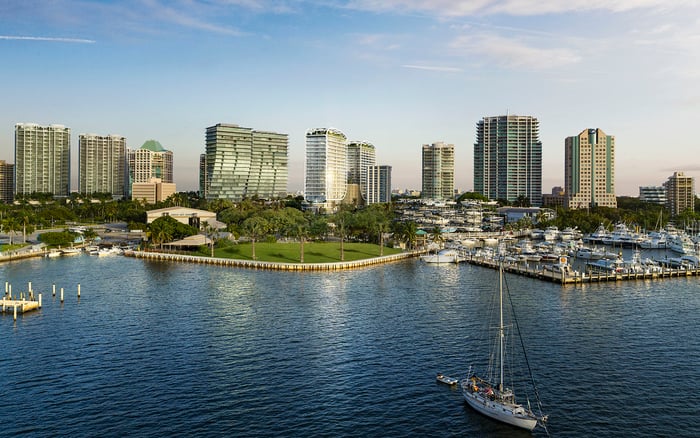
Coconut Grove has long rewarded buyers who value privacy, greenery, and a residential cadence. For owners who host as part of daily life, the neighborhood’s best buildings tend to justify their premiums through thoughtful space planning and indoor-outdoor continuity.
A standout example is Grove at Grand Bay, a luxury condominium in Coconut Grove with two twisting towers and 96 residences. The towers were designed by BIG (Bjarke Ingels Group). The rotating floor plates create the twist and, importantly for entertaining, shift views and terrace conditions from level to level.
For hosting, the twist matters less as sculpture and more as a planning tool. The concept has been described as enabling owners to customize layouts by moving kitchens, bathrooms, and bedrooms, a meaningful departure from more standardized towers. If you entertain frequently, that flexibility can be the difference between a home that simply accommodates furniture and a home that genuinely supports a specific hosting style.
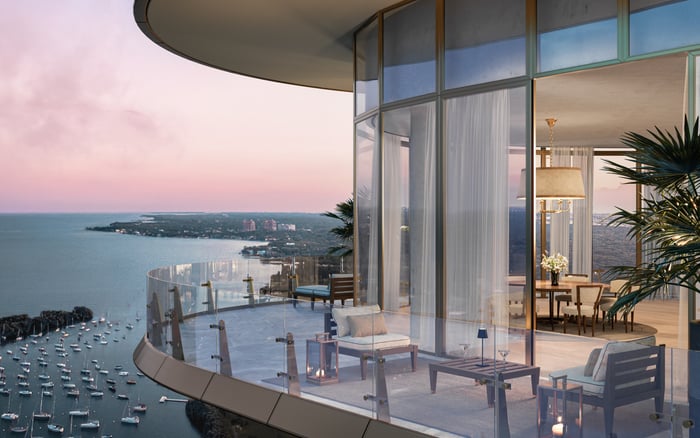
Inside the residences, the intent reads as modern and open, anchored by large terraces designed to operate as true indoor-outdoor living and entertaining zones. The kitchen is positioned as a social engine rather than a hidden back-of-house space, with European-style cabinetry and Miele appliances referenced in project materials.
Equally important, terraces are not treated as decorative ledges. Summer kitchens are planned on terraces, reinforcing that the outdoor room is meant to handle real hosting, not only cocktails. In South Florida, where gatherings naturally migrate, a terrace that can accommodate food, cooking, and conversation without feeling like overflow is a luxury in itself.
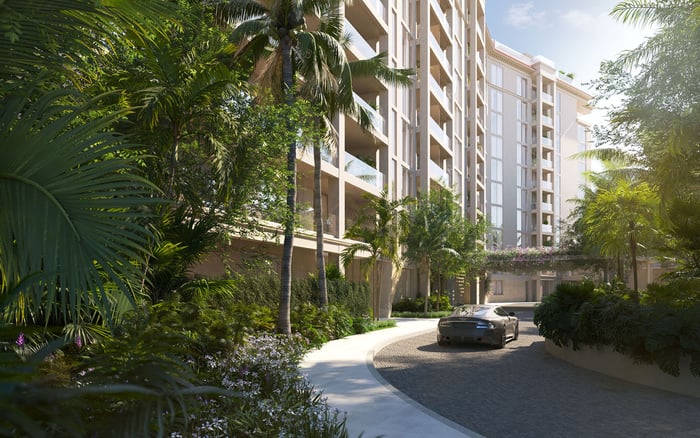
The building’s broader environment supports the same thesis. Landscape design by Raymond Jungles is conceived as a lush, park-like setting with extensive plantings and outdoor circulation. For the host, that translates into atmosphere and approach: arriving through greenery, stepping outside without a hard boundary between “building” and “garden,” and creating a composed backdrop that makes even a small gathering feel intentional.
Finally, the amenity program is positioned as an extension of entertaining, not just a list of perks. It includes multiple resident social and hosting spaces such as a private dining room and residents’ lounge-style areas. Service-oriented features are also part of the positioning, with concierge and butler-style hospitality language used in marketing. The implication is clear: the residence is the centerpiece, and the building can still help you execute.
For some owners, the most luxurious version of entertaining is not a more elaborate kitchen. It is a more effortless night, with fewer moving parts to manage.
Mr. C Tigertail Coconut Grove, a Terra development positioned around a hospitality-first lifestyle tied to the Cipriani and Mr. C brand, is a useful lens for this approach. Rather than leaning into heavy personalization, the project emphasizes a consistent, curated design language across residences. Publicly disclosed materials identify architecture by Arquitectonica and interiors by Meyer Davis, signaling a unified aesthetic rather than a blank canvas.
Within the residences, branded materials market custom Italian kitchens. Appliance packages are described in project collateral as premium, with Sub-Zero and Wolf commonly cited. The result is a chef-grade feel aligned with an overall brand identity, which can support a particular kind of evening: elevated, controlled, and aesthetically cohesive.
Where the hospitality-first model differentiates itself is in how it relocates parts of entertaining beyond the unit. Mr. C Tigertail integrates food-and-beverage style amenities, including market and café concepts and a Bellini Bar concept, as described in branded materials. Poolside service-oriented spaces further reinforce a “host without cooking” pattern that many high-net-worth buyers increasingly prefer.
This is not a rejection of private outdoor space. The project also emphasizes indoor-outdoor living through private terraces and large window walls, keeping the terrace as a key overflow zone even when food and beverages are handled through services.
Amenities expand the hosting toolkit as well, with multiple social rooms such as lounges and business or library-style areas referenced in project collateral. A resident services and tech layer, including app-based service requests, supports the logistics that can quietly make or break a night: timing, housekeeping coordination, and last-minute problem solving.
In short, this is the residence as a private home that benefits from hotel-like operating intelligence.
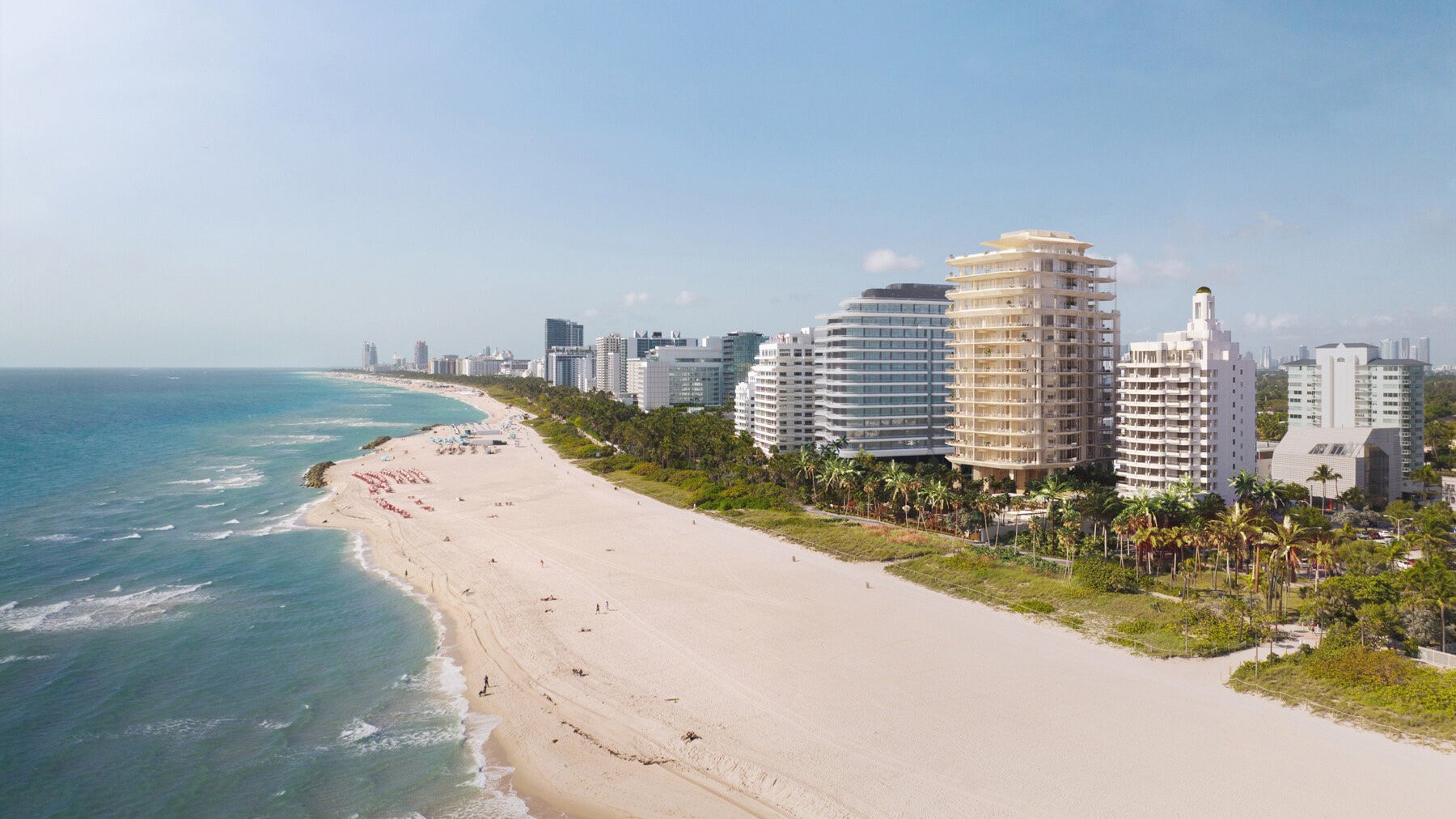
Coconut Grove leans into greenery and a slower tempo. Miami Beach, by contrast, makes a different promise: proximity to energy, culture, and an established social circuit. For buyers who entertain often, that changes the framing from “How do I host everything at home?” to “How do I position home within my hosting ecosystem?”
In that mindset, the most compelling purchase may be the building that lets you pivot between intimate in-residence gatherings and an on-demand, city-scale social calendar. This is why many Miami Beach searches begin by anchoring on building identity and the lifestyle it signals, then working backward into floor plans and views.
For example, Five Park Miami Beach appeals to the buyer who wants a modern, design-forward base that reads as contemporary Miami. Casa Cipriani Miami Beach is often considered by those who respond to a clubby, heritage-leaning hospitality narrative. Shore Club Private Collections Miami Beach suggests another expression of branded, service-aware living, where the residence is part of a broader social proposition. And for buyers who prefer an established ultra-luxury posture, Setai Residences Miami Beach fits the desire for a refined, internationally legible address.
Even when the exact entertaining style differs, the buyer logic is consistent: in Miami Beach, the residence is often chosen not only for its plan, but for how convincingly it supports a life that alternates between private and public.
Entertaining is personal, but the evaluation can be objective. When touring, think like an operator and walk the home as if you are hosting next weekend.
First, test circulation. Can guests move from entry to the living area without passing through working zones? Is there a natural center of gravity where people gather? Open layouts can be beautiful, but the strongest ones still create subtle structure so the space does not read as a single undifferentiated volume.
Second, treat the kitchen as a social instrument. If you love cooking, prioritize a kitchen that faces the room and can accommodate multiple people without compressing. If you prefer catered or service-supported evenings, prioritize a kitchen that is impeccably finished but not necessarily the focal point.
Third, audit the terrace like an interior room. Depth and usability matter more than raw square footage. A true entertaining terrace supports seating clusters, lighting, and an easy transition for food and drink. Projects that plan outdoor summer kitchens signal that the terrace is intended to be operational, not ornamental.
Fourth, evaluate building-level hosting infrastructure. A private dining room, lounge-style social spaces, and service positioning such as concierge or butler-style support can meaningfully expand how and where you host. In a hospitality-forward building, pay attention to how services are requested and delivered, because logistics are part of luxury.
Finally, consider landscape and arrival. Lush, park-like grounds can soften the emotional temperature of an event. Guests remember how a place makes them feel before they remember the menu.
The best entertaining residence in South Florida is the one that matches your preferred level of involvement, from hands-on, kitchen-centered evenings to effortless, service-assisted socializing.
What makes a condo “good for entertaining”? A strong entertaining condo has clear circulation, an open but structured living area, and outdoor space that functions as a real room.
Why do terraces matter so much in South Florida? They extend usable living space and allow gatherings to flow between indoor and outdoor zones in a way that suits the climate.
What is distinctive about the design of Grove at Grand Bay? Its two twisting towers use rotating floor plates, a strategy that shifts views and terrace conditions across levels.
How many residences are at Grove at Grand Bay? Grove at Grand Bay is publicly described as having 96 residences.
What kitchen specifications are associated with Grove at Grand Bay? Project materials describe European-style cabinetry and Miele appliances, with terraces planned to include summer kitchens.
How does landscaping affect hosting at a luxury building? A lush, park-like landscape and thoughtful outdoor circulation can elevate arrival and create a more relaxed setting for guests.
What is the hospitality-first idea behind Mr. C Tigertail Coconut Grove? It emphasizes a branded, service-led lifestyle where entertaining can extend into food-and-beverage style amenities and social spaces.
Who is associated with the architecture and interiors at Mr. C Tigertail? Publicly disclosed materials identify Arquitectonica for architecture and Meyer Davis for interiors.
Do hospitality-led residences eliminate the need for a good terrace? No. Terraces remain critical as overflow space and for indoor-outdoor living, even when services handle food and drinks.
Where can I explore more South Florida luxury residences? Explore more with MILLION Luxury.
If branded residences are on your mind — as a home or as an allocation — we would be glad to share what we are seeing, privately.
Begin a quiet conversation