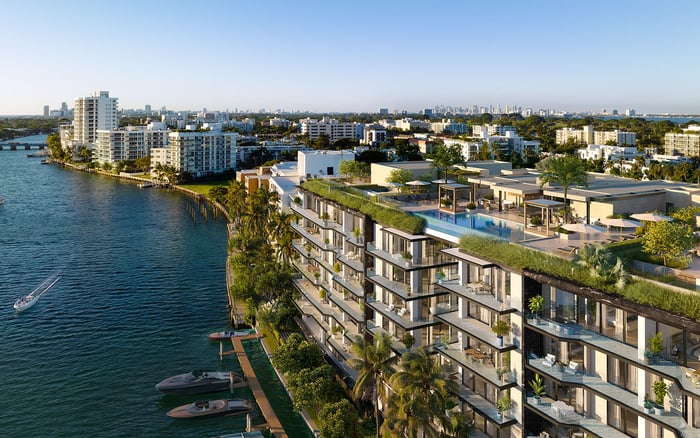
A buyer-focused MILLION editorial guide to evaluating three South Florida oceanfront condominium addresses through building-specific, location-specific, operational, regulatory, and lifestyle due diligence.

For ultra-high-net-worth buyers and family offices, South Florida oceanfront condominiums should not be evaluated as a single asset class with interchangeable views and services. The stronger question is not whether a residence is simply beachfront. It is how a particular building, on a particular stretch of coastline, within a particular municipal context, supports capital preservation, private use, family logistics, and long-term resilience.
That distinction matters when comparing Eighty Seven Park Surfside, Jade Signature Sunny Isles Beach, and Oceana Key Biscayne. Each sits within the contemporary coastal-living conversation, where architectural pedigree, oceanfront land position, amenities, and neighborhood context all influence desirability. Yet the diligence lens should be sharper than the marketing vocabulary. Surfside, Sunny Isles Beach, and Key Biscayne carry different lifestyle patterns, surrounding environments, and risk profiles.
A disciplined buyer should separate romance from verification. The residence may be acquired for personal enjoyment, but the decision still deserves the rigor applied to any meaningful real asset: title, governance, condition, operating costs, regulatory exposure, insurance, liquidity, and family fit.
Eighty Seven Park Surfside belongs to a quieter coastal context where privacy, adjacency, and neighborhood tone can matter as much as the residence itself. For a buyer drawn to Surfside, diligence should examine how the building’s oceanfront position interacts with daily arrival, beach access, neighboring parcels, service circulation, and the character of nearby residential streets.
Jade Signature Sunny Isles Beach operates within a different luxury rhythm. Sunny Isles Beach is known for a vertical oceanfront skyline, so diligence should account for density, traffic patterns, building scale, service capacity, and the relationship between high-rise living and beachfront use. The due-diligence question is not whether Sunny Isles Beach is desirable. It is whether this specific building’s operating model and setting suit the buyer’s household, staff, guests, and seasonal habits.
Oceana Key Biscayne introduces another frame. Key Biscayne is often evaluated through privacy, island access, family rhythm, and a more contained residential atmosphere. A buyer considering Oceana Key Biscayne should test the practical experience of living there in peak season, during school calendars if relevant, and across ordinary weekday routines. For legacy-minded families, the island context may be central to the decision, but it still requires scrutiny.
A serious condominium review should begin with primary building documents, not amenity photography. For each of the three properties, diligence should include the condominium declaration, current budget, reserve materials, board minutes, insurance certificates, pending assessment information, rules and regulations, leasing policies, pet policies, alteration rules, and records relating to building maintenance and structural review.
The purpose is not to presume a problem. It is to understand governance culture. A well-run luxury condominium should be able to communicate how major systems are maintained, how reserves are approached, how capital projects are planned, and how owners are notified about material decisions. Buyers should ask whether the association has a clear cadence for maintenance planning, whether board minutes reveal recurring disputes, and whether budgets reflect the service expectations promised by the building’s positioning.
For family offices, this is where lifestyle and investment discipline overlap. A residence that feels effortless during a private tour may read differently once insurance, reserves, staffing, and capital planning are reviewed together.
Architectural pedigree can create enduring value, but buyers should verify how design intent translates into daily performance. In all three buildings, diligence should include the quality and condition of envelope systems, terrace areas, glazing, mechanical systems, elevators, parking, life-safety systems, amenity spaces, and back-of-house operations. The goal is to understand how the building functions in a salt-air, beachfront environment.
Buyers should ask for evidence of maintenance protocols, recent capital work, service contracts, and any available engineering or structural documentation. If renovations are contemplated, the review should also cover alteration approval requirements, contractor access, work-hour restrictions, elevator reservations, insurance obligations, and whether neighboring units or common elements could affect the timeline.
This is especially important for purchasers who intend to combine lifestyle use with long-term ownership. A trophy residence is not only a view corridor and a floor plan. It is a technical asset operating in a coastal climate, governed by a condominium association, and subject to evolving expectations around safety, reserves, and resilience.
Legal and regulatory diligence should run parallel to design review. Buyers should have counsel review the declaration, bylaws, association rules, purchase contract, title exceptions, parking and storage rights, use restrictions, leasing limitations, and any disclosures provided during the transaction. For oceanfront condominiums, flood-zone considerations, insurance structure, local code requirements, and building recertification or milestone-related obligations may affect ownership experience and future costs.
Timing is critical. These questions should be raised before emotional attachment hardens. A buyer deciding among Surfside, Sunny Isles Beach, and Key Biscayne may find that the strongest fit is not the residence with the most dramatic first impression, but the one whose governance, regulatory profile, and operating assumptions are most compatible with the family’s long-term plans.
Insurance should also be reviewed with specificity. Buyers should understand what is covered by the association, what requires individual coverage, how deductibles are structured, and how coverage expectations may influence personal risk planning. A beautiful beachfront residence can still require careful risk allocation.
In ultra-luxury condominium acquisitions, purchase price is only one line in the ownership model. Buyers should assess monthly assessments, reserves, planned capital expenditures, insurance trends, service levels, staffing expectations, and potential special assessments. None of these should be treated as mere closing mechanics.
For Eighty Seven Park Surfside, Jade Signature Sunny Isles Beach, and Oceana Key Biscayne, the appropriate financial review is building-specific. A family office may want a multiyear ownership model that includes acquisition cost, carrying costs, estimated renovation costs, taxes, insurance, liquidity assumptions, and exit scenarios. Even when the primary motivation is personal use, disciplined modeling clarifies whether the residence supports the buyer’s broader balance sheet and legacy-planning objectives.
Closed-sale comparisons can be useful, but only when adjusted for floor level, view quality, condition, floor plan, outdoor space, parking, storage, renovation status, and timing. A comparable sale is not truly comparable until the differences are isolated.
Lifestyle diligence is often the most underestimated part of the process. Buyers should examine how the building works in practice: airport patterns, school or club access if relevant, staff arrival, guest protocols, valet operations, package handling, beach service, privacy, pets, wellness routines, dining habits, and seasonal occupancy.
For some households, Surfside may offer the right sense of discretion. For others, Sunny Isles Beach may better support a high-rise, resort-style rhythm. Key Biscayne may appeal to buyers who value a more contained island environment. None of these is inherently superior. The correct answer depends on how the residence will be used.
A buyer should visit at different times of day, study arrival and departure patterns, understand elevator and amenity usage, and speak with appropriate professionals before waiving contingencies. In a market where presentation can be polished, lived experience remains the most revealing due-diligence category.
Within MILLION Buyer’s Guides, the central principle is simple: protect optionality. The best acquisition is not merely the most beautiful residence available today. It is the residence whose documents, physical condition, location context, governance structure, and lifestyle utility remain persuasive after scrutiny.
Eighty Seven Park Surfside, Jade Signature Sunny Isles Beach, and Oceana Key Biscayne each belong in a serious coastal-living conversation. The buyer’s work is to determine which one aligns with the family’s priorities, tolerance for complexity, and vision of long-term ownership. In the ultra-premium tier, discretion is valuable, but diligence is indispensable.
Why should buyers compare these three buildings differently? They occupy distinct neighborhood contexts in Surfside, Sunny Isles Beach, and Key Biscayne. Each location can shape lifestyle, risk, operations, and long-term asset performance.
What documents should be reviewed first? Buyers should request the condominium declaration, budget, reserve materials, board minutes, insurance certificates, rules, and any available structural or maintenance records.
Is architectural pedigree enough to justify a purchase? No. Design matters, but buyers should also verify building condition, governance, operating costs, regulatory exposure, and practical usability.
How should family offices approach the review? They should model carrying costs, capital needs, insurance, liquidity, and lifestyle value alongside broader estate and legacy-planning objectives.
What makes oceanfront due diligence different? Salt-air exposure, flood considerations, insurance structure, maintenance intensity, and resilience planning can all affect long-term ownership.
Should buyers rely on comparable sales alone? No. Comparables should be adjusted for view, floor level, condition, layout, parking, storage, outdoor space, and timing.
What should be tested during property visits? Arrival experience, elevator flow, staff protocols, privacy, amenity usage, beach access, and neighborhood rhythm should all be observed.
Can lifestyle fit affect resale value? Yes. A residence that works elegantly for daily life, seasonal use, and guest logistics may retain broader appeal over time.
When should legal counsel become involved? Counsel should review documents before contingencies are waived or before a buyer becomes too emotionally committed to the residence.
What is the core due-diligence principle? Treat each building as its own asset with its own documents, systems, governance, location context, and risk profile.
If you'd like a private walkthrough and a curated shortlist, connect with MILLION.
If branded residences are on your mind — as a home or as an allocation — we would be glad to share what we are seeing, privately.
Begin a quiet conversation