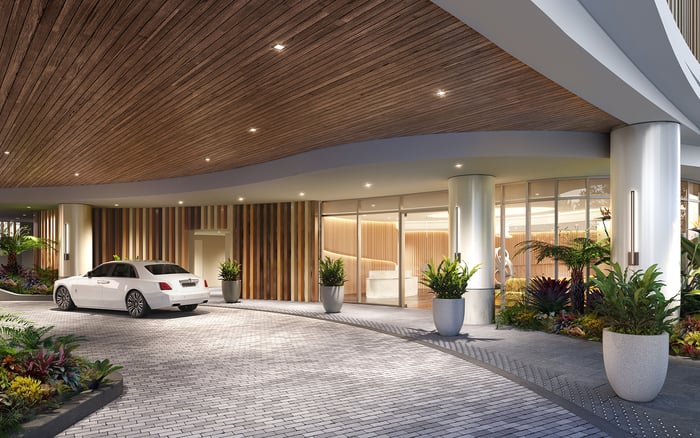
A discreet buyer’s guide to comparing Cipriani Residences Brickell and The Ritz-Carlton Residences® West Palm Beach through the lens of arrival design, storm operations, valet planning, and hurricane-readiness documentation.

Cipriani Residences Brickell and The Ritz-Carlton Residences® West Palm Beach occupy two distinct South Florida mindsets. One belongs to the Brickell cadence of Miami, where vertical living, financial-district energy, and metropolitan arrival sequences shape daily life. The other belongs to the West Palm Beach side of the market, where discretion, access, and a calmer civic rhythm often define the appeal.
For the buyer focused on hurricane readiness, however, the more important comparison is not one brand identity versus another. It is whether the building’s most visible gestures-the lobby, the porte-cochère, the valet operation, and the garage access-are supported by clear operating protocols when weather pressure turns from theoretical to immediate.
In this new-construction and pre-construction tier, polished renderings are not enough. A porte-cochère can photograph beautifully and still fail as an operational zone if staffing, queuing, storm closure, resident communication, and vehicle relocation are not disciplined. A lobby can feel grand and still be less useful in a disruption if power, access control, life safety, and service staffing have not been defined in detail.
Luxury buyers often react to a lobby emotionally first. Ceiling height, materiality, scent, art placement, lighting temperature, and the rhythm of the concierge desk all matter. But for a storm-conscious buyer, lobby volume is not simply a design note. It is a question of how the building receives, manages, and communicates with residents under stress.
At Cipriani Residences Brickell, the Brickell context raises practical questions around density, traffic, vertical circulation, and how residents move between private apartments, amenities, lobby services, garage levels, and exterior arrival areas during a weather event. A buyer should ask how the lobby functions when normal hospitality becomes incident management. Where do residents receive updates? Which systems remain powered? How is access managed if elevators are limited or staged differently?
At The Ritz-Carlton Residences® West Palm Beach, the same lens applies in a different urban environment. West Palm Beach buyers may prioritize ease, privacy, and a less compressed arrival pattern, but the due diligence remains exacting. A West Palm Beach search may begin with geography, but the real filter is operational discipline. The buyer should look for written clarity on how the lobby shifts from gracious arrival room to controlled residential command point.
The strongest answer is not a sales adjective. It is a plan: where residents gather, how staff communicates, what areas remain accessible, which services pause, and which continue.
A porte-cochère is one of the most revealing pieces of a residential tower. In fair weather, it protects privacy, softens arrival, and separates residents from the public street. In severe weather preparation, it becomes a choreography zone. Vehicles arrive, staff directs movement, deliveries may be curtailed, contractors may be restricted, and resident priorities must be handled without confusion.
For Cipriani Residences Brickell, the Miami-side question is how the arrival sequence performs within the tempo of Brickell. Buyers should evaluate turning radius, stacking logic, service access, guest drop-off, ride-share behavior, and whether the entrance can be managed without exposing residents to unnecessary public congestion. The stronger the normal-day choreography, the more credible the storm-day plan becomes.
For The Ritz-Carlton Residences® West Palm Beach, privacy may be a different kind of luxury. The arrival experience should still be examined with the same rigor. How are residents separated from guests? How is staff positioned before landfall? What happens when multiple residents request vehicle movement, luggage assistance, or last-minute departure support at once?
The most refined porte-cochère is not necessarily the largest. It is the one whose circulation has been considered before pressure arrives.
Valet service is often sold as convenience. In hurricane readiness, it becomes risk control. The issue is not simply whether a building offers valet. It is whether the valet team has a documented pre-landfall vehicle plan, a hierarchy for resident requests, a cutoff time for nonessential movements, and a garage strategy that reduces exposure.
Buyers comparing Cipriani Residences Brickell with The Ritz-Carlton Residences® West Palm Beach should ask for specificity without demanding spectacle. Which vehicles are moved first? How are keys tracked? Are resident instructions collected in advance? What happens if an owner is traveling? Is there a written communication sequence before, during, and after the storm?
The garage question is equally important. Luxury towers are not immune to water-management realities. Buyers should understand flood-elevation strategy, garage access protection, drainage assumptions, emergency power coverage, and how staff secures vulnerable entry points. If a building cannot explain the vehicle plan in plain language, the buyer should continue asking.
This is particularly relevant for second-home owners. The owner who is away during a storm watch needs confidence that the residence is not dependent on improvisation.
The Cipriani Residences Brickell versus The Ritz-Carlton Residences® West Palm Beach decision can be framed as lifestyle first, but hurricane readiness deserves its own private interview. A composed buyer should request operational clarity in writing, ideally before contract comfort becomes emotional commitment.
Start with lobby operations. Ask for the intended use of the lobby during a storm watch, storm warning, and post-storm assessment period. Ask which systems have emergency power coverage and which resident-facing functions remain staffed.
Then move to arrival control. The porte-cochère should have more than an aesthetic role. Buyers should ask how the entrance is closed, secured, staffed, and reopened. If temporary barriers, storm shutters, access limitations, or alternate routes are part of the plan, the sequence should be understandable.
Valet is the next test. Ask how vehicles are prioritized, what happens to long-term parked cars, how keys are accounted for, and how owners are notified if a vehicle must be relocated. A luxury building should be able to describe this calmly.
Finally, ask whether protocols are rehearsed on a documented schedule. The most persuasive hurricane-readiness program is not the most dramatic. It is the one practiced enough to feel uneventful.
South Florida’s ultra-premium buyers are increasingly fluent in the difference between amenity and infrastructure. A spa, private dining room, or owner’s lounge can elevate daily life, but operational luxury is what preserves confidence when routine breaks.
Cipriani Residences Brickell may speak to buyers who want a Miami address with a strong hospitality identity and immediate Brickell relevance. The Ritz-Carlton Residences® West Palm Beach may speak to buyers who want the West Palm Beach setting with a service culture associated with branded residential living. Neither preference eliminates the need for precise due diligence.
The mature buyer does not ask, “Is the building hurricane proof?” That question invites vague reassurance. The better question is, “What exactly happens, who is responsible, when does it happen, and how will I know?”
That distinction separates rhetorical readiness from operational readiness. It also protects the buyer from overvaluing images and undervaluing process. In the best buildings, the two are aligned: the arrival is beautiful because it is controlled, and it is controlled because operations were designed into the residential experience.
Is Cipriani Residences Brickell the Miami-side subject in this comparison? Yes. Cipriani Residences Brickell is treated here as the Brickell and Miami-side project in the comparison.
Is The Ritz-Carlton Residences® West Palm Beach the Palm Beach-side subject? Yes. The Ritz-Carlton Residences® West Palm Beach is treated as the West Palm Beach-side project in this comparison.
Should buyers rely on lobby renderings to judge hurricane readiness? No. Renderings can show atmosphere, but buyers should request written operating details for power, access, staffing, and resident communication.
Why does lobby volume matter during storm preparation? Lobby volume can influence circulation, gathering, communication, and controlled access during periods when normal hospitality functions change.
What should buyers ask about a porte-cochère? Buyers should ask how vehicles queue, how privacy is protected, how the entrance is secured, and how operations change before landfall.
Why is valet planning important for luxury condo buyers? Valet planning determines how vehicles, keys, resident requests, and garage movements are handled when timing and access become critical.
What is the most important garage question? Ask how the garage is protected from water intrusion, how vehicles are prioritized, and what systems remain operational during an event.
Is brand reputation enough to confirm storm readiness? No. Brand can signal service expectations, but buyers should still verify building-specific protocols, staffing, and emergency systems.
Should second-home owners ask different questions? Yes. They should focus on remote communication, vehicle instructions, access authorization, and post-storm condition updates.
What is the best way to shortlist comparable options for touring? Start with location fit, delivery status, and daily lifestyle priorities, then compare stacks and elevations to validate views and privacy.
For a discreet conversation and a curated building-by-building shortlist, connect with MILLION.
If branded residences are on your mind — as a home or as an allocation — we would be glad to share what we are seeing, privately.
Begin a quiet conversation