A discreet buyer’s guide to reading arrival design in South Florida luxury residences, from lobby volume and porte-cochère privacy to valet choreography and branded service culture.
In South Florida’s highest tier of residential real estate, the first five minutes inside a building can be as revealing as the penthouse view. The driveway, the porte-cochère, the handoff to valet, the sightline into the lobby, and the distance between public energy and private refuge all disclose the kind of life a building is designed to support.
That is why a comparison between Delano Residences & Hotel Miami and The Ritz-Carlton Residences® West Palm Beach is less about decoration than culture. One name carries a residence-and-hotel identity in Miami. The other sits in the West Palm Beach market with branded-residence positioning. Both invite the same buyer question: how does the building perform before one reaches the elevator?
For high-net-worth owners, arrival is not merely ceremonial. It is operational privacy, guest management, staff fluency, weather protection, luggage handling, dinner-hour traffic control, and the quiet preservation of composure after a long flight.
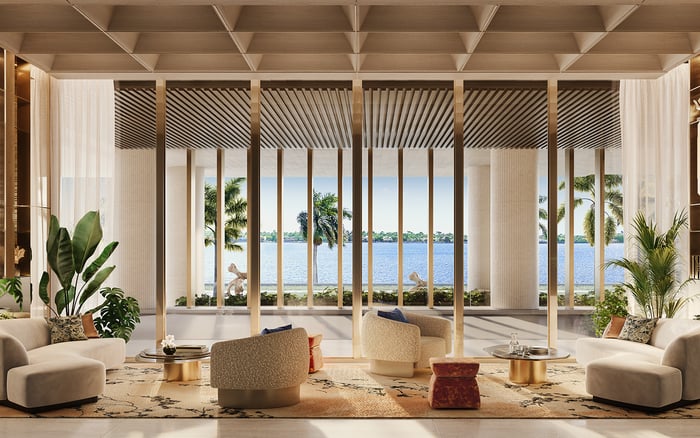
Lobby volume is often mistaken for size. In practice, it is about psychological tempo. A tall, theatrical space can create a sense of occasion, particularly in Miami, where hospitality-inflected residences often borrow from the emotional language of hotels. But volume without sequencing can feel exposed. The best lobbies do not simply impress; they edit.
A buyer should study where the eye travels upon entry. Is the room designed for a grand reveal, or does it create a measured decompression zone? Are residents moving through the same visual field as visitors, hotel guests, couriers, or restaurant patrons? In a condo-hotel context, that distinction matters even more because hospitality energy can enrich a property while also increasing the need for careful residential separation.
This is where building culture becomes legible. A lobby that celebrates arrival may suit an owner who enjoys social electricity. A quieter lobby with controlled sightlines may appeal to an owner who values discretion. Neither is inherently superior. The more important question is whether the design’s social promise matches the owner’s daily rhythm.
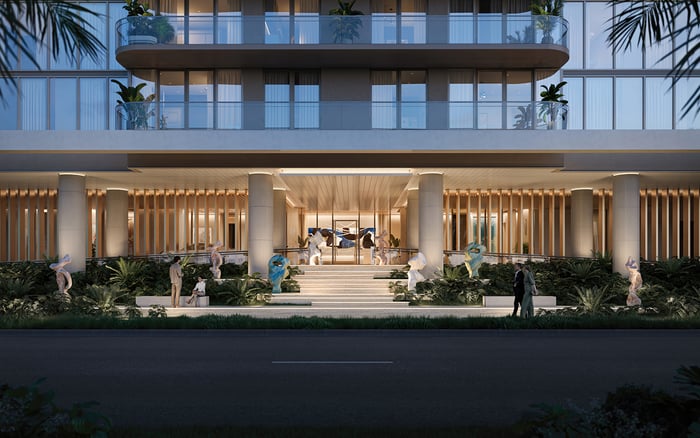
The porte-cochère has become one of South Florida’s most underestimated luxury amenities. It is not simply a covered drop-off. It is a privacy instrument, a traffic regulator, and a weather buffer. In a region where rainstorms can arrive quickly and peak-season dinner traffic can compress curb space, the depth and choreography of the covered arrival can shape everyday satisfaction.
Privacy begins before the door opens. A well-considered porte-cochère gives owners time to exit without feeling displayed to the street. It allows valets to stage vehicles without visual clutter. It gives guests a clear route while preserving a more discreet pattern for residents. When a residence sits within a high-profile urban or waterfront setting, that ability to separate spectacle from sanctuary becomes central.
Compare this with the expectations formed around other branded and design-led South Florida properties, such as 888 Brickell by Dolce & Gabbana, where the broader conversation around luxury naturally includes image, arrival, and a polished public face. In that kind of market, the entrance is not an accessory. It is part of the brand language.
Valet is where architecture meets training. A beautiful driveway can fail if the choreography is weak. Conversely, a compact arrival can feel highly refined when staff movement, vehicle staging, guest recognition, and luggage handling are synchronized.
For buyers considering Delano Residences & Hotel Miami or The Ritz-Carlton Residences® Miami Beach, the question is not simply whether valet exists. The sharper question is how the sequence is likely to feel when several owners arrive at once, when a guest is expected, when a driver needs to wait, or when privacy matters more than speed.
Branded-residence positioning is especially relevant here because names associated with service traditions create expectations beyond finishes. The promise is cultural: remembered preferences, controlled handoffs, calm tone, and an absence of visible friction. The building should feel staffed, not crowded; attentive, not performative.
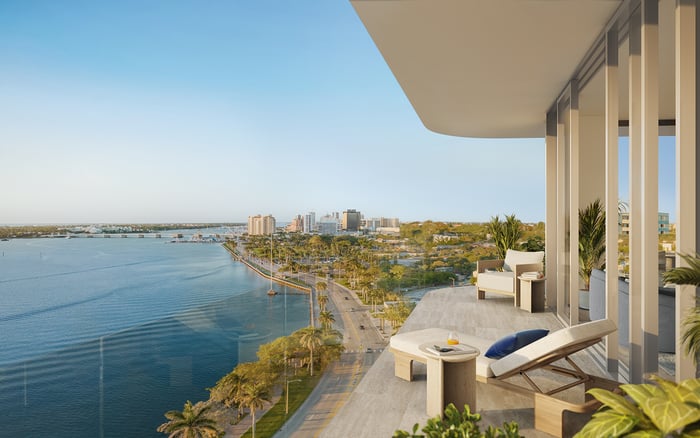
West Palm Beach buyers often evaluate this through a different lens than Miami buyers. The West Palm Beach conversation tends to reward polish without excess, while Miami’s more vertical luxury market may place greater emphasis on theatricality and hospitality tempo. Both can be executed beautifully, but they produce different emotional climates.
The savviest buyers now study arrival the way they study ceiling heights, terraces, and exposure. They ask where vehicles stack, where visitors wait, how residents are identified, how privacy is preserved, and whether the lobby volume supports the building’s intended mood.
This lens also helps compare new-construction offerings across submarkets. A new project in Brickell, Miami Beach, or West Palm Beach may promise similar amenities on paper, yet the arrival sequence can reveal the true hierarchy of resident experience. A building like The Ritz-Carlton Residences® Miami Beach naturally sits within a broader regional dialogue about branded living, while projects in denser urban settings must solve for different curb pressures and guest patterns.
The language buyers use may vary: top project, branded residence, hotel-residential hybrid, private tower, or resort-style address. But the essential test is consistent. Does the building make arrival feel effortless, protected, and personally calibrated?
The next generation of luxury evaluation is less about a checklist and more about atmosphere under pressure. A lobby can photograph beautifully and still feel chaotic at peak hours. A porte-cochère can appear gracious and still lack discretion. A valet program can sound premium and still reveal tension when multiple owners arrive with drivers, guests, and luggage.
For Delano Residences & Hotel Miami, the residence-and-hotel name frames a conversation about the balance between hospitality energy and residential privacy. For The Ritz-Carlton Residences® West Palm Beach, the branded-residence identity places service culture at the center of buyer expectation. In both cases, the entrance is not the prelude to ownership. It is ownership, expressed in motion.
Why does lobby volume matter in a luxury residence? Lobby volume shapes the emotional tempo of arrival. It can create drama, calm, privacy, or exposure depending on how the space is sequenced.
Is a larger lobby always better? Not necessarily. A smaller lobby with controlled sightlines and strong service choreography may feel more private than a grand but exposed room.
What should buyers look for in a porte-cochère? Buyers should study depth, cover, vehicle stacking, resident privacy, and the ease of moving from car to lobby without confusion.
Why is valet choreography important? Valet is the most visible expression of service culture. It determines whether arrival feels seamless during quiet moments and peak demand.
How does branded-residence positioning influence expectations? Branded residences imply a higher level of service consistency, recognition, and operational polish. Buyers often expect the culture to match the name.
Does a residence-and-hotel identity change the buyer analysis? Yes. It can add energy and amenity depth, but it also makes privacy separation and resident-only circulation especially important.
How should Miami and West Palm Beach arrivals be compared? Miami often rewards theatrical hospitality and urban presence, while West Palm Beach buyers may prioritize discretion, ease, and quiet polish.
Can arrival design affect resale perception? Yes. Buyers remember whether a building feels calm, private, and well-run before they remember many secondary amenities.
Should investors tour during peak hours? Ideally, yes. Peak arrival periods reveal traffic flow, valet discipline, lobby crowding, and how staff manage pressure.
What is the simplest test for a luxury arrival sequence? Ask whether the building feels effortless from curb to elevator. If it does, the architecture and service culture are likely working together.
To compare the best-fit options with clarity, connect with MILLION.
If branded residences are on your mind — as a home or as an allocation — we would be glad to share what we are seeing, privately.
Begin a quiet conversation