In South Florida’s top tier, a shopping address is often more than convenience. Bal Harbour Shops and Palm Beach’s Worth Avenue operate as economic anchors, lifestyle signals, and scarcity engines that can shape nearby residential premiums, with a nuanced “close, but not too close” sweet spot.
In many markets, “near shopping” is shorthand for convenience. In South Florida’s ultra-prime enclaves, it often reads as a form of social and economic proof. World-class retail becomes part of the daily rhythm: a fitting between meetings, a jewelry appointment handled quietly, a composed lunch that does not require a full itinerary. For buyers who value time, discretion, and predictability, that proximity can feel less like a perk and more like infrastructure.
That lifestyle halo also has a measurable foundation. When a luxury corridor maintains persistent tenant demand and exceptional sales performance, it signals enduring strength in the local consumer base and a consistent willingness to reinvest in the surrounding environment. The retail address becomes a proxy for what matters to residential value: the quality of the streetscape, the caliber of nearby services, and the probability that the neighborhood continues to compete at the top of the market.
Still, prime retail is not a one-way positive. The same energy that supports “walkable luxury” can introduce friction: traffic at peak hours, noise, visibility, and a diminished sense of seclusion. Peer-reviewed research on retail proximity and housing values reflects this dual effect. Amenities can lift home values, while the externalities that come with activity can soften them.
The practical conclusion is not “closer is always better.” It is “closer, with the right buffer.” Buyers who underwrite this well tend to look for the correct distance, the cleanest access pattern, and the most controlled arrival experience.
Two addresses illustrate the dynamic with particular clarity, each defined by its own brand of discretion: Bal-harbour’s Bal Harbour Shops and Palm-beach’s Worth Avenue.
Bal Harbour Shops opened in 1965 as an open-air shopping center and has long been cited as one of the highest-performing luxury retail destinations in the U.S., often appearing on a global short list. That reputation is not simply cultural cachet. It provides a rare, quantifiable indicator of how strongly a location attracts the highest-tier discretionary spending.
Two widely noted milestones helped solidify the center’s positioning in luxury retail: Neiman Marcus opened there in 1971, followed by Saks Fifth Avenue in 1976. In this segment, anchors do more than generate foot traffic. They set the merchandising standard that influences adjacent tenancy, service expectations, and the overall tone of the experience.
The metric most often quoted is sales productivity. Bal Harbour Shops has been widely cited around roughly $3,400 per square foot (2022 figures are commonly referenced). For a residential buyer, the exact number matters less than what it represents. A center that can sustain that level of productivity typically has a deep moat: a brand mix that is difficult to replicate, a destination customer base, and a reputation that travels well beyond the local market.
Expansion plans have also been widely covered over time, often framed as a major, multi-hundred-million-dollar project. Whether a buyer is focused on construction details is secondary to the broader signal: capital continues to pursue the address, and the retail ecosystem has the momentum to evolve rather than stagnate.
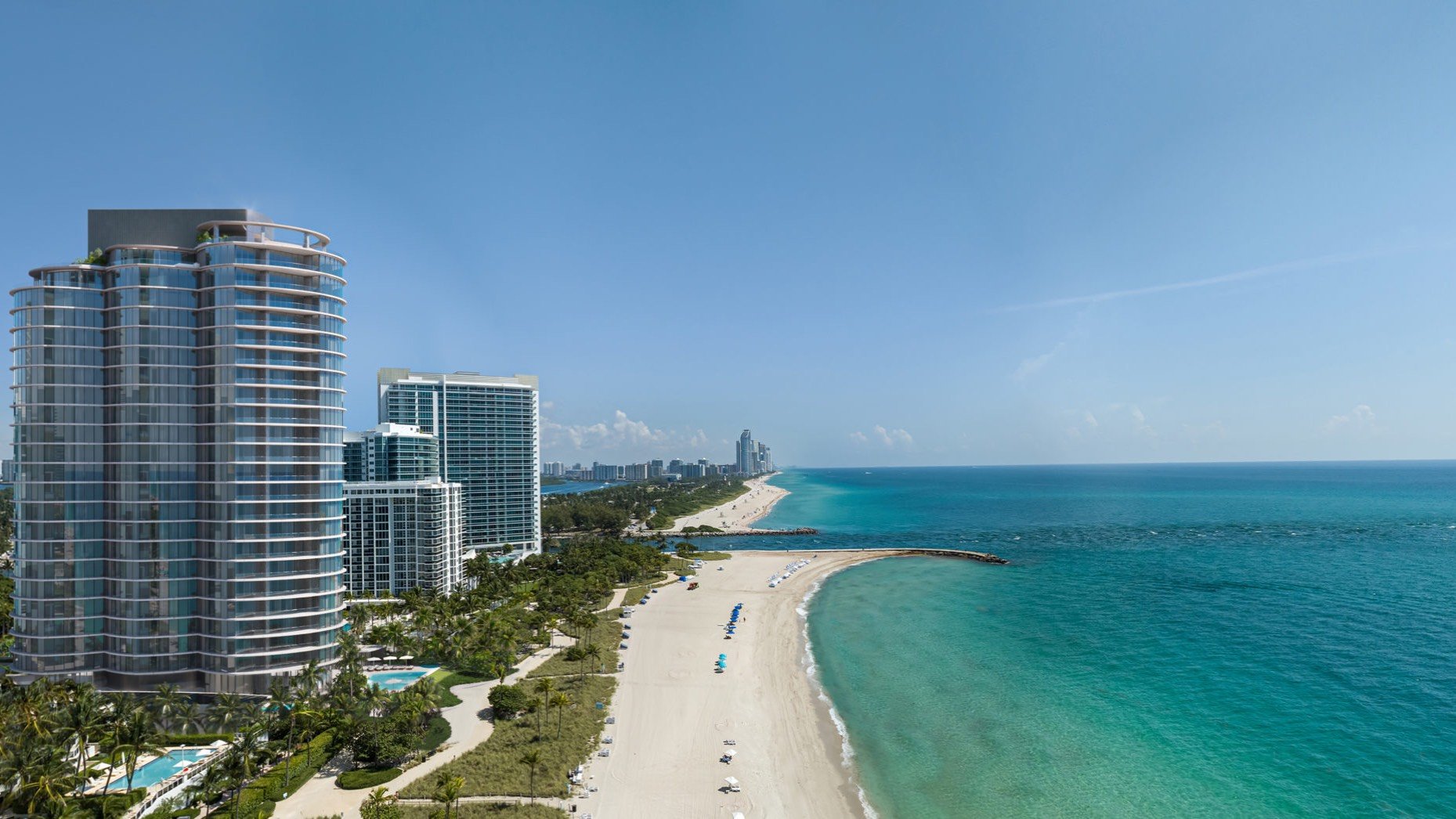
In the Miami Beach area, Bal Harbour and Surfside are often discussed as a distinct ultra-prime pocket. Recent luxury market reporting has positioned Bal Harbour/Surfside among the stronger segments on price and momentum, with pricing in 2025 reported around roughly $1,300 per square foot.
The nuance is that this is not simply “beachfront equals expensive.” Beachfront is a constant along much of Miami-beach. What distinguishes Bal Harbour is the way its retail, hospitality, and residential layers align. A buyer can prioritize oceanfront privacy while keeping immediate access to a retail environment that functions, in practice, like a members-only amenity.
This is why proximity to the Shops appears repeatedly in positioning language for nearby residences. The retail corridor is not a generic neighborhood feature; it is a recognizable lifestyle anchor that communicates taste, efficiency, and social ease.
That dynamic is visible in how certain properties are framed in the market. For example, Oceana Bal Harbour is frequently positioned around beachfront placement and proximity to the retail core. In a buyer pool that is often time-compressed and preference-driven, that combination can read as both functional and socially legible.
Worth Avenue is positioned and marketed as Palm Beach’s premier luxury shopping district, defined by legacy and destination status. Its influence comes from more than the brand roster. It is also the choreography: intimate storefront scale, curated hospitality, and an atmosphere that feels intentionally composed. The avenue’s appeal is not loud. It is coded, and that subtlety is part of the product.
For residential buyers, Worth Avenue operates as shorthand for the broader Palm Beach ecosystem. It is a social and commercial anchor that signals continuity, stewardship, and tradition. That framing helps explain why nearby residential offerings can command notable premiums. Public listing inventory underscores the point: trophy-level residences are tied directly to the corridor, including penthouse offerings on Worth Avenue itself.
The commercial land-value story is also instructive. A widely reported landmark transaction involved a Worth Avenue building associated with a Versace store selling for $30.26 million, roughly $3,173 per square foot. A retail sale price does not translate linearly into home values, but it does demonstrate scarcity and willingness to pay for the address. When the street supports valuations at that level, it inevitably influences expectations for surrounding residential product.
Coverage of investor activity around notable Worth Avenue buildings, including discussion of a “Tiffany building” deal, reinforces the avenue’s role as an economic anchor, not simply a lifestyle amenity. For an ultra-prime buyer, that matters because it suggests continued stewardship and a higher probability that the corridor’s retail quality and streetscape standards remain protected.
Luxury buyers rarely debate whether they want amenity access. They debate friction. How many turns are required? How visible is the entry? How predictable is the exit? How shielded is the arrival, especially at peak times?
Academic work on amenity proximity points to a distance-decay effect: value impact changes with distance, and the relationship is not always linear. In practical terms, the same retail node can create a premium for one building and a penalty for another, depending on how the building interfaces with activity.
In South Florida, this tends to show up in three recurring patterns:
Privacy and curb management win. Buildings that can offer discrete arrivals, controlled access, and a calm threshold often capture the upside of proximity. When the transition from car to lobby feels protected, buyers are more willing to pay for the convenience of nearby retail.
Micro-location can outrank macro-location. “Near Bal Harbour Shops” is not a single condition. Sound, traffic exposure, and sightlines vary by block and by approach route. Two addresses can be the same distance from a corridor but deliver very different day-to-day experiences.
Convenience needs to be clean. In ultra-prime product, buyers want walkability that feels effortless, not walkability that feels like living in the lobby of a destination. The goal is access without constant exposure.
The result is a definable sweet spot: close enough to convert retail into a weekly ritual, far enough to preserve the quiet that justifies the price.
Luxury retail corridors can seduce buyers into viewing a neighborhood as a weekend itinerary. A stronger approach is to pressure-test the address the way a long-horizon owner would, with an emphasis on durability, friction, and the neighborhood’s capacity to protect its standards.
At Bal Harbour Shops, durability is expressed through longevity and productivity: open since 1965, anchored by legacy department stores that arrived in the 1970s, and widely cited for best-in-class sales per square foot. These indicators are not guarantees, but they are meaningful signals that the ecosystem is not fragile and that tenant demand has remained deep.
At Worth Avenue, durability reads differently. It shows up through legacy positioning, a formal luxury tenant ecosystem that reinforces the corridor’s identity, and a pattern of high-value commercial transactions that reflect scarcity.
Many luxury buyers want to be one decision away from retail, not one glass wall away from it. When you tour, focus on the mechanics that determine whether proximity adds value or adds stress:
These details are not cosmetic. They determine whether retail adjacency becomes a repeatable benefit or an occasional compromise.
Major expansion plans at a retail anchor, and sustained investor interest in core commercial assets, indicate reinvestment capacity. For residential owners, that can translate into better-maintained streetscapes, stronger tenant mixes, and long-term destination power. The underwriting question is simple: does the corridor have the momentum and capital interest to stay best-in-class as preferences evolve?
Not every luxury buyer wants to be anchored to Bal-harbour or Palm-beach. Some prioritize an urban resort cadence that is unmistakably Miami-beach. In those cases, the same principle applies: buyers pay for adjacency to a complete lifestyle district, provided the building preserves discretion.
For example, Setai Residences Miami Beach reflects a category of ownership where hospitality-grade service and a walkable luxury environment can function as a substitute for a purely residential campus. For many buyers, the presence of service, dining, and retail in close proximity is the point, as long as arrivals and privacy remain controlled.
For other buyers, a quieter, design-forward beachfront posture matters more than being in the center of activity, which is why ultra-premium oceanfront options such as 57 Ocean Miami Beach remain part of the conversation. The value proposition shifts from being near a corridor to being insulated from it while still retaining access when desired.
There is also a cohort that wants Miami-beach access with a more residential sensibility, where service and privacy are emphasized over spectacle. In that lane, The Ritz-Carlton Residences® Miami Beach represents the kind of product where “amenity adjacency” can be curated rather than constant. The neighborhood connection is real, but the day-to-day experience can remain composed.
The point is not that these addresses replicate Bal Harbour Shops or Worth Avenue. They do not. The point is that the best-performing luxury submarkets tend to share a common trait: an amenity ecosystem with enough gravity to make the location feel inevitable, without compromising discretion.
In Bal-harbour and Surfside, the retail anchor is unusually measurable. It is not only prestige; it is a proven destination with a long operating history and widely cited productivity levels. In Palm-beach, the value case comes from a different kind of certainty: legacy and scarcity, reinforced by commercial valuations that serve as a proxy for how difficult it is to buy into the street.
If you are underwriting an ultra-prime purchase near either corridor, focus on three practical questions:
Answer those well and retail adjacency becomes more than a listing line. It becomes a stabilizer for value and a multiplier for livability, with the best outcomes reserved for buyers who prioritize access with insulation.
Is living near luxury retail always a premium in South Florida? Not always. Proximity can support value through convenience and lifestyle appeal, but congestion, noise, and visibility can reduce desirability if you are too close or poorly buffered.
What makes Bal Harbour Shops different from typical malls? It has a long history as a luxury destination, opening in 1965, with legacy anchors added in the 1970s and widely cited best-in-class sales productivity that signals durable demand.
Why does Worth Avenue influence nearby residential pricing? Worth Avenue’s legacy positioning and scarcity are reinforced by high-value commercial transactions and an established luxury tenant ecosystem, which can elevate the perceived prestige of nearby addresses.
How close should I be to Bal Harbour Shops or Worth Avenue? Many buyers prefer a “close, but not too close” radius: near enough to enjoy walkability and easy access, far enough to protect privacy, quiet, and smooth arrivals.
For discreet guidance on South Florida’s ultra-prime markets, connect with MILLION Luxury.
If branded residences are on your mind — as a home or as an allocation — we would be glad to share what we are seeing, privately.
Begin a quiet conversation