A buyer-oriented 2026 due-diligence guide to evaluating three branded Miami residences through the quieter measures that determine livability: private-suite separation, guest circulation, storage, light, service flow, and long-term comfort.

South Florida’s ultra-prime condominium market has moved beyond the simple pull of a celebrated name. For 2026 buyers, the more important question is how a residence performs at 8 a.m., 6 p.m., and midnight, when privacy, guests, staff, storage, acoustics, and light either support daily life or quietly introduce friction.
619 Residences by Foster + Partners + Nobu Hospitality, Aston Martin Residences Downtown Miami, and Kempinski Residences Miami Design District belong naturally in that conversation because they attract buyers who already understand brand, architecture, and location. The sharper due-diligence lens is more intimate. Does the primary suite feel genuinely removed from social life? Can guests arrive, gather, and leave without crossing private zones? Will the plan feel as composed in year seven as it did during the first walkthrough?
For a MILLION reader, the answer is rarely found in a single feature. It lives in the sequence of spaces, the hierarchy of doors, the generosity of transitions, and the degree to which a residence allows formal entertaining and private daily life to coexist.
In a large-format residence, the primary suite is not merely a bedroom. It is the private wing, the recovery zone, and often the place where a buyer can tell whether a floor plan has been designed for real ownership rather than brochure photography.
The first test is separation. A primary suite should not sit directly off the principal entertaining space unless the plan provides a meaningful buffer. That buffer may be a vestibule, a gallery, a closet zone, or a private corridor. The purpose is not theatrical. It is to prevent sound, sightlines, and guest movement from bleeding into the most personal part of the home.
The second test is internal logic. A strong suite allows the bedroom, bath, dressing area, and terrace access to function without awkward crossings. If one partner rises early, uses the closet, and leaves for the day, the other should not feel the entire sequence. If staff enter for housekeeping, they should not need to pass through zones that make the suite feel exposed.
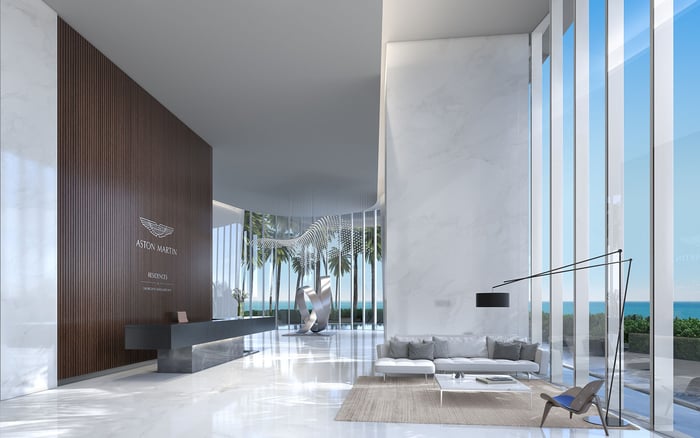
Aston Martin Residences Downtown Miami brings the Downtown tag into a distinctly urban context, where vertical living and skyline orientation make privacy planning essential. The diligence question is not simply whether the view is impressive. It is whether the suite remains calm when elevators, guests, deliveries, and evening entertaining animate the rest of the residence.
Guest circulation is one of the most revealing ways to read an ultra-luxury plan. A residence can have exceptional finishes and still feel compromised if visitors arrive without a proper receiving sequence.
Begin at the elevator or entry. The best plans create a sense of arrival before revealing the full living environment. A foyer, gallery, or transitional wall gives the home a ceremonial rhythm while protecting the living room from feeling like a lobby. From there, guests should move naturally toward the entertaining area, powder room, dining zone, and terrace without passing the bedroom corridor.
This matters especially for buyers who entertain with discretion. A dinner guest should not need to infer where the family sleeps. A weekend visitor should understand where to go without being guided through private doors. A caterer, driver, house manager, or nanny should have a logical path that supports service without visual clutter.
For 619 Residences by Foster + Partners + Nobu Hospitality, the right buyer questions should focus on how hospitality sensibility and residential privacy are reconciled inside the plan. Branded atmosphere can be highly appealing, but the long-term ownership experience depends on whether arrival, service, dining, and retreat are choreographed with discipline.
The most resilient residences remain easy to live in after the novelty fades. In 2026, that is central to any investment thesis, particularly for buyers comparing branded residences across Downtown, Brickell, and the Design District.
Comfort begins with storage. Eveningwear, luggage, sports equipment, art shipping materials, seasonal objects, and household supplies all need a place to disappear. A beautiful plan without storage forces a luxury buyer into daily compromises. Closet depth, laundry placement, pantry capacity, and utility zones should be read with the same seriousness as view corridors.
Light is equally important. South Florida brightness can be magnificent, but glare, heat gain, and terrace usability vary by orientation and glazing strategy. Buyers should consider where they will actually sit in the morning, how a dining area behaves at sunset, and whether bedrooms can remain restful without requiring constant shading.
Acoustics are another under-discussed measure. Elevator proximity, mechanical rooms, amenity adjacencies, and the relationship between bedrooms and entertaining zones all influence daily calm. For the new-construction buyer, it is worth studying not just the residence itself, but the spaces above, below, beside, and across the corridor.
Pre-construction purchasers should be especially attentive to plan evolution. Small adjustments to closets, doors, slab edges, or kitchen dimensions can have outsized impact on how a home lives. The luxury is not only in the finish palette. It is in the absence of irritation.
A buyer evaluating 619 Residences by Foster + Partners + Nobu Hospitality should look closely at hierarchy. Does the plan create an elegant gradation from public to semi-private to private space? Do bedrooms feel insulated from entertaining? Is the residence capable of absorbing guests without losing domestic calm? These questions matter because a hospitality-inflected residence must still function as a private home.
At Aston Martin Residences Downtown Miami, the diligence lens should concentrate on vertical urban living. The name carries design association, but ownership quality is ultimately tested by entry sequence, room proportions, elevator experience, private-suite positioning, and the ability to host without sacrificing quiet. Downtown buyers often value immediacy, but the residence itself must provide refuge.
For Kempinski Residences Miami Design District, the Design District setting naturally invites a buyer to think about lifestyle, art, dining, and daily movement. The more important residential question is whether the plan feels serene behind that cultural energy. A successful home in this context should make the city feel available, not intrusive.
Before focusing on finishes, walk the plan as four different people. First, as the owner returning home alone. Does the entry decompress the day? Second, as a dinner guest. Is the route to the living room and powder room clear? Third, as an overnight guest. Is there privacy without confusion? Fourth, as staff or service. Can the residence be maintained without disrupting the primary suite?
Then pause in the primary bedroom and listen. Imagine music in the living room, a late dinner, a suitcase rolling through the foyer, or an early delivery. The best residences anticipate these moments. They do not require a household to adjust around flaws in circulation.
Finally, consider the exit strategy. Future buyers will respond to brand, location, and views, but sophisticated buyers increasingly notice the invisible architecture of comfort. A plan that protects privacy, organizes guests, and supports daily life can remain desirable through changing cycles.
What is the main due-diligence question for these residences? Whether the private wing, guest path, and daily service rhythm can coexist without friction.
Why does primary-suite privacy matter so much in ultra-luxury condominiums? It determines whether the home feels restorative during entertaining, staff movement, and ordinary family life.
How should a buyer evaluate guest circulation? Trace the path from arrival to living room, powder room, dining area, terrace, and exit without crossing private bedroom zones.
Is a branded residence automatically more comfortable? Not automatically. Brand can frame the experience, but the floor plan determines daily comfort.
What should buyers study at Aston Martin Residences Downtown Miami? Focus on the entry sequence, private-suite placement, guest movement, and how the residence balances urban energy with retreat.
How does Brickell compare in this discussion? Brickell is a useful benchmark for dense, vertical luxury living where privacy and arrival sequence can define the ownership experience.
What should matter most in a new-construction review? Study storage, acoustics, light exposure, bedroom separation, and how service functions are handled.
What should pre-construction buyers ask before contract decisions? Ask how plan details may evolve and whether any changes could affect closets, doors, terraces, or primary-suite privacy.
Can long-term comfort influence resale? Yes. Sophisticated buyers often recognize plans that live easily, which can support desirability over time.
What is the most overlooked comfort feature? The quiet transition space between public rooms and the primary suite, because it protects privacy every day.
If you'd like a private walkthrough and a curated shortlist, connect with MILLION.
If branded residences are on your mind — as a home or as an allocation — we would be glad to share what we are seeing, privately.
Begin a quiet conversation