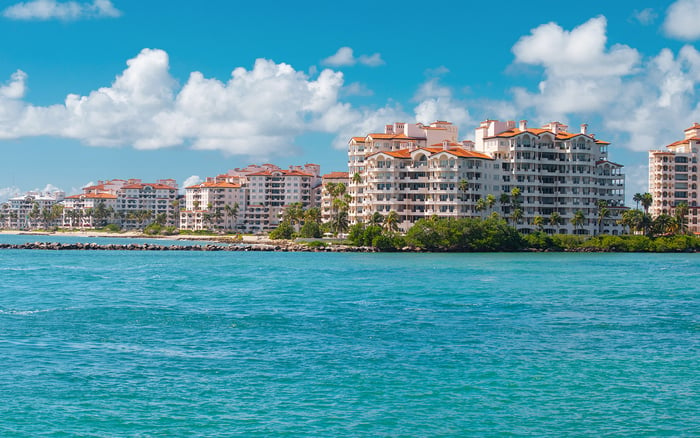
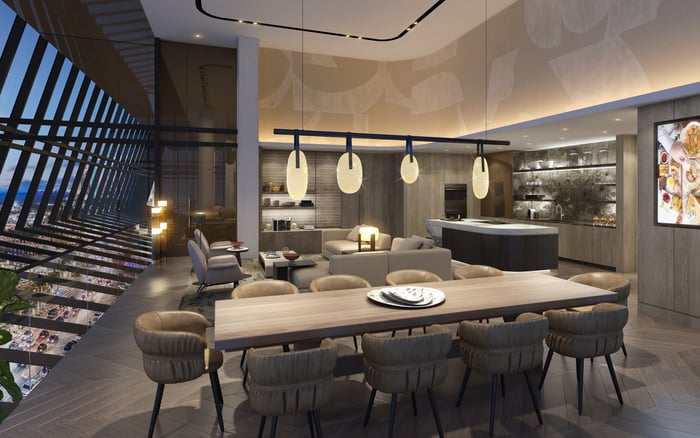
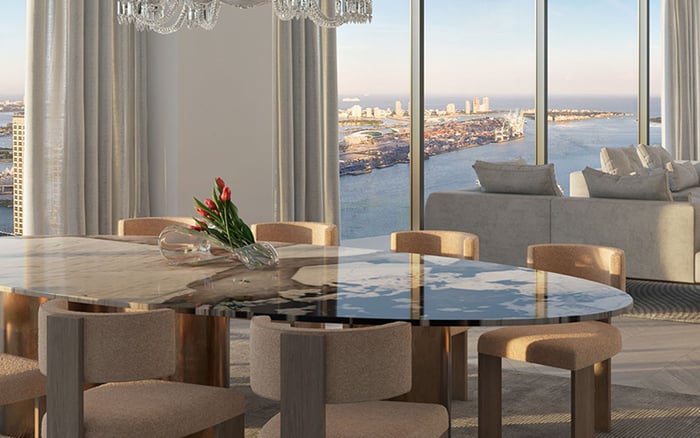
Miami’s luxury market has moved past the improvised desk. Today’s buyers are evaluating buildings for legitimate work infrastructure: acoustic privacy, enterprise-grade connectivity, resident-only business centers, and amenity programs that let “office hours” and “resort hours” coexist in the same address.
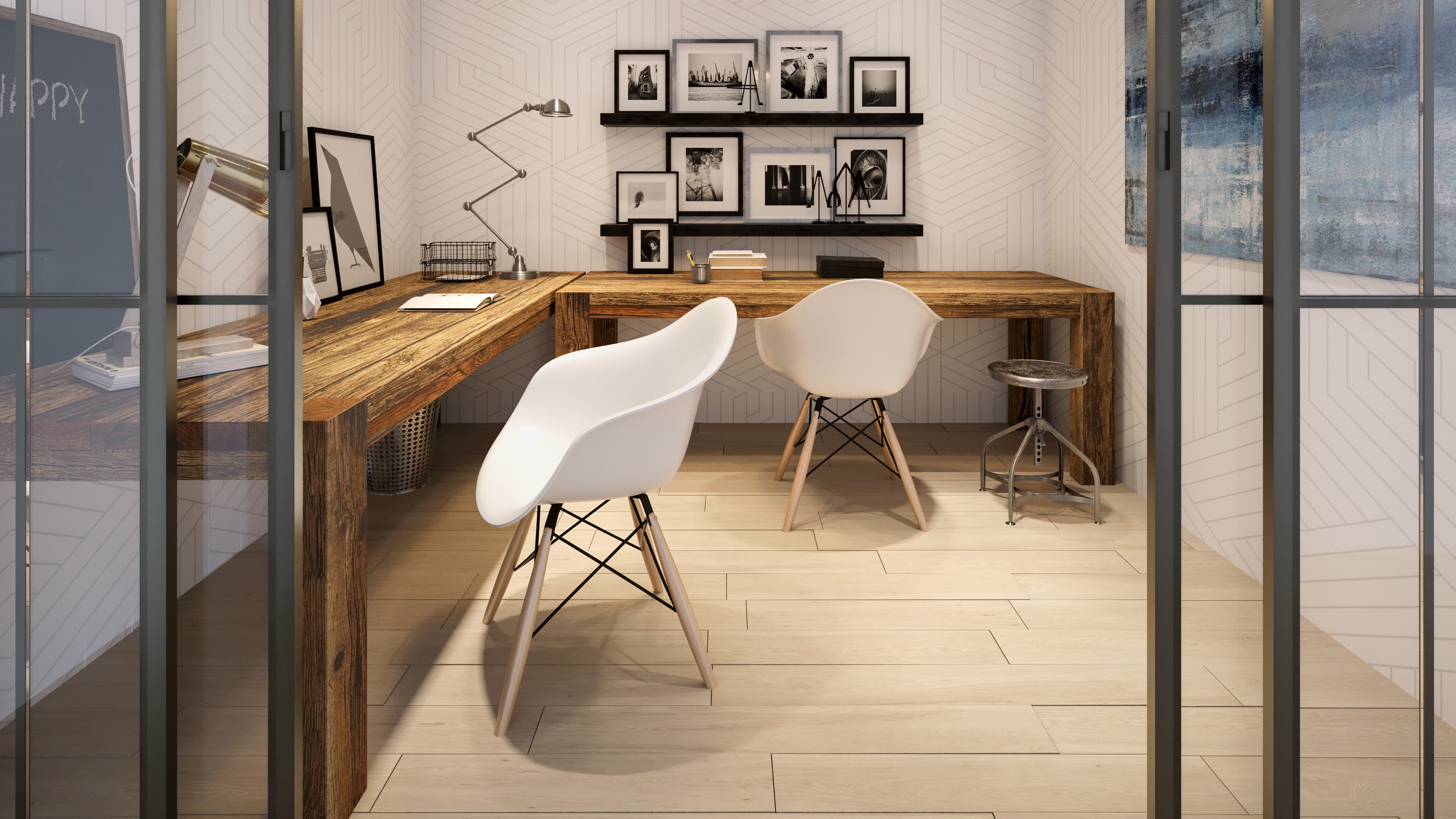
For a growing share of South Florida’s luxury buyers, the most valuable room is not the media lounge or the guest suite. It is the space that lets you perform at a high level on a Tuesday morning, then shift into sunset mode without leaving the building. Remote and hybrid work have evolved from a temporary arrangement into a durable lifestyle, and the market has answered with a new kind of residence, one designed for focus, privacy, and professional polish. In advanced economies, a meaningful portion of the workforce is expected to remain remote long-term. In Miami, that expectation shows up in floor plans, amenity programs, and even the language developers use to describe ownership. “Live-work” once meant proximity to an office district. Now it increasingly means the office is built into the property itself, supported by the kind of infrastructure buyers associate with a private club. The most discerning purchasers are no longer asking whether a unit can fit a desk. They are asking whether the building can carry a full workday with the same competence it brings to the weekend.
A true work-from-home residence is a system, not a single feature. The strongest offerings typically combine four elements. First is spatial clarity. A credible home office needs separation from living areas, either a dedicated room or a layout that supports a door and controlled sightlines. The point is not square footage. It is psychological boundaries, especially in households where multiple calls happen at once. Second is acoustic strategy. In a high-rise, sound can travel through walls, doors, and structure. Luxury buyers should pay close attention to how a space handles sound blocking and absorption, and how vibration may transfer between units. When a building and residence are designed to reduce unwanted noise, the improvement is immediate: clearer calls, stronger concentration, and less friction between work and leisure. Third is connectivity you can trust. Video conferencing, cloud workflows, and real-time collaboration reward low-latency, stable service more than flashy peak speeds. Miami has broad access to fiber options, and some communities negotiate connectivity terms at the building level to simplify installation and improve the resident experience. Fourth is a building-level work ecosystem. The modern benchmark includes resident business centers, meeting areas, and co-working lounges that are quiet enough for solo work, yet polished enough for a client conversation. At the top end, these spaces feel like an extension of home, not a repurposed lobby.
The clearest signal that Miami has entered a new era of live-work luxury is privately owned office space inside a residential tower. One Twenty Brickell Residences has been marketed around deeded, private office suites allocated to residences on specific floors, effectively pairing “home + office” within a single building. Publicly shared details describe a 34-story tower in Brickell by PMG, with the project reported sold out in 2024. Beyond the ownership structure, the larger point is the model itself: separating home from office while keeping both within one controlled environment. This is the difference between a desk in the corner and a true second space. For founders, finance executives, attorneys, and anyone whose day involves confidential conversations, stepping into an office setting without leaving the property changes the rhythm of daily life. It also helps protect the social integrity of the residence, keeping work energy from overtaking the home. In Brickell, buyers often compare lifestyle programs across projects, not just interiors. The neighborhood’s appeal is its ability to feel intensely urban yet carefully curated, especially in buildings that treat services, wellness, and resident privacy as the baseline. For those who want Brickell’s momentum with a distinctly residential sensibility, Una Residences Brickell is the kind of address that keeps the conversation centered on architecture, waterfront presence, and day-to-day livability.
Downtown’s next wave of development has embraced the reality that work space now belongs in the amenity stack. HUB Miami Residences is planned as a 41-story tower in the Downtown and Miami Worldcenter area, positioned with residences plus co-working and business-oriented amenity spaces. Its marketing emphasizes a comprehensive lifestyle, pairing work settings with wellness, meditation-oriented zones, fitness, and a pool deck. Nearby, Miami World Tower also promotes a co-working space among its resident amenities. The takeaway is not that every buyer will use a co-working room every day. It is that credible work settings inside the building expand optionality. You can keep your primary office in-residence, while still having a place for a meeting, a quiet sprint, or a change of scenery, without commuting. Downtown’s luxury story is also increasingly about vertical service culture. When smart building features and resident app-style connectivity are integrated into the experience, the property begins to function like a managed environment. For buyers who value design-forward living paired with a more technological, concierge-driven relationship, Waldorf Astoria Residences Downtown Miami fits naturally into the conversation.
In the best new luxury towers, the goal is not to turn residents into permanent homebodies. It is to create clean transitions. One Twenty Brickell Residences has marketed an amenity program spanning roughly 60,000 square feet, described as including pools, fitness and wellness spaces, and lounges designed to keep work and resort living distinct. Even without fixating on a specific number, the philosophy is clear: when a building offers enough purpose-built environments, the day no longer has to feel like one blurred continuum. That separation is a luxury in itself: a private call in a quiet lounge; a workout that resets the day between meetings; a pool deck that feels like a genuine reward once the laptop closes. At the ultra-premium end of the Brickell conversation, branded residential experiences often bring hospitality discipline, an advantage for remote workers. Baccarat Residences Miami is marketed as a three-tower project with 324 residences plus 28 riverfront duplexes and flats, and its amenity program is positioned to include a business center and meeting and work spaces alongside wellness and service. For buyers who want the aesthetics of a luxury brand with the practicality of on-site work settings, Baccarat Residences Brickell is an obvious reference point.
The live-work thesis is not limited to the financial core. In the Midtown and Wynwood area, the value proposition often blends walkability, galleries, dining, and a more creative cadence. Cortland Midtown Miami promotes coworking space with WiFi, private offices, and conference rooms as resident amenities, along with a rooftop pool and sundeck, a rooftop lounge, and EV charging. For residents, that combination solves a practical problem: you can take a meeting, reset on the roof, and step into the neighborhood without planning the day around driving. Wynwood’s residential positioning has also evolved. WYND 27/28 markets layouts and features that include dedicated home office space, an explicit acknowledgment that modern buyers expect a residence to support focus, not only entertaining. In this part of the city, luxury is often defined less by formality and more by intelligent, flexible living. For buyers drawn to Miami’s design culture and proximity to the urban core, Aria Reserve Miami can serve as a nearby counterpoint, offering a more residential, skyline-and-water oriented experience while staying connected to the same energy.
In a luxury residence, the most important systems are often the least visible. Connectivity is one of them. Miami has broad availability of fiber internet options, and for remote and hybrid households that can translate into more dependable video calls and stronger cloud performance. Just as important is how buildings manage provider relationships. Some community management groups promote connectivity programs designed to negotiate bulk rates and terms, which can simplify the resident experience and reduce friction around installation and billing. In parallel, smart-home integration has become part of Miami’s luxury expectations. Lighting scenes that support camera-ready meetings, automated shading to control glare, and climate zoning that keeps a small office comfortable in the afternoon are not gadgets. They are productivity tools. When evaluating a building for work-from-home readiness, treat internet capability, building policies, and in-residence automation as one ecosystem. If any single component is weak, the lived experience can feel surprisingly ordinary.
Remote work rewards stamina. Miami’s luxury market has responded by treating wellness less as an amenity and more as an operating system. Projects that emphasize health-forward services and wellness-centric living increasingly align with high-performance lifestyles. A residence that supports sleep quality, stress management, and routine does not simply feel better. It helps make the workday more sustainable. In Coconut Grove, The Well Coconut Grove speaks directly to this priority, aligning the idea of home with a broader, wellness-oriented approach to daily life. Even for buyers who spend significant time on calls and in meetings, the promise is straightforward: your environment should help you recover as well as it helps you produce.
Before committing to a building or a specific stack, treat work-from-home capability as part of your due diligence. Confirm where you will take calls. A bedroom desk is a compromise. Look for true separation, and a background you would feel comfortable showing on camera. Walk the amenity floors the way you would tour a private club. Ask whether the co-working areas feel genuinely quiet, whether there are settings for two-person conversations, and whether the lighting is suited to longer stays. Treat sound as a primary feature. Listen for corridor noise, mechanical hum, and how doors close. In a high-rise, acoustic comfort is often the difference between “beautiful” and “livable.” Finally, ask direct questions about connectivity at both the unit and building levels. Reliability is the real luxury, and it is also the easiest detail to overlook when views take the lead.
What makes a luxury condo genuinely work-from-home ready? Look for acoustic privacy, reliable connectivity, and building-level workspaces that feel professional.
Is a dedicated home office better than a flexible den? A dedicated room with a door typically performs better for calls, confidentiality, and routine.
Why do co-working amenities matter if I can work in my unit? They provide meeting space, variety, and a separation between work time and home time.
How important is soundproofing in a high-rise home office? It is critical; sound transfer can undermine calls and concentration even in otherwise luxury homes.
Should buyers prioritize fiber internet when shopping in Miami? Fiber availability can improve stability for video and cloud work, so it is a practical priority.
What is a deeded office suite, and why is it desirable? It is privately owned workspace in the building, offering separation and confidentiality without commuting.
Do wellness amenities really affect productivity for remote workers? Yes; fitness, recovery, and routine-supporting spaces help sustain performance over long periods.
Can smart-home systems improve a home office? Automated shading, lighting scenes, and climate control can reduce glare, fatigue, and distractions.
Are Downtown and Brickell the best areas for live-work luxury? They lead for business-centric amenities, while other neighborhoods compete through lifestyle and wellness.
What should I ask a building about connectivity before purchasing? Ask about available providers, any bulk connectivity programs, and how service is installed and managed.
Explore residences designed for modern work and modern life with MILLION Luxury.
If branded residences are on your mind — as a home or as an allocation — we would be glad to share what we are seeing, privately.
Begin a quiet conversation