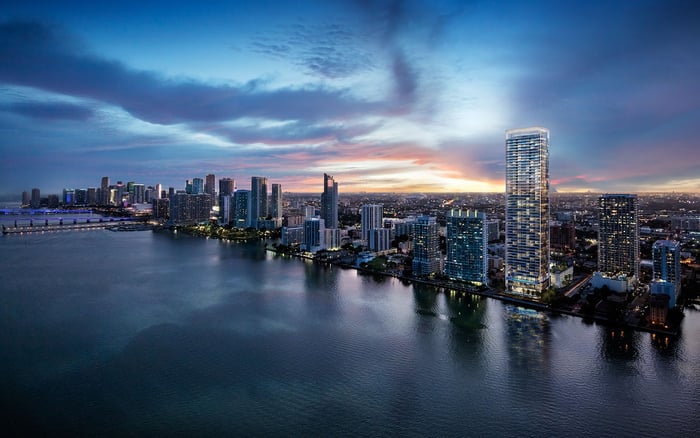
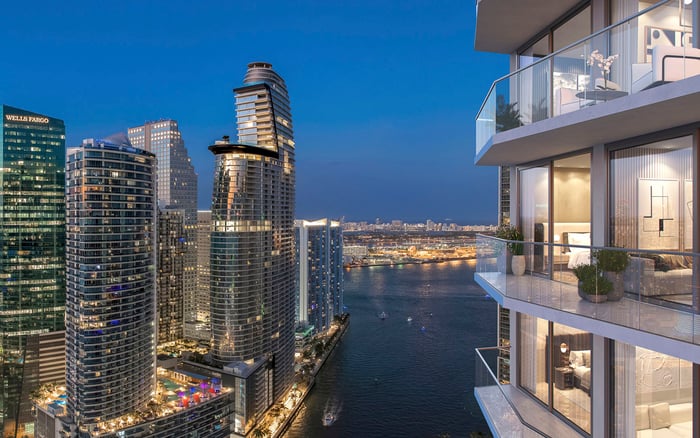
Miami Design District offers European buyers a composed South Florida base shaped by culture, design literacy, proximity and discreet access to the broader Miami luxury market.

For many European buyers, South Florida is not simply a sunshine purchase. It is a lifestyle hedge, a family foothold, a business-friendly stopover and, increasingly, a place to live with the same aesthetic discipline they expect in London, Paris, Milan, Madrid or Geneva. Miami Design District can answer that brief with unusual precision.
Its appeal is not spectacle. It is the ability to choose a Miami base that feels curated rather than improvised. A buyer accustomed to strong architecture, edited retail, gallery culture, serious dining and polished service may find the Design District more legible than a purely beach-driven address. It offers an urban rhythm with access to the rest of Miami, without making every day feel organized around a resort corridor.
That distinction matters. European owners often want a residence they can use intensely for part of the year, close easily when they return abroad and reopen without friction. The Design District, together with the adjacent residential pockets that orbit it, can support that pattern because the experience is compact, design-aware and connected.
European buyers tend to understand neighborhoods where retail, culture and dining sit close together, and where the street itself contributes to daily life. Miami Design District speaks that language. It is not a substitute for a historic European capital, but it offers a Miami interpretation of the same priorities: composition, proximity and a strong sense of place.
A European buyer may not need an ocean view to feel that a residence has value. The more relevant questions are often more nuanced. Is the building well conceived? Does the lobby feel restrained rather than theatrical? Can the apartment accommodate art, guests and quiet work? Is there privacy without isolation? Does the address make dinner, design appointments and cultural programming easy?
That is where the district can feel especially appropriate. It allows a buyer to treat Miami as a refined base, not only as a beach destination. For some, the right comparison begins with Kempinski Residences Miami Design District, then extends to nearby options such as Miami Design Residences Midtown Miami for those who want to remain close to the district’s design-led orbit.
Boutique scale is often undervalued in broad market conversations, yet it can be central for international buyers. A smaller, more considered residential environment can feel closer to the private-building tradition familiar in European cities. The benefit is emotional as much as practical: fewer transitions, less noise, a stronger sense of arrival and a building culture that feels personal rather than anonymous.
The Design District also works because it is not a cul-de-sac. Wynwood, Downtown and Brickell can be part of the same daily map, while Miami Beach, Surfside and Bal Harbour remain reachable when the day calls for the ocean. That gives the buyer optionality without forcing a single identity onto the purchase.
This is particularly useful for owners who divide time among continents. A residence can serve as a pied-à-terre for art week, winter holidays, family visits, business travel or longer seasonal stays. It can also function as a calm place to land after a transatlantic flight, before moving between meetings, private clubs, restaurants and the waterfront.
Some European buyers begin their search in Brickell because it reads as Miami’s financial and residential vertical core. That instinct is understandable. Brickell offers a more corporate rhythm, a denser skyline and a strong sense of metropolitan convenience. For those whose Miami life is tied to finance, legal advisory, family office meetings or weekday business routines, Brickell may remain an essential comparison.
Yet the Design District provides a different kind of refinement. It feels less like a workday address and more like a curated urban base. The choice is not necessarily either-or. A buyer may evaluate the Design District for lifestyle and cultural proximity, while also considering branded or design-forward residences in Brickell for a more formal downtown routine.
Projects such as 888 Brickell by Dolce & Gabbana and The Residences at Mandarin Oriental, Miami illustrate how the wider Miami market speaks to globally fluent buyers who understand hospitality, design identity and service as part of residential value. The Design District can sit alongside those choices as the softer, more artful base.
Investment should not be reduced to yield alone, especially for a buyer purchasing in the ultra-premium segment. The better lens is resilience of desirability. A European buyer should consider how a residence will feel over time: whether its location remains relevant, whether the floor plan supports different stages of use and whether the building experience will age gracefully.
In that sense, the Design District’s advantage is qualitative. It can appeal to buyers who care about culture and design as durable forms of demand. This is not a market segment built only on square footage. It is built on taste, access, privacy, services and the ability to feel at home quickly.
Second-home planning is also different for international families. The residence may need to support grandparents, adult children, guests, staff coordination and remote work. It may need to be easy to maintain from abroad. It may need enough flexibility to feel comfortable for a week, a month or an entire season. Those practical requirements should guide the choice of building as much as the view.
The Design District can be the preferred urban base, but many European buyers still compare it with the beach. Miami Beach living offers a different emotional register: more resort energy, stronger ocean association and a clearer vacation identity. That can be ideal for buyers whose primary objective is a leisure residence.
Surfside and Bal Harbour can feel more discreet than the busiest beach corridors, which is why they often enter the conversation for buyers who want sand, privacy and a quieter coastal rhythm. A project such as Arte Surfside may appeal to those who prefer the ocean side of the equation while still wanting a design-conscious sensibility.
The decision often turns on use pattern. If the residence is mainly for winter sun and family holidays, the beach may lead. If it is intended as a year-round Miami base for culture, dining, appointments and business access, the Design District can feel more versatile. The most sophisticated buyers do not choose by postcard. They choose by calendar.
The most successful purchase begins with restraint. Buyers should define how the residence will actually be used before becoming attached to a view, brand or floor height. For the Design District brief, the priorities are usually privacy, service, parking logistics, guest accommodation, storage, building security, wellness amenities and ease of closing the residence when abroad.
Interior architecture also deserves careful attention. European buyers often value proportion, material quality and natural light more than decorative excess. A residence that supports art, books, entertaining and quiet mornings may outperform a flashier apartment in daily satisfaction.
Finally, buyers should consider how the address feels at different hours. A refined South Florida base should work in the morning, between meetings, at dinner and during a quiet weekend. Miami Design District is compelling because it can satisfy those separate moments without requiring the owner to leave the neighborhood constantly for a sense of completion.
Is Miami Design District a good fit for European buyers? Yes. It can suit buyers who want design, culture and urban convenience rather than a purely resort-led address.
Is the area better for a primary home or a second home? It can work well as a second home, especially for buyers who value easy seasonal use and a refined Miami base.
How does it compare with Brickell? Brickell feels more financial and high-density, while the Design District feels more cultural, design-led and lifestyle oriented.
Should beach buyers still consider the Design District? Yes. Buyers who do not need daily oceanfront living may find the district more flexible for dining, culture and city access.
What type of residence works best here? A well-serviced, lock-and-leave condominium with privacy, strong interiors and practical storage is often the most useful format.
Is the Design District suitable for families? It may suit families who prioritize urban access, culture and short stays, though each household should assess daily routines carefully.
Why do design-conscious buyers respond to the area? The neighborhood’s identity aligns naturally with architecture, interiors, fashion and art, which many European buyers already value.
Can the area support business travel? Yes. Its central positioning can make it convenient for owners who move between meetings, dinners and other Miami districts.
What should buyers avoid? They should avoid choosing only by brand or view and instead test whether the building supports their real calendar and lifestyle.
What is the best way to shortlist comparable options for touring? Start with location fit, delivery status, and daily lifestyle priorities, then compare stacks and elevations to validate views and privacy.
If you'd like a private walkthrough and a curated shortlist, connect with MILLION.
If branded residences are on your mind — as a home or as an allocation — we would be glad to share what we are seeing, privately.
Begin a quiet conversation