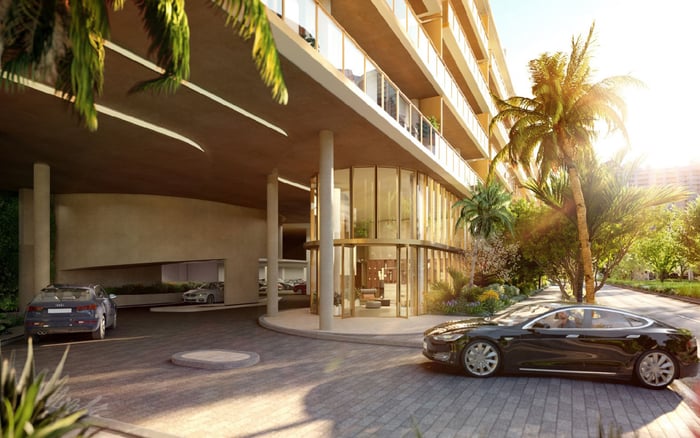
A refined buyer’s guide to assessing EV charging capability, guest parking operations, and multi-vehicle household logistics in South Florida luxury buildings.

In South Florida’s upper tier, the garage is no longer a back-of-house utility space. It is an operational asset that shapes convenience, security, resale flexibility, and the daily rhythm of a residence. Buyers with multiple vehicles, visiting family, staff, drivers, or an electric vehicle in rotation should look well beyond the phrase EV-ready.
For a modern buyer, the right questions are practical. Is the charging setup actually installed or merely planned? Is the parking space assigned, shared, or controlled as a common element? Can guests park without friction on a holiday weekend? Can a household with a resident vehicle, a second-home vehicle, a service vehicle, and frequent deliveries function smoothly within the building’s rules?
This is particularly relevant in markets such as Brickell, Miami Beach, Sunny Isles Beach, Fort Lauderdale, and West Palm Beach, where luxury towers often promise seamless living while garage operations vary widely in execution. In projects such as The Residences at 1428 Brickell or St. Regis® Residences Brickell, buyers may reasonably expect sophisticated infrastructure, but even premier branding does not replace document review.
The first distinction is between EV-capable, EV-ready, and fully installed charging. A buyer should confirm whether the residence includes an active charger, a dedicated outlet, conduit for future installation, or simply electrical planning that could support one later. These are materially different conditions.
A prudent review should cover the charger, branch circuit, panel capacity, disconnects if applicable, and whether the installation was properly approved and documented. Buyers should also confirm whether garage electrical work and life-safety review align with the building’s current requirements and operating policies.
Charging speed is another area where marketing language can obscure reality. Level 2 charging, using 240 volts, is the standard residential and multifamily solution. Fast charging of the sort associated with highway corridors is generally not the residential norm. Even within Level 2, performance varies, so buyers should verify the actual connector type, power rating, and vehicle compatibility rather than assume every space delivers the same experience.
In Coconut Grove and Bay Harbor Islands, where boutique developments can be highly tailored, this distinction is especially important. A beautifully designed building such as The Well Coconut Grove or La Maré Bay Harbor Islands may offer compelling lifestyle value, but the buyer still needs the garage schedule and written charging policy.
A charger can be physically elegant and operationally complicated. Before closing, verify whether the parking space and charger are deeded, licensed, limited-use, or part of the building’s common elements. That distinction affects who can approve upgrades, who pays for repairs, and whether the charging asset transfers cleanly on resale.
Billing should also be explicit. Some buildings include charging in common dues. Others separately meter usage. Others route billing through a networked app or access platform. For a primary residence, this determines monthly operating costs. For a second-home owner, it may influence whether the system remains useful during periods of vacancy. For an investor or future seller, it affects the ease of transfer and disclosure.
Managed charging deserves particular attention. In larger towers, load management can allow more residents to charge without forcing an oversized service upgrade. That can be a meaningful advantage, but buyers should still ask how the building prioritizes usage during peak hours, whether charging sessions are time-limited, and whether residents can rely on predictable overnight access.
In luxury buildings, guest parking often appears generous in a sales presentation and far more conditional in practice. Verify whether the property uses reservations, digital permits, time limits, valet coordination, or electronic enforcement. If the building advertises smart parking, confirm which features actually exist: real-time availability, app-based access, license-plate recognition, or only basic digital registration.
The most useful question is not simply how many guest spaces there are, but how the building manages peak demand. Holiday entertaining, seasonal occupancy, and concurrent service traffic can all strain even a well-run garage. A tower in Miami Beach such as The Perigon Miami Beach may offer a refined arrival experience, yet buyers should still request the written house rules that govern guest stays, parking duration, and enforcement.
Guest EV charging should be verified separately from resident charging. Access control is often the real issue. A building may have resident chargers with no guest privileges, or a shared setup that requires advance coordination through management or valet. For households that regularly host family staying for several days, that distinction matters.
Many ultra-premium buyers are managing not one vehicle but several. That can include a daily driver, an additional seasonal vehicle, a household staff vehicle, a driver-operated car, bicycles or low-speed vehicles, vendor access, and recurring deliveries. A serious building should have documented registration procedures, access permissions, and operating rules for each category.
This is where the conversation shifts from parking supply to fleet management. Ask whether the building tracks vehicles by plate, fob, transponder, or app. Confirm whether a resident may register multiple vehicles under one unit, whether substitutions are permitted for seasonal use, and whether drivers or staff can access the garage independently.
Delivery and service traffic should be reviewed separately from guest parking. Loading, staging, and turnover needs create a different operational pattern, especially in dense urban buildings. In Downtown Miami and Brickell, where vertical circulation and valet choreography can define the ownership experience, these policies may matter as much as the number of stalls.
In coastal markets, garage infrastructure has to do more than function on a fair-weather day. Buyers should review flood exposure, the location of electrical rooms, and the placement of EV infrastructure relative to lower garage levels.
Heat, moisture, and salt air also matter. Charger maintenance plans and replacement schedules should be documented, especially in oceanfront environments where enclosure durability and organized inspection programs directly affect reliability. A building that treats chargers as install-and-forget equipment may create avoidable service issues later.
This is worth emphasizing in communities such as Surfside, Sunny Isles Beach, and Bal Harbour, where buyers often prioritize design, views, and access to the water. In a residence such as Rivage Bal Harbour, a sophisticated purchaser should pair architectural scrutiny with questions about long-term garage resilience and maintenance discipline.
A concise request list can quickly separate polished marketing from durable operations. Ask for the EV charging policy, the billing method, the maintenance contract or service approach, guest parking house rules, and any vehicle-registration or fleet policies. If valet or concierge plays a role in charging access, ask for the written operating protocol.
Also confirm whether installed equipment was approved, whether the charger is tied to a specific unit or parking space, whether future upgrades require board approval, and whether any waiting list exists for additional charging access. In newer towers and new-construction product, these answers can affect both convenience and future value.
The most sophisticated luxury buyers understand that a residence functions as a system. The floor plan may win the heart, but the garage, the charging policy, and the household vehicle rules determine how gracefully the property performs once daily life begins.
What does EV-ready really mean in a luxury building? It may mean anything from conduit for future installation to an active charger already in place. Verify the exact hardware, electrical capacity, and whether the system is operational.
Is Level 2 charging the normal standard for residential towers? Yes. Level 2, using 240 volts, is the typical residential and multifamily charging format buyers should expect.
Should I verify charger compatibility with my specific vehicle? Yes. Charging speed and functionality vary by vehicle and charger, so connector type and power rating should be confirmed in writing.
Why does charger ownership matter on resale? Because a charger may be deeded, licensed, or part of common elements, and each structure affects transfer rights, upgrades, and repair obligations.
Can guest parking policies be more important than the number of spaces? Absolutely. Reservations, time limits, digital permits, and valet protocols often determine real usability more than the raw count.
Should guest EV charging be reviewed separately from resident charging? Yes. A building may have resident charging with no guest access, or shared charging that requires separate approvals or scheduling.
What is managed charging in a condominium garage? It is a load-management approach that helps more vehicles charge without overbuilding electrical service. Buyers should ask how usage is prioritized.
Why ask about delivery and vendor vehicle rules? Because service traffic can conflict with guest parking and daily circulation, especially in dense luxury towers with limited staging areas.
How do flood and heat risk affect garage infrastructure? Low garage levels, electrical rooms, and charging equipment may face higher resilience and maintenance concerns in exposed coastal locations.
What documents should I request before closing? Request the EV policy, billing details, maintenance plan, guest parking rules, and vehicle-registration or fleet procedures.
For a confidential assessment and a building-by-building shortlist, connect with MILLION.
If branded residences are on your mind — as a home or as an allocation — we would be glad to share what we are seeing, privately.
Begin a quiet conversation