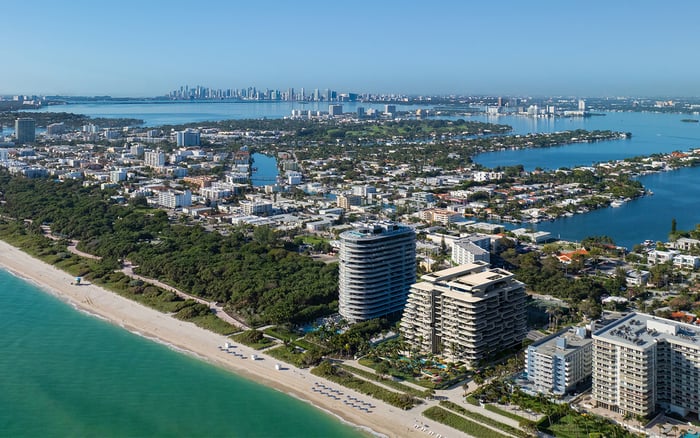
A practical luxury buyer’s guide to evaluating hurricane glass, shutters, building protocol, and storm-day access before purchasing in South Florida.

In South Florida luxury real estate, hurricane protection is often compressed into a reassuring phrase: impact glass, hurricane glass, or shutters included. For a serious buyer, that language should begin the conversation, not end it. The essential question is whether the residence, openings, balcony conditions, doors, frames, attachments, and building storm procedures operate as a complete system.
That distinction matters across the market, from a waterfront single-family home to a full-service condominium tower. A glass wall may look seamless during a blue-sky showing, but a buyer should understand how it is specified, maintained, serviced, and integrated with the rest of the envelope. The same applies to shutters. Their presence is not the same as their readiness.
A refined due-diligence conversation should feel less like a checklist and more like a building interview. Who understands the system? Where are the records? What happens when a storm is approaching? Who is allowed on property, and when? In towers such as The Residences at 1428 Brickell, the questions are not only about the view corridor. They are about how the residence is meant to be lived in, secured, and accessed through seasonal weather.
The first question is simple: what exactly is being described as hurricane glass? Ask whether that statement applies to every exterior opening or only to selected windows and doors. In many residences, the most visually prominent openings are not always the only ones that matter. Service doors, secondary sliders, terrace access points, and unusual architectural details deserve the same scrutiny.
Buyers should request documentation identifying the glass, frame, and installation condition, not just a verbal assurance. The frame and anchoring are as important to the assembly as the glass itself. A panel may be impressive, but it performs as part of a larger opening. Ask whether any glass, seal, or door component has been replaced, repaired, modified, or deferred.
For resale properties, the inquiry should include age and maintenance. Has the seller kept records? Have rollers, tracks, gaskets, locks, or seals been serviced? Does any slider require force to close? Does a door latch cleanly without lift or adjustment? In a luxury residence, effortless operation is more than convenience. It can signal that the system is properly aligned.
Oceanfront buyers should be especially attentive to exposure. Salt, wind, sun, and repeated use can affect the feel and condition of exterior openings. At projects such as The Delmore Surfside, where architecture and coastal living are inseparable, the buyer’s questions should extend from the beauty of the glass to the practical choreography of storm preparation.
Shutters can be reassuring, but buyers should not assume installed means usable. Ask what type of shutter system is present, where it is stored if removable, and who is responsible for deployment. In a condominium, the answer may differ between private terraces, association-controlled areas, and common elements. In a single-family home, the issue may involve labor, access, labeling, storage, and timing.
If shutters are manual, ask who can physically install or close them and how long the process takes. If they are motorized, ask how they are tested, how they are powered, and whether a backup operating procedure exists. Buyers should also ask whether shutters block exits, impede terrace movement, or require furniture to be relocated.
The best question is practical: if a storm watch were announced while the owner was away, what happens next? A luxury property should not depend on guesswork. There should be a defined process, clear responsibility, and an understanding of whether the building, a property manager, a caretaker, or the owner must act.
In new-construction residences, buyers often focus on finishes and amenities. They should bring the same attention to storm-protection handoff. If shutters are included, ask when the owner receives instructions, warranty information, remote-control details, or service contacts. If shutters are not part of the design because another protection strategy is used, ask for that explanation in plain language.
Storm-day access is one of the most under-discussed issues in luxury acquisitions. Buyers want to know whether they can arrive, leave, park, secure a pet, receive help, or access a residence as weather conditions deteriorate. Yet those questions are often left until after closing.
In a condominium, ask how the association communicates before and after a storm. Are elevators placed on a special protocol? Is valet service modified? Are garages restricted? Are contractors or caretakers allowed on-site? Are residents advised to remove balcony furnishings by a certain time? The goal is not to challenge the building, but to understand its rhythm.
For a buyer considering a high-floor residence in Brickell, Sunny Isles, Surfside, or another vertical waterfront market, the storm-day plan should be read with the same seriousness as the amenity program. A private dining room is elegant. A clear emergency communication process is essential. At St. Regis® Residences Sunny Isles, or any comparable full-service coastal tower, the operational questions belong in the early conversation, not the final walk-through.
Single-family buyers should ask about gates, generators, garage doors, drainage patterns, landscaping, outdoor kitchens, and dock equipment if applicable. The most beautiful exterior features often require the most deliberate preparation. If a house depends on staff, vendors, or remote management, the buyer should confirm who has keys, gate access, alarm credentials, and authority to act.
A buyer does not need to become an engineer to ask better questions. The goal is to gather enough documentation for the buyer’s inspector, insurance advisor, attorney, or property manager to review intelligently. Ask for permits, warranties, product labels, service records, association rules, shutter instructions, and any recent repair invoices tied to exterior openings.
For condominiums, request the building’s rules on balcony preparation, storm notices, access restrictions, and vendor entry. Ask whether owners are required to bring in furniture, planters, umbrellas, grills, art, or loose decorative objects. Clarify whether the association may enter a residence or terrace under certain conditions, and how notice is handled.
For homes, ask whether the seller has a written storm-preparation routine. The best sellers often have a simple sequence: close certain shutters, move outdoor furniture, secure exterior equipment, check doors, confirm caretaker access, and photograph conditions. Even if informal, that knowledge can be valuable to a new owner.
The documentation conversation is equally relevant in emerging waterfront markets and established enclaves. A buyer evaluating The Ritz-Carlton Residences® Pompano Beach may be attracted to resort-style coastal living, but should still ask how the residence transitions from leisure mode to storm-readiness mode.
During inspection or final walk-through, ask to see doors and sliders opened, closed, locked, and latched. Watch the movement. Listen for grinding. Notice whether water staining, swelling, corrosion, or resistance appears around thresholds and frames. Ask where removable shutters are stored and whether all parts are present, labeled, and accessible.
If a property has large terraces, ask how furniture is secured or stored. If there are private elevators, service elevators, or private garages, ask how each is managed as storms approach. If the residence is part of a branded or highly serviced building, understand the division between owner responsibility and building responsibility. Luxury service is valuable, but it does not eliminate the need for owner clarity.
A prudent buyer also asks how storm-readiness affects insurance discussions. The buyer’s insurance advisor may want details about openings, protection, roof condition, construction, elevation, or prior repairs. The earlier those questions are asked, the less likely they are to interrupt a closing timeline.
The most elegant answer is usually operational. Who closes the shutters? Who verifies the sliders? Who communicates building restrictions? Who moves terrace furniture? Who can enter if the owner is abroad? Who photographs conditions before and after a storm? Who calls the vendor if a motorized component fails?
In South Florida, luxury ownership often includes travel, seasonal use, and multiple residences. That makes delegation central. A buyer should understand whether the residence is self-managed, building-supported, or best served by a private manager. For the right property, this becomes part of the lifestyle design.
The buyer who asks these questions is not being difficult. They are protecting the experience they are purchasing. Hurricane glass, shutters, and access protocols are not aesthetic footnotes. They are part of the architecture of confidence.
Is “hurricane glass” enough protection on its own? Not necessarily. Buyers should ask which openings are protected, how the frames are installed, and whether doors and sliders are included.
Should I still ask about shutters if the building has impact glass? Yes. Some properties use shutters for certain openings, while others rely on different systems, so the exact approach should be clarified.
What should I request from the seller? Ask for warranties, permits, product details, service records, shutter instructions, and any rules governing storm preparation.
Why does storm-day access matter in a condo? Access affects elevators, parking, valet, vendors, pets, staff, and the ability to secure the residence when conditions change.
What should seasonal owners ask before closing? They should ask who can prepare the residence if they are away, who has access, and how authorization is documented.
Are motorized shutters always easier? They can be convenient, but buyers should ask how they are tested, powered, serviced, and operated if the primary control fails.
What should I look for during the walk-through? Open and close sliders, doors, and shutters, then check locks, tracks, seals, labels, storage areas, and visible wear.
Do building staff handle all storm preparation? Not always. Responsibilities vary, so buyers should clarify what the association handles and what remains the owner’s duty.
Should insurance questions come before or after closing? Before closing. Insurance review may require details about openings, protection systems, maintenance, and building procedures.
What is the most important question to ask? Ask who does what, when, and with what authority, because a clear plan is often more valuable than a vague assurance.
To compare the best-fit options with clarity, connect with MILLION.
If branded residences are on your mind — as a home or as an allocation — we would be glad to share what we are seeing, privately.
Begin a quiet conversation