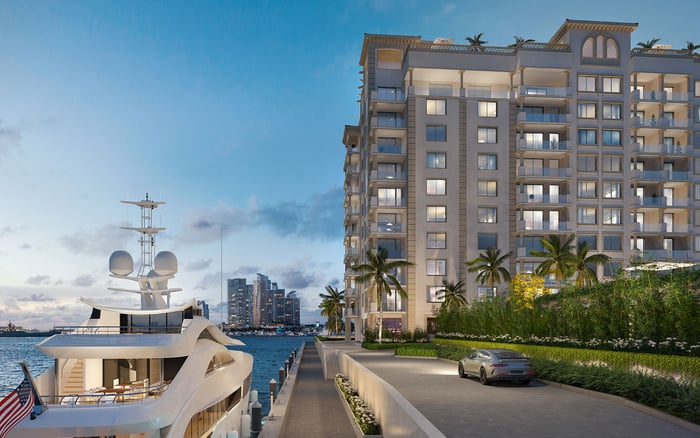
A discreet buyer’s guide to the insurance questions that matter before purchasing a South Florida luxury residence, from flood coverage and elevation documentation to association-level protections and deductibles.

In South Florida, water is part of the allure. It frames the view, defines the lifestyle, and often elevates the value of a residence. It also demands discipline. Before a buyer falls for a terrace, a private dock, a glass-wrapped great room, or an oceanfront arrival, the insurance conversation should begin.
The most polished purchase process treats flood insurance, elevation certificates, and association coverage as core due diligence, not late-stage paperwork. These questions do not diminish the romance of the property. They protect it. A residence may be beautifully designed, impeccably serviced, and positioned in one of the region’s most coveted enclaves, yet the buyer still needs to understand how risk is allocated among the owner, lender, insurer, and association.
For luxury buyers comparing vertical residences in Brickell, beach residences in Miami Beach, or estate-style homes along the Intracoastal, the objective is not simply to confirm that coverage exists. The better question is what the coverage actually does, where it stops, who pays the deductible, and what documentation supports the premium being quoted.
The first insurance question should be precise: is flood coverage carried by the owner, the association, or both? In a condominium, a master policy may address portions of the building, while the individual owner may still need coverage for personal property, interior improvements, or items not included under the association’s policy. In a single-family home, the owner’s responsibility is more direct, but careful review remains just as important.
Buyers should ask for current policy declarations, deductible information, renewal timing, and a plain-language explanation of what is and is not included. Flood, wind, general property, contents, loss assessment, and liability coverage should not be grouped casually. Each can operate differently. A sophisticated buyer needs to understand the layers.
At a tower such as The Residences at 1428 Brickell, the inquiry may focus on how the building’s insurance framework interacts with unit-level coverage and lender requirements. In a coastal setting such as The Perigon Miami Beach, the conversation may place greater emphasis on flood, wind, ground-level areas, and shared amenities. The property type changes the questions, but the standard remains the same: understand the exposure before the deposit feels permanent.
An elevation certificate can be one of the most important documents in a flood-insurance review, but buyers should resist treating it as a simple box to check. Ask whether one exists, when it was prepared, what structure or portion of the property it applies to, and whether the insurer has used it in pricing the quoted coverage.
For a single-family home, buyers should ask about the elevation of finished living areas, garages, mechanical equipment, pool equipment, guest structures, and any lower-level space. For a condominium, the focus often shifts to building-wide documentation and whether the association has current records that insurers, lenders, and owners can reference.
The practical question is not merely whether the residence is elevated. It is whether the right parts of the residence and its essential systems are protected in a way that aligns with the buyer’s expectations. A dramatic lobby, a waterside fitness room, or an amenity deck may be part of the daily luxury experience. Buyers should know how those shared spaces are treated in insurance planning.
In a condominium or managed residential community, the association’s insurance program can influence a buyer’s real cost of ownership. The master policy, deductibles, reserves, claims procedures, and assessment authority deserve close review. Buyers should ask which building components are insured by the association and which fall to the unit owner.
Windows, sliding doors, terraces, interior finishes, flooring, cabinetry, appliances, and built-ins should be discussed with care. A residence may feel turnkey, but the insurance responsibility for its most visible elements may not be automatic. The same is true for temporary housing, contents, and upgrades made after original delivery.
At The Delmore Surfside, a buyer may want to understand how association coverage applies to common areas, building systems, and any owner obligations for interiors. At St. Regis® Residences Sunny Isles, similar questions belong in the early diligence file, particularly when the buyer is evaluating lifestyle services alongside long-term carrying costs.
Deductibles are central. A master policy can exist and still carry a deductible that becomes meaningful after a storm event. Ask whether deductibles may be passed to owners through assessments, how those allocations are calculated, and whether reserves or other association funds are intended to address insurance-related expenses.
Before making an offer, request the seller’s current insurance information, any available elevation certificate, association insurance summaries, and the most recent budget documents available to buyers. For new-construction residences, ask which insurance assumptions are preliminary, when final policies are expected, and how future association budgets may be refined.
Buyers should also ask their insurance advisor to review the property before the inspection period becomes compressed. A premium estimate is useful, but it is not the same as a full review of exclusions, deductibles, required coverage, and lender expectations. If financing is involved, the lender’s requirements should be compared with the buyer’s own comfort level. If the purchase is cash, the review is still essential. Freedom from lender requirements does not remove exposure.
A careful buyer also asks how renovations may affect coverage. Adding custom millwork, specialty stone, smart-home systems, wine storage, art lighting, or bespoke closets may change what should be insured at the unit or home level. The more tailored the residence, the more important it becomes to align coverage with actual replacement expectations.
Before closing, confirm that insurance quotes are still current, that the association coverage information has not materially changed, and that the buyer understands all deductibles. If the transaction involves a condominium, the closing file should clearly separate association responsibilities from owner responsibilities.
This is also the moment to confirm timing. When must the buyer’s policy bind? What proof is required for closing? Who receives certificates of insurance? Are lenders, associations, or property managers asking for specific documentation? These are administrative questions, but they are not minor. A luxurious closing should feel controlled, not improvised.
The best insurance diligence has a certain elegance to it. It is calm, detailed, and completed before emotions and deadlines narrow the field of vision. In South Florida, that level of discipline is not a defensive posture. It is part of buying well.
Should a cash buyer still review flood insurance? Yes. A cash buyer may avoid lender requirements, but still needs to understand exposure, deductibles, and replacement risk.
Is association insurance enough for a condo buyer? Not by itself. Buyers should determine what the association covers and what remains the owner’s responsibility.
What is the first insurance document to request? Ask for current policy summaries or declarations, deductible details, and any available elevation documentation.
Does an elevation certificate apply to every part of a property? Not necessarily. Buyers should ask what structure, area, or building component the certificate addresses.
Should flood and wind coverage be discussed separately? Yes. They can function differently, so buyers should review each category on its own terms.
Can association deductibles affect individual owners? They can. Buyers should ask how deductibles may be allocated and whether assessments are possible.
When should insurance diligence begin? Ideally before an offer or early in the contract period, while the buyer still has negotiating flexibility.
Do interior upgrades need separate attention? Yes. Custom finishes, fixtures, built-ins, and personal property may require owner-level coverage.
Are waterfront homes and condos reviewed the same way? No. The questions overlap, but ownership structure and association responsibilities can change the analysis.
Who should explain the final coverage picture? A qualified insurance advisor should review the documents alongside the buyer’s real estate and legal team.
To compare the best-fit options with clarity, connect with MILLION.
If branded residences are on your mind — as a home or as an allocation — we would be glad to share what we are seeing, privately.
Begin a quiet conversation