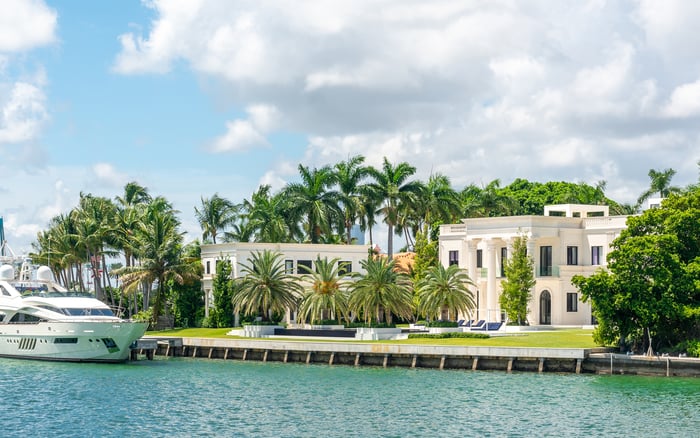
A discreet look at Four Seasons Residences Coconut Grove as a case study in how affluent Florida buyers can frame homestead portability as part of a broader ownership strategy.

In South Florida luxury real estate, the most sophisticated purchase decisions often begin with what is absent from the listing presentation. The view, service culture, architecture and neighborhood character matter, of course. Yet for buyers moving within Florida, another layer can shape the ownership decision: whether a prior homestead advantage may be portable to the next residence.
That is why Four Seasons Residences Coconut Grove is a useful case study. The project sits in Coconut Grove, a Miami neighborhood where privacy, tree canopy and waterfront sensibility have long attracted buyers who prefer refinement without the performative edge of more conspicuous luxury corridors. For a buyer already established in Florida, the question is not simply whether the residence is desirable. It is whether the move can be structured with the same discipline that guides the acquisition of art, operating companies or generational property.
Save Our Homes portability belongs within that discipline. It should not be treated as a casual closing-table afterthought. It is a planning issue to raise early with qualified tax, legal and property advisory professionals, especially when a buyer is replacing one Florida homestead with another and wants to understand whether any assessment benefit may transfer.
Coconut Grove is not a market that needs to shout. Its appeal is quieter: shaded streets, a village rhythm, proximity to the bay and a residential identity that feels distinct from Miami’s high-gloss urban core. For wealth buyers, that discretion can be as valuable as square footage.
The presence of Four Seasons Residences Coconut Grove gives the neighborhood another lens for evaluating branded residential living. The decision is not merely about services or a globally recognized name. It is about how a buyer might consolidate lifestyle, privacy and long-horizon planning into one move. Nearby, the broader Grove conversation includes projects such as Mr. C Tigertail Coconut Grove and Park Grove Coconut Grove, each reinforcing the neighborhood’s position as a mature alternative to more overtly vertical luxury districts.
Some buyers may shorthand the search as Coconut Grove, new construction, investment, second home and waterview. The real work is more nuanced. A Grove acquisition may be a primary residence, a lifestyle recalibration or a legacy foothold. Each use case changes the questions a buyer should ask before signing a contract.
For high-net-worth buyers, tax planning is often discussed in broad terms: domicile, estate structure, liquidity, insurance, trust planning and asset location. Florida homestead planning can sit within that same family of decisions. Save Our Homes portability, where available and properly applied, may affect the economics of moving from one Florida homestead to another. The critical point is that eligibility, timing, caps and procedures are not lifestyle details. They are technical issues.
In practical terms, a buyer considering Four Seasons Residences Coconut Grove should place portability on the diligence checklist before the emotional momentum of a purchase takes over. That means coordinating with professionals who understand the buyer’s existing Florida homestead, intended new homestead, application requirements and likely assessment implications. It also means resisting simplified savings narratives. A meaningful analysis depends on the buyer’s own facts, not a generic example.
Luxury buyers are accustomed to underwriting cost of carry with precision. Association expenses, insurance, financing terms, liquidity preferences and renovation exposure all receive attention. Portability deserves the same treatment because it can influence the all-in ownership picture over time.
The strongest argument for Four Seasons Residences Coconut Grove is not that tax planning alone should drive the purchase. It should not. A residence at this level must stand first as a place to live, receive, retreat and establish continuity. The portability conversation is additive, not primary.
That distinction matters. Buyers who focus only on a possible tax benefit risk reducing a deeply personal residence decision to a spreadsheet. Buyers who ignore the issue entirely may miss a legitimate planning opportunity. The balanced approach is to begin with the right property, then test whether the tax architecture supports the move.
This is where quiet luxury becomes more than an aesthetic. It becomes a way of making decisions without theatrical urgency. In Coconut Grove, the purchase can be viewed through permanence: daily life, family patterns, access to Miami’s core and the desire for an address that feels residential rather than transactional. The Well Coconut Grove and Ziggurat Coconut Grove further demonstrate how the area’s residential pipeline continues to attract buyers who value context as much as branding.
The first question is whether the buyer currently benefits from a Florida homestead assessment position that may have portability value. The second is whether the intended new property will become the buyer’s qualifying homestead. The third is how timing, documentation and applications should be handled so the planning objective is not undermined by avoidable procedural errors.
These are not questions for the sales gallery alone. They belong with the buyer’s full advisory team. A contract strategy may need to reflect closing timing, occupancy intentions and broader residency planning. If the residence is intended as a second home rather than a primary homestead, the analysis changes. If ownership is contemplated through an entity or trust, the advisory conversation becomes even more important.
At the upper end of the market, precision is a form of discretion. The best buyers do not overstate potential benefits and do not rely on informal assumptions. They ask better questions earlier.
South Florida’s premium market has matured beyond the simple migration narrative. The next stage is about intelligent permanence: choosing where to establish a life, not merely where to buy a trophy asset. Four Seasons Residences Coconut Grove fits that moment because it pairs a globally understood hospitality sensibility with a neighborhood that reads as private, grounded and distinctly Miami.
For buyers moving from another Florida homestead, Save Our Homes portability may become part of the ownership thesis. For buyers arriving from outside Florida, the lesson is broader: understand the homestead framework before assuming how a residence will perform as a primary base. In both cases, the Grove rewards patience and specificity.
The quiet luxury case is ultimately this: a buyer does not need to choose between beauty and discipline. The best acquisition blends the two. Four Seasons Residences Coconut Grove offers a setting for that blend, while portability planning reminds buyers that elegant ownership is often built before the deed is recorded.
Why discuss Save Our Homes portability with Four Seasons Residences Coconut Grove? Because buyers moving within Florida may need to evaluate whether a prior homestead assessment benefit can be part of the new ownership plan.
Is portability the main reason to buy in Coconut Grove? No. It is a planning consideration that should support, not replace, the lifestyle and property decision.
Can every Florida buyer use Save Our Homes portability? Not necessarily. Eligibility depends on buyer-specific facts and should be reviewed with qualified advisors before closing.
Should a buyer rely on a generic savings estimate? No. Any estimate should be based on the buyer’s own assessment history, intended homestead status and current local tax framework.
When should portability be discussed? Early in the search, ideally before an offer strategy is finalized and before timing assumptions become difficult to change.
Does a second-home purchase usually require a different analysis? Yes. A second-home intention can affect the homestead conversation and should be reviewed before the buyer assumes any portability benefit.
Why is Coconut Grove attractive to discreet luxury buyers? Coconut Grove offers a residential tone within Miami, with a quieter character that appeals to buyers seeking privacy and continuity.
Are branded residences relevant to tax planning? The brand is not the tax factor, but the purchase decision around a branded residence can be an appropriate moment to review homestead strategy.
Should trusts or entities be reviewed before purchase? Yes. Ownership structure can affect planning questions, so legal and tax review should occur before the contract and closing sequence are fixed.
What is the most important takeaway for buyers? Treat portability as part of disciplined luxury due diligence, not as an afterthought or a marketing promise.
To compare the best-fit options with clarity, connect with MILLION.
If branded residences are on your mind — as a home or as an allocation — we would be glad to share what we are seeing, privately.
Begin a quiet conversation