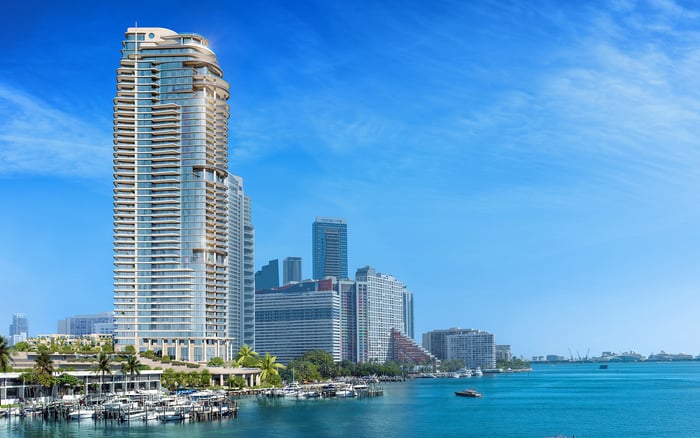
For South Florida luxury buyers, storm-day staffing is not a lifestyle promise to assume. It is an association-document question that sits in declarations, bylaws, management agreements, emergency powers language, budgets, and vendor contracts.

In South Florida luxury real estate, the most reassuring phrases are often the least specific: 24-hour concierge, full-service residence, white-glove management, attended lobby. They suggest continuity, calm, and the impression that a building will operate with hotel-like grace under pressure. During storm season, however, the legal question is narrower and more consequential: what do the association documents actually require when conditions change?
Atlantic hurricane season runs from June 1 through November 30, so storm readiness is not an abstract concern for coastal buyers. It is a recurring operational issue, especially for waterfront and barrier-island communities where storm surge is a major hazard. For a purchaser weighing a residence at The Perigon Miami Beach, a tower in Brickell, or an oceanfront home along Broward’s coastline, the conversation should move beyond finishes and amenity renderings into the association’s governing records.
Those records do not read like hospitality literature. They are more precise, and more revealing. They show who has authority, what services are contracted, how emergencies alter ordinary operations, and whether the annual budget supports the staffing model implied by the sales experience.
For Florida condominium associations, authority flows through the declaration, bylaws, articles of incorporation, rules, contracts, and Chapter 718. For homeowners’ associations, the relevant records likewise include governing documents, rules, management agreements, contracts, and financial records. In either structure, a buyer should not treat a brochure phrase as an operational guarantee.
Start with the declaration and bylaws. The declaration often defines common elements, association responsibilities, and the scope of services attached to ownership. The bylaws govern administration, including how decisions are made and who can act for the association. In storm conditions, that administrative authority matters. A board may need to close amenities, limit access to parts of the property, suspend certain services, or prioritize protection of association property.
The rules and regulations are the next layer. They may address access, deliveries, elevator use, parking, pets, guests, move-ins, balcony items, and amenity closures. During a named storm or declared emergency, routine conveniences may yield to safety protocols. A buyer who expects normal valet, front desk, and package operations throughout a weather event should look for explicit language, not infer it from everyday service culture.
The management agreement is one of the most important documents in a storm-day staffing review. Association records include management agreements, and those contracts may reveal whether on-site staffing is required, optional, modified, or suspended during emergencies.
This is where the distinction between luxury service and legal obligation becomes visible. A building may market attentive staffing during normal conditions while the management contract gives the manager discretion to withdraw personnel when travel becomes unsafe, when government orders apply, or when emergency protocols are activated. Conversely, a more robust agreement may address pre-storm preparation, post-storm assessment, communication procedures, vendor coordination, and staffing coverage in greater detail.
In a vertical urban market such as Brickell, where buyers may compare residences like St. Regis® Residences Brickell with other service-driven towers, the management agreement can help clarify whether the building’s operating personality is backed by contractual substance. The question is not simply whether there is a desk downstairs. It is whether the association has contracted for emergency procedures, after-hours coverage, and recovery coordination.
A staffing promise without funding is a sentiment. Accounting records and budgets can help reveal whether an association actually funds the labor, overtime, emergency vendors, insurance-related support, and recovery capacity needed to perform under stress.
Buyers should look for evidence of practical readiness: line items for security, management, maintenance, janitorial support, contingency planning, reserve considerations, and vendor relationships. Emergency staffing is rarely a question of one employee remaining at a desk. It can involve pre-storm site protection, securing common areas, shutting down vulnerable systems, communicating with residents, coordinating access after the event, and engaging mitigation, repair, and restoration vendors.
That financial layer is especially important in boutique and ultra-luxury buildings, where residents may expect a highly personalized response. A smaller association can offer intimacy and discretion, but it may also have a different staffing base than a large tower. The budget helps reveal whether the service expectation is operationally realistic.
Florida condominium boards have statutory emergency powers during qualifying emergencies, including authority tied to disaster planning and protecting association property. Those powers can include determining that portions of the condominium property are unavailable for entry or occupancy based on safety conditions. Boards may also contract for mitigation, repair, and restoration after an emergency.
That authority is important, but it should not be confused with a promise that normal luxury services will continue uninterrupted. Emergency powers are tied to declared emergencies and disaster conditions. They are designed to let boards act quickly when ordinary procedures are impractical or unsafe.
For buyers evaluating coastal enclaves such as Surfside, a residence at The Surf Club Four Seasons Surfside may naturally invite expectations shaped by exceptional service. The association documents, however, remain the place to distinguish between everyday hospitality and emergency authority. A board’s ability to close a pool deck, restrict garage access, or deem an area temporarily unavailable may be essential to safety, even if it interrupts the lifestyle rhythm residents enjoy most of the year.
Luxury buyers often move fluidly between condominium towers, branded residences, gated estates, and waterfront HOA communities. The storm-day staffing analysis should travel with them, even when the governing framework differs.
Condominium purchasers have a legal pathway to review key condominium documents before closing through resale disclosure rules. HOA buyers should likewise examine official records, including governing documents, rules, management agreements, contracts, and accounting records. The central question remains the same: how are storm-day operations authorized and funded?
In an HOA context, staffing may involve gate access, roving security, landscape preparation, lake or drainage vendors, clubhouse closures, and post-storm debris coordination. In a condominium, the focus may include elevators, generators, lobby access, garage entries, façade issues, common-area water intrusion, and vertical evacuation logistics. The vocabulary changes, but the document trail remains essential.
When a project presents itself as full-service, buyers should admire the lifestyle promise while testing the legal foundation. At The Ritz-Carlton Residences® Pompano Beach, as in other premium coastal settings, the word oceanfront carries both emotional and operational meaning. It suggests views, access, and air. It also underscores why storm planning deserves careful review.
The strongest due-diligence read compares marketing claims such as 24/7 service with the declaration, bylaws, rules, management agreement, emergency powers language, annual budget, and vendor contracts. The goal is not to diminish the luxury proposition. It is to understand its limits under extraordinary conditions.
Ask direct questions. Who decides whether staff remain on site? Is there a written emergency plan? Does the management agreement address hurricane protocols? Are there pre-arranged vendors for mitigation, repair, and restoration? What resident communications are contemplated before and after a storm? Are overtime and emergency expenses budgeted, or handled as special circumstances?
A disciplined buyer should request current copies of the declaration, bylaws, rules, management agreement, major association contracts, recent budgets, and relevant accounting records. If the residence is in a condominium resale, the statutory disclosure process provides a formal path to review key documents. If the property is governed by an HOA, official records can still illuminate how operations are authorized and paid for.
The most valuable review is comparative. Read the service language alongside the budget. Read the emergency powers alongside the rules. Read the management contract alongside the staffing assumptions made during tours. If there is a gap, ask whether it is intentional, temporary, or simply undocumented.
For Sunny Isles, Miami Beach, Surfside, Brickell, and other high-value South Florida markets, this is the quiet due diligence that preserves confidence. Luxury is not only what happens on a blue-sky afternoon. It is also the clarity of governance when the forecast changes.
Do luxury buildings guarantee storm-day staffing? Not unless the governing documents, management agreement, or other binding records create that obligation. Marketing language alone should not be treated as a guarantee.
Which association document should buyers read first? Start with the declaration and bylaws, then review the rules, management agreement, association contracts, and budget together.
Why is the management agreement so important? It may explain whether on-site personnel are required, discretionary, modified, or suspended during emergency conditions.
Can a board close amenities before or after a storm? During qualifying emergencies, boards may have authority to restrict access to portions of the property when safety conditions justify it.
Do HOA communities raise the same staffing questions? Yes, although the focus may shift to gates, security, drainage, clubhouse operations, vendors, and post-storm cleanup.
What does the annual budget reveal? It can show whether staffing, overtime, emergency vendors, and recovery capacity are actually funded by the association.
Should buyers rely on 24/7 concierge language? They should verify it against the governing documents and management contract, especially for emergency conditions.
Are emergency powers the same as normal operating rules? No. Emergency powers apply during qualifying emergencies and may temporarily change access, services, and procedures.
Why do vendor contracts matter? Pre-arranged mitigation, repair, and restoration vendors can indicate whether the association has planned for recovery capacity.
When should this review happen? Ideally before closing, while the buyer still has time to evaluate documents, ask questions, and understand operational limits.
If you'd like a private walkthrough and a curated shortlist, connect with MILLION.
If branded residences are on your mind — as a home or as an allocation — we would be glad to share what we are seeing, privately.
Begin a quiet conversation