A refined field guide for evaluating private dining rooms during a luxury residence showing, with attention to privacy, acoustics, lighting, service flow, comfort, and entertaining readiness.
A private dining room is not merely an amenity to admire. It is a stage for birthdays, collector dinners, family holidays, investor lunches, philanthropic committees, and quieter evenings when privacy matters more than spectacle. During a private showing, the goal is to move beyond finishes and determine whether the room can carry the kind of hospitality you intend to practice.
Before you arrive, define one real scenario. Perhaps it is a seated dinner for twelve with a chef, a cocktail reception before Art Week, or a Sunday lunch for grandparents and children. That scenario sharpens the room’s true value. A beautiful table that cannot support the choreography of arrival, service, conversation, and departure is not a private dining room. It is a decorated chamber.
In Brickell, where buyers often balance business entertaining with residential privacy, a project such as ORA by Casa Tua Brickell is a useful reminder to ask hospitality questions early. Who manages the room, how far in advance it may be reserved, whether outside chefs are permitted, and what the guest protocol looks like should all be understood before the romance of the space takes over.
The first test is not the chair, the chandelier, or the view. It is the threshold. Stand outside the room with the door closed, then enter as a guest would. Notice whether the arrival feels ceremonial or exposed. A private dining room should allow guests to arrive without crossing a crowded amenity path, package area, or overly public corridor.
Ask where guests wait if they arrive early, whether they are escorted from the lobby, and how the building handles names, access, and parking. If the room sits near a lounge or bar, listen for bleed. Social proximity can be convenient, but a private dinner should not feel like an annex to someone else’s evening.
Then sit with your back to the door. This simple exercise is revealing. If the room feels vulnerable, if service constantly passes behind guests, or if the main entry interrupts the host’s sightline, the layout may not support the calm expected at the upper end of the market.
Acoustics are one of the most overlooked tests. During a showing, clap once, speak at a normal dinner volume, and ask another person to stand across the table. Hard surfaces, high ceilings, glass, stone, and open-plan adjacency can create a handsome room that becomes tiring after twenty minutes.
A private dining room should allow conversation to travel without forcing guests to perform. Test a toast. Test a quiet aside. Test the distance between the head of the table and the far corner. If the room is meant for multi-generational hosting, consider whether older guests will hear comfortably without the table growing loud.
Music should be treated as architecture. Ask how audio is controlled, whether it can be zoned separately from nearby amenity areas, and whether the room can remain quiet when the rest of the building is active. Luxury, in this context, is not volume. It is control.
The most elegant rooms are often judged by what guests never see. During a private showing, trace the route from kitchen or catering prep to table. Where does food enter? Where are trays staged? Where do staff place glassware, linens, flowers, ice, and coffee service? A room that lacks proper back-of-house logic may still photograph beautifully, but it will ask the host to compromise.
Ask whether there is a catering kitchen, warming capability, refrigeration, dish storage, and a discreet cleanup route. If a chef is involved, where can that person work without turning the dinner into theater unless theater is the intention? If building staff assists, clarify what is included and what is separately arranged.
In Miami Beach, a residence conversation around The Perigon Miami Beach can inspire a broader question for any coastal buyer: how does the building support entertaining when guests arrive in resort attire, from beach-adjacent afternoons to formal evening dinners? The room should adapt without losing dignity.
Do not evaluate the room only from the doorway. Sit in several chairs, including the least desirable positions. Check leg clearance, spacing, sightlines, temperature, and the distance to service points. A host may focus on the best seat, but guests remember the awkward one.
Look at the relationship between table size and circulation. Staff should be able to pass behind chairs without brushing shoulders. Guests should be able to stand, greet, and move without creating a bottleneck. If a sideboard, credenza, or floral installation is planned, imagine it in place. Many rooms feel generous when empty and constrained once fully dressed.
Lighting deserves its own trial. Ask to see daytime, evening, and dimmed settings if possible. The best private dining rooms can shift from lunch clarity to candlelit intimacy without flattening faces or turning food into shadow. If art is part of the room, confirm that lighting does not compete with the table.
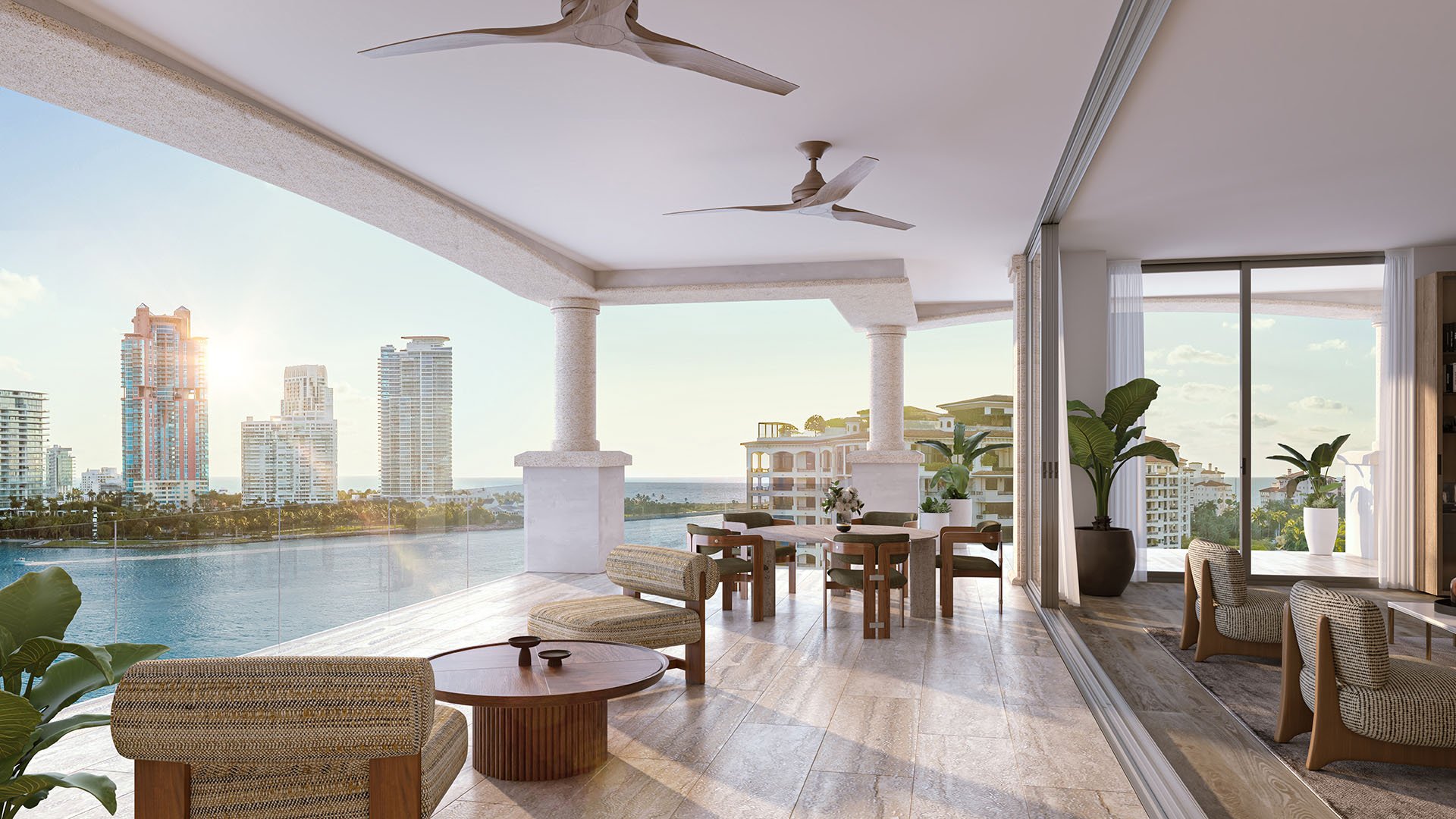
When a private dining room connects to outdoor space, evaluate the terrace as part of the evening rather than as a separate amenity. Can guests step outside between courses without disturbing service? Is the door heavy, loud, or disruptive? Does wind affect candles, florals, linens, or conversation? A graceful indoor-outdoor connection can deepen the experience, but only if it remains composed.
For buyers considering island or enclave living, The Residences at Six Fisher Island may prompt a useful line of inquiry: how do arrival rituals, security, and guest movement shape the feeling of a dinner before anyone sits down? Exclusivity should feel seamless, not procedural.
Also look at restrooms, coat storage, elevator proximity, and the path back to valet or private transportation. The end of the evening matters. A refined departure preserves the host’s impression as much as the first glass of champagne.
Private dining rooms live within building rules. Ask how reservations are prioritized, whether peak dates have restrictions, whether fees apply, and what happens if two residents request the same evening. Clarify guest limits, alcohol policy, catering rules, decoration permissions, music hours, cleanup obligations, and cancellation requirements.
This is particularly important in new construction, where renderings may present atmosphere before operating details are fully felt. The question is not whether the room looks luxurious. The question is whether the building culture will protect a refined private experience over time.
In Coconut Grove, wellness-oriented and community-minded buyers may look to projects such as The Well Coconut Grove and ask how shared amenity life balances sociability with discretion. A private dining room should feel available, cared for, and professionally managed, not treated as a decorative promise.
A successful private dining room should make hosting feel easier, not more complicated. It should give residents the pleasure of a restaurant, the privacy of home, and the operational discipline of a well-run residence. During a showing, trust the room only after you have walked the service route, sat at the table, listened to the acoustics, tested the lighting, and imagined a complete evening from arrival to farewell.
The best test is simple: if you can picture your guests relaxing before you begin explaining the logistics, the room is doing its work.
What should I ask first about a private dining room? Ask how the room is reserved, staffed, accessed by guests, and cleaned after use. These operating details determine whether the amenity will be effortless or complicated.
Should I test the acoustics during a showing? Yes. Speak across the table, listen for corridor noise, and notice whether hard surfaces make conversation feel sharp or tiring.
How important is proximity to a catering kitchen? Very important for formal entertaining. Food, glassware, and cleanup should move discreetly without disrupting guests.
What makes a private dining room feel truly private? A controlled entrance, limited sound bleed, discreet service paths, and a sense of separation from busier amenity areas are key.
Should I ask about outside chefs or caterers? Yes. Some residences may have rules about vendors, insurance, staffing, preparation areas, and cleanup responsibilities.
How do I evaluate the table layout? Sit in multiple seats and check circulation behind chairs. The weakest seat often reveals the room’s real limitations.
Is outdoor access always an advantage? Not always. Outdoor access is valuable only if wind, noise, door movement, and service flow remain controlled.
What lighting should I request to see? Ask for daytime, evening, and dimmed settings. A proper room should flatter faces, food, art, and table design.
Can building rules affect resale appeal? Yes. Clear, reasonable amenity governance can make the room more usable and more compelling to future buyers.
What is the biggest mistake buyers make? They judge the room as a photograph instead of a live event. Always test arrival, seating, sound, service, and departure.
For a discreet conversation and a curated building-by-building shortlist, connect with MILLION.
If branded residences are on your mind — as a home or as an allocation — we would be glad to share what we are seeing, privately.
Begin a quiet conversation