A buyer-focused comparison of W Pompano Beach Hotel & Residences and The Perigon Miami Beach through the lens of private dining, entertaining flow, and acoustic separation.
For a certain South Florida buyer, the most important room is not simply the primary suite, the salon, or the terrace. It is the invisible space between them: the circulation path that lets a dinner party breathe, the service rhythm that keeps a table composed, and the acoustic envelope that allows bedrooms to remain quiet while the evening continues elsewhere.
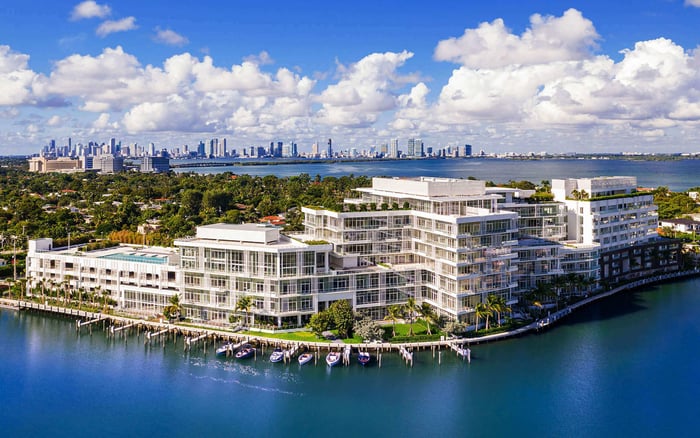
That is why W Pompano Beach Hotel & Residences and The Perigon Miami Beach make a useful comparison. They are not interchangeable ownership decisions. A buyer looking at a hotel-and-residences environment will usually ask different questions than a buyer focused on a more residentially controlled private tower experience.
The available facts provided here do not establish detailed floor plans, acoustic ratings, service policies, ownership restrictions, or operating rules for either project. That matters. The right way to compare them is not to assume what the brochure will deliver, but to identify the specific questions a buyer should resolve before choosing between hospitality activation and residential seclusion.
Private dining in a luxury residence is no longer only about having a beautiful table. For many owners, the more consequential question is operational: who helps make the evening feel effortless?
At W Pompano Beach Hotel & Residences, buyers should evaluate how the hotel-and-residences context affects dining support, guest arrival, service access, and the energy surrounding an evening at home. The appeal of this ownership direction is often the possibility of a more service-aware lifestyle, but the details should be verified through project materials, governing documents, and direct questions to the sales team.
That diligence should be practical. Ask whether food and beverage support is available to residents, how it is requested, whether outside staff or private chefs have defined access protocols, and how deliveries or catered events move through the property. Also ask whether resident privacy is protected when hospitality activity is high.
At The Perigon Miami Beach, the private dining analysis should start with residential control. Buyers should review how arrival, dining, terrace, kitchen, and sleeping areas relate to one another in the specific residence under consideration. If the goal is a quieter and more private evening, the plan itself becomes the service mechanism: it must support guests without allowing the event to overtake the entire home.
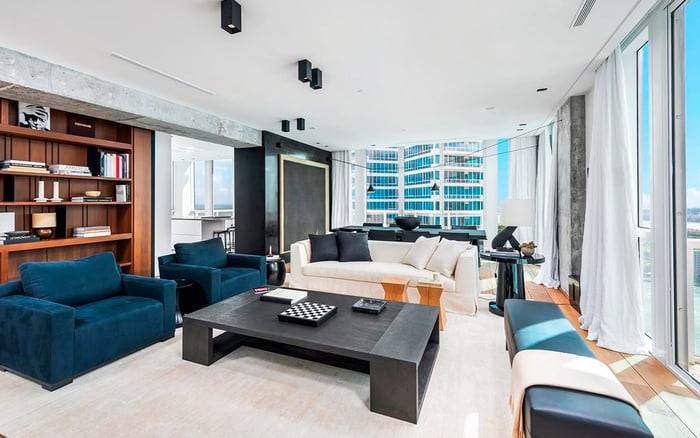
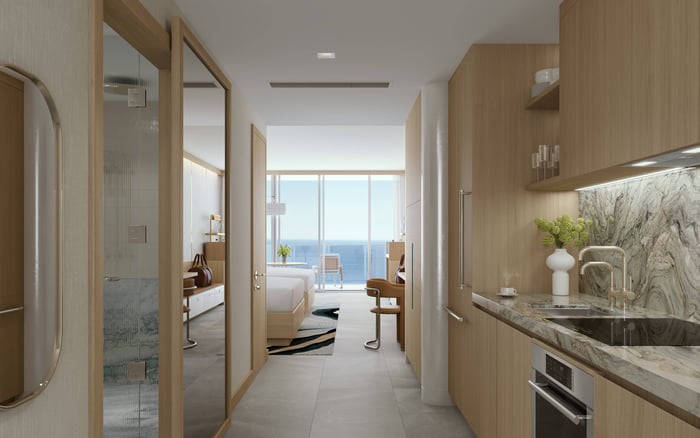
For both properties, serious buyers should evaluate entertaining flow through the relationship among living, dining, kitchen, terrace, arrival, and bedroom zones. Because the provided facts do not include verified floor-plan specifics, the safest approach is to avoid assumptions and ask for the actual plan, not only renderings or general lifestyle language.
At W Pompano Beach Hotel & Residences, the first question is how the residence connects to the broader property environment. Is guest arrival intuitive? Can service-supported entertaining reach the home without compromising privacy? Are social spaces positioned so activity remains in the right part of the residence? In a hotel-and-residences setting, the best ownership experience depends on enjoying the building’s activation while still maintaining a personal domain once the residence begins.
At The Perigon Miami Beach, the flow question is more about separation and hierarchy. Buyers should look for a legible sequence from arrival to gathering, dining, terrace, and quiet retreat. The residence should make hosting feel intentional, not improvised, especially when guests move between indoor and outdoor areas.
Terraces deserve special attention in both buildings. A terrace can be a powerful extension of the dining and entertaining program, but it can also change how sound travels and how guests circulate. A terrace that is too detached from the dining area may underperform for hosting, while one too close to bedrooms may complicate quiet retreat.
Acoustic separation is one of the least glamorous and most important luxury specifications. Finishes can be assessed in minutes. Sound performance is revealed over evenings, mornings, and repeated use.
At W Pompano Beach Hotel & Residences, the acoustic review should account for the possibility of shared movement, amenity activity, service circulation, and public-facing energy associated with a hotel-and-residences environment. That does not make the model better or worse. It simply means the buyer should understand how private residential areas are separated from any more active parts of the property.
The questions should be specific. How are residential corridors separated from other circulation? What glazing is used in residences exposed to active outdoor areas? How are amenity levels buffered from living floors? What measures address mechanical sound and vibration? The value of a more activated model depends partly on the building’s ability to deliver energy without letting that energy intrude where it should not.
At The Perigon Miami Beach, the acoustic priorities are likely to center on inter-unit separation, corridor noise control, mechanical quietness, and the relationship between social and sleeping areas within the residence. Buyers should still avoid assuming quietness from positioning alone. The relevant proof is in construction assemblies, glazing specifications, corridor design, and mechanical isolation.
In either case, request project-specific details such as wall assemblies, slab construction, glazing specifications, corridor separation, mechanical isolation, and any STC or IIC targets if available. The most sophisticated buyers do not ask only whether a residence is quiet. They ask how quietness is engineered.
W Pompano Beach Hotel & Residences is the conceptual fit for buyers who want to test whether a hotel-and-residences model can support entertaining, hosting, and service-oriented daily life. That buyer may appreciate a more animated setting, provided that privacy and sound control are handled convincingly.
The tradeoff is diligence. A hospitality-adjacent ownership experience can be compelling, but buyers should confirm circulation, service protocols, noise control, elevator strategy, and resident-only boundaries before treating activation as an advantage.
The Perigon Miami Beach is the conceptual fit for buyers who want the residence itself to do more of the work. That buyer is likely to focus on privacy, plan discipline, guest flow, and the separation between social rooms and quiet rooms. The experience may feel less dependent on a broader hospitality ecosystem and more dependent on the quality of the individual home.
Neither model is inherently superior. They simply answer different questions. W Pompano asks whether the owner wants a more activated property context to be part of the lifestyle. The Perigon asks whether the owner wants the home itself to remain the primary instrument of privacy and control.
Before choosing between these two ownership philosophies, buyers should move beyond renderings and amenity language. For private dining, ask how food, beverage, staff, deliveries, and guest access are handled. For entertaining flow, review the plan for adjacency, arrival sequence, terrace usability, and the relationship between public and private rooms.
For acoustics, insist on technical clarity. Wall assemblies, slab systems, glazing, elevator proximity, corridor design, mechanical isolation, and STC or IIC targets all matter. In a hospitality-led property, understand how residential life is insulated from any more active common areas. In a residentially focused tower, understand how residences are separated from one another and how social rooms are buffered from bedrooms.
The core tradeoff remains activation versus seclusion. Buyers who name that preference early will ask better questions and make a more confident decision.
Is W Pompano Beach Hotel & Residences automatically better for private dining? Not automatically. Buyers should verify service access, food and beverage procedures, guest arrival, and privacy protocols before assuming the model supports their hosting style.
Is The Perigon Miami Beach automatically quieter? Not automatically. Buyers should review construction details, glazing, corridor design, and mechanical isolation rather than relying on positioning alone.
Which project should a frequent host consider first? A frequent host should consider which environment better matches the desired evening: more property activation and service potential, or more residential control and separation.
What should buyers ask about private dining? Ask how catering, private chefs, deliveries, resident services, guest access, and cleanup are handled in the building’s actual operating procedures.
What should buyers ask about entertaining flow? Ask how living, dining, kitchen, terrace, arrival, and bedroom zones relate to one another in the specific residence plan.
What is the main acoustic concern at W Pompano? Buyers should understand how private residential areas are protected from shared circulation, amenities, service movement, and any active hospitality areas.
What is the main acoustic concern at The Perigon? Buyers should focus on inter-unit separation, corridor sound, mechanical quietness, and the transition between social rooms and sleeping areas.
Are verified acoustic ratings provided here? No. The provided facts do not include measured STC or IIC ratings, so buyers should request project-specific documentation.
Is one ownership model objectively better? No. The better choice depends on whether the buyer values activation, service potential, and energy, or privacy, control, and quieter retreat.
What is the most important diligence step before choosing? Review the actual residence plan and technical acoustic details before relying on general lifestyle positioning.
For a discreet conversation and a curated building-by-building shortlist, connect with MILLION.
If branded residences are on your mind — as a home or as an allocation — we would be glad to share what we are seeing, privately.
Begin a quiet conversation