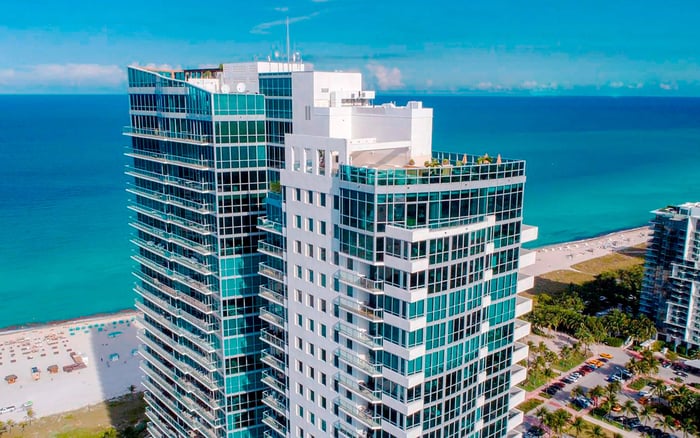
A seasonal buyer’s guide to evaluating privacy, circulation, amenity boundaries, security, and operating rules at Shore Club Private Collections Miami Beach.

Shore Club Private Collections Miami Beach occupies a category with strong appeal for seasonal owners: a luxury Miami Beach residence offering service, beach proximity, and lock-and-leave ease. Yet for a buyer who may use the home only part of the year, the central question is not simply how polished the finishes appear. It is whether the private residence truly lives like a private home when hospitality activity is at its busiest.
That distinction matters. Hotel-adjacent living can deliver meaningful convenience, but only when resident life is separated from guest traffic in a disciplined, day-to-day manner. Seasonal owners should evaluate the project through privacy, security, convenience, and long-term resale appeal. Architecture matters, but operations matter more. A private lobby has value only if the arrival sequence, elevators, corridors, amenity rules, staff protocols, and service routes all reinforce the same boundary.
In practical buyer shorthand, Miami Beach, condo-hotel ownership, second-home use, beach access, and Art Basel season are prompts to ask how the residence functions when the city is full, the hotel is active, and the owner is either arriving for the season or away for several months.
For seasonal buyers, arrival is the first test of separation. A distinct residential entrance can set the tone, but buyers should look beyond the front door. The real question is whether residents, hotel guests, restaurant patrons, vendors, and event traffic are directed through clearly different paths.
A private residential lobby should feel composed at peak arrival times, not like overflow space for hospitality operations. Ask how valet queues are managed during winter holidays, major weekends, and high-demand cultural periods. If the same curb, staff, or waiting areas serve multiple audiences, the experience may change materially when occupancy rises.
Buyers should also consider how resident guests are received. The most refined buildings make guest access feel gracious without weakening control. That means clear credentialing, defined check-in procedures, and staff who understand the difference between a residence guest and a hotel visitor. The best outcome is not austerity. It is discretion.
Dedicated residential elevators are among the clearest practical markers of privacy. Shared elevator banks may feel benign on a quiet Tuesday, then become a point of friction during a fully booked week. A seasonal owner arriving with luggage, family, or household staff should not feel folded into hotel circulation.
The same principle applies to corridors and floor access. Buyers should ask whether residential floors are physically controlled and whether elevator access is credentialed by floor or zone. A residence corridor should never function as a shortcut, service path, or spillover area for hospitality activity.
Controlled circulation is also about predictability. Who can access the garage? Which elevators do vendors use? How are deliveries routed? Are staff areas and service routes separated from resident areas? These questions may sound operational, but they define the lived experience of privacy. In luxury real estate, invisible choreography often preserves the calm.
Amenity boundaries deserve particular scrutiny because they are where hotel-adjacent residences can become either highly convenient or quietly compromised. Seasonal owners should confirm which amenities are resident-only and whether any spaces may be shared with hotel guests through reservations, memberships, events, or special access rules.
Pool, beach, fitness, spa, dining, and lounge spaces should be reviewed not only for design quality, but for access discipline. Beach access, in particular, can become a pressure point when hotel guests, residents, private guests, and event patrons move through the same exterior areas. A private path or controlled transition can make the difference between resort energy and residential ease.
Peak-season conditions matter. Winter holidays, school-break periods, major events, and Art Basel can increase demand on staff, valet, pool seating, beach service, elevators, restaurants, and security. Buyers should ask how the property handles high-volume arrival times and whether residential service standards remain consistent when hotel operations are under pressure.
The essential issue is not whether shared services exist. Many seasonal owners value service access. The point is whether shared convenience is governed by firm boundaries, so the private home remains private even when the public-facing side of the property is fully activated.
Seasonal ownership changes the meaning of security. The residence may sit empty for long stretches, and the building must have clear procedures for packages, vendor entry, maintenance access, emergency contact, and unit checks. A buyer should understand who may enter the residence, under what authority, and how each entry is documented.
Credentialing should be reviewed closely. Residents, family members, household staff, visiting guests, hotel guests, vendors, contractors, and building employees should not be treated as a single access category. Strong buildings distinguish among them through both technology and human protocol.
Package handling is another revealing detail. If deliveries sit in a general hospitality area or depend on hotel staff priorities, the arrangement may be less suitable for a seasonal owner. The same applies to vendor access for housekeeping, repairs, art handling, furnishings, and seasonal preparation. The system should protect the owner’s home without making ordinary upkeep cumbersome.
Before a seasonal buyer commits, the condo documents and operating agreements deserve careful review. Key issues include hotel use, rental programs, guest privileges, noise rules, event policies, amenity access, service charges, staff responsibilities, and any operating rights that affect residential life.
Rental-program provisions are especially important. Even if an owner does not intend to rent, the rules governing other owners can influence traffic, security, and building culture. Guest privileges should also be understood in detail. A flexible guest policy may be appealing, but it should not blur the boundary between private residence access and hotel use.
Maintenance scheduling belongs in the same conversation. Seasonal owners often need work performed while they are away, whether for preventive maintenance, repairs, or pre-arrival preparation. The process should not depend on hotel operating priorities, nor should it expose the residence to loosely managed access.
Hotel-guest separation is often discussed as a lifestyle preference, but it also carries resale implications. Future buyers will judge whether the residence offers the ease of hospitality without sacrificing the dignity of a private home. If the experience feels too public during peak periods, the value proposition can become less compelling.
For the seasonal owner, the strongest version of this lifestyle is straightforward: arrive privately, move through resident-only circulation, use amenities without ambiguity, leave the residence under secure supervision, and return months later to a home that still feels personal. That is the standard buyers should apply.
At Shore Club Private Collections Miami Beach, the right diligence is therefore not cosmetic. It is operational. The residence should be evaluated as a living system, with privacy and service designed to coexist without confusion.
Why is hotel-guest separation so important for seasonal buyers? Seasonal owners often arrive during peak periods and leave the home unattended for months, making privacy, access control, and operational clarity essential.
What should buyers look for at arrival? Look for a distinct residential entrance, private lobby access, controlled valet flow, and clear separation from hotel, restaurant, and event traffic.
Are dedicated residential elevators necessary? They are a key feature to verify because shared elevator banks can reduce privacy when hotel occupancy and guest movement are high.
Should amenities be resident-only? Buyers should confirm which amenities are strictly resident-only and whether any spaces are shared with hotel guests through reservations or access programs.
How do peak Miami Beach events affect the analysis? Holidays, school breaks, cultural events, and major weekends can stress valet, beach, pool, elevator, and staff systems, revealing weak boundaries.
What access-control questions should buyers ask? Ask how residents, guests, staff, vendors, contractors, and hotel visitors are credentialed, monitored, and routed through the property.
Why do service routes matter? Separate service routes help keep deliveries, maintenance, and vendor movement from disrupting residential corridors, garages, and amenity areas.
What should seasonal owners review in the documents? Review rules for hotel use, rental programs, guest privileges, noise, events, amenity access, maintenance procedures, and unit entry.
Can hotel-adjacent living still feel private? Yes, if the property has disciplined physical separation, strong access protocols, and operating rules that protect the residential experience.
How does separation affect resale? Buyers often value service convenience, but future demand depends on whether the residence continues to feel like a private home during busy periods.
When you're ready to tour or underwrite the options, connect with MILLION.
If branded residences are on your mind — as a home or as an allocation — we would be glad to share what we are seeing, privately.
Begin a quiet conversation