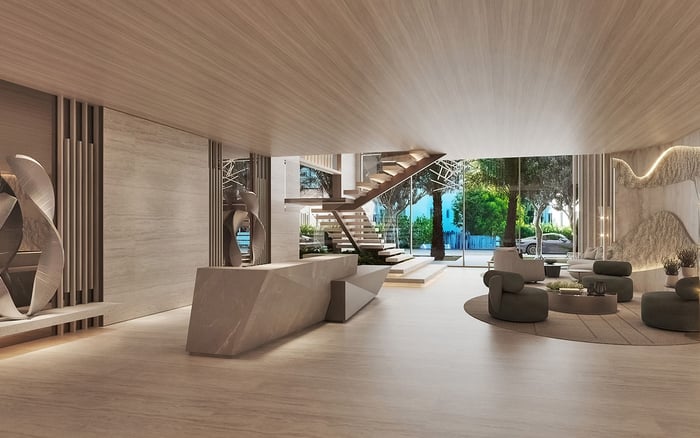
A discreet buyer’s guide to redundant fiber internet as a defining infrastructure amenity in South Florida luxury residences, with practical questions for evaluating resilience, privacy, service, and long-term livability.

Quiet luxury has always been less about display than discernment. In South Florida residential real estate, that discernment now extends beyond stone, millwork, view corridors, and arrival sequences. The next tier of buyers is asking a quieter, more consequential question: will the residence remain connected when everything else depends on it?
Better redundant fiber internet is not a decorative amenity. It does not photograph like a marble bath or announce itself like a dramatic lobby. Yet for a household that works globally, manages staff digitally, streams entertainment at scale, relies on cloud security, and expects a seamless smart-home experience, connectivity is part of the architecture. It belongs in the same conversation as elevators, generators, access control, and climate systems.
The luxury case is simple. A residence should not feel fragile. The more refined the home, the less the owner should have to think about the systems that support daily life. Redundant fiber, properly understood, is one of those systems.
In casual conversation, buyers often hear “fast” and assume the problem is solved. Speed matters, but it is only one part of the experience. Redundancy is about continuity. It asks what happens when the primary connection is interrupted, when equipment needs service, or when a household is hosting guests who are all using the network simultaneously.
A better conversation separates three ideas. First, the residence should have robust primary connectivity. Second, there should be a secondary path that can take over with minimal disruption. Third, the supporting equipment, cabling, power, and configuration should be maintained with the same seriousness as other building systems.
The most elegant setup is not necessarily the most complicated one. It is the one that has been designed, labeled, tested, and made legible to the owner’s representatives. A redundant line that no one understands, or a backup service that has never been tested, is not truly a luxury feature. It is an unresolved promise.
A sophisticated buyer does not need to become a network engineer. The goal is to ask the right questions early enough for the answers to inform negotiations, due diligence, and post-closing planning.
Start with pathways. Is the secondary service truly separate from the primary service, or does it rely on the same vulnerable route into the property or building? In a private home, that question may involve the service entrance, low-voltage room, exterior conduit, and equipment location. In a condominium or branded residence, it may involve the building’s telecom rooms, risers, and management protocols.
Then ask about failover. If the main connection drops, does the home automatically move to the backup connection, or must someone intervene manually? A manual solution may be acceptable for some owners, but it should be a conscious choice. For residences with security systems, remote access, staff coordination, and intensive media use, automatic failover can be part of the service standard.
Power deserves equal attention. Connectivity equipment is only useful if it remains powered and protected. Buyers should ask how routers, switches, access points, and related systems are supported during power transitions. The finest home network can be compromised by a single overlooked device plugged into an unprotected outlet.
Finally, ask who owns the ongoing responsibility. The cleanest luxury experience has a named professional or service team that can monitor, maintain, and document the system. It is not enough for the prior owner to say it works. A buyer should know who can verify it.
South Florida luxury living is increasingly mobile, global, and operationally complex. A residence may serve as a primary home, seasonal base, family gathering place, executive office, or long-term asset. The digital layer must accommodate all of those modes without becoming visible.
Search shorthand often frames the decision by Brickell, Miami Beach, Coconut Grove, Sunny Isles, Fort Lauderdale, and Palm Beach, because each market asks a different version of the same question: will the home remain connected when the household needs it most?
In a vertical urban setting, the question may focus on building infrastructure and management responsiveness. In a waterfront or estate setting, it may focus on private service pathways, equipment rooms, and service access. In a lock-and-leave residence, remote visibility may matter most. In a family home, the priority may be predictable coverage across work areas, bedrooms, media spaces, outdoor living areas, and staff zones.
This is where quiet luxury becomes practical. The owner should be able to take a video call, unlock access for a vendor, check a camera, stream a film, or manage a household system without wondering which carrier is currently behaving. The point is not technology for its own sake. The point is a residence that feels composed.
Many residences now market connectivity in the language of lifestyle. The stronger question is whether the system has been treated as infrastructure. Amenity language can be vague. Infrastructure language is more exact.
Ask for documentation. A current network diagram, equipment inventory, service contacts, and maintenance notes can reveal whether a home has been thoughtfully managed. Ask whether the system has been tested under real conditions. Ask whether there are known dead zones or recurring service issues. Ask whether smart-home, security, audio, lighting, shading, and access systems are dependent on the same network configuration.
For new-construction buyers, the conversation should begin before walls close and finishes are installed. For resale buyers, it should be part of the same diligence mindset that applies to mechanical systems and building condition. The cost of improving low-voltage infrastructure can be modest or substantial depending on access, finish sensitivity, and the degree of retrofit required. The earlier the issue is identified, the more gracefully it can be addressed.
Luxury buyers are often attracted to what is visible, then persuaded by what is invisible. Better redundant fiber belongs to the latter category. It signals that the residence was planned for the way affluent households actually live: privately, digitally, with high expectations and little tolerance for friction.
There is also a service dimension. Staff, property managers, security consultants, AV integrators, and family office representatives all benefit from a stable digital backbone. A home that is easier to operate is often easier to enjoy. It becomes less dependent on improvisation and more aligned with the owner’s rhythm.
For sellers, this can be a subtle differentiator. It may not replace view, design, location, or provenance, but it can support confidence. A buyer who sees disciplined infrastructure often reads the rest of the property more favorably. The home feels cared for, not merely staged.
During a showing, the buyer’s representative can begin with simple observations. Where is the equipment housed? Is it neat, ventilated, labeled, and accessible? Do the systems appear professionally installed? Is there a clear distinction between building-level service and residence-level equipment?
During diligence, bring in the right specialist. A luxury AV or network professional can review the setup, identify weaknesses, and estimate improvements. The best review is not theatrical. It is precise, calm, and focused on practical risk.
Buyers should also resist the impulse to treat every system as permanent. Connectivity changes. Household needs change. Equipment ages. A good redundant fiber strategy should be adaptable, with clean pathways and enough clarity that future upgrades do not require unnecessary disruption.
The ultimate luxury is not simply having more bandwidth. It is having fewer interruptions, fewer explanations, and fewer moments when the home’s invisible systems call attention to themselves.
What is redundant fiber internet? It generally means having a primary fiber connection supported by a secondary connection or pathway that can help maintain service if the primary setup fails.
Is faster internet the same as better redundancy? No. Speed measures performance when service is working, while redundancy focuses on continuity when something interrupts the primary connection.
Should condo buyers ask different questions than single-family buyers? Yes. Condo buyers should understand building-level infrastructure, while single-family buyers should also examine private service entrances, equipment locations, and internal wiring.
Does redundant fiber matter if I do not work from home? It can still matter because security, access control, entertainment, smart-home systems, and household management often depend on stable connectivity.
What should I ask for during due diligence? Ask for service details, equipment documentation, network diagrams if available, maintenance contacts, and confirmation that backup connectivity has been tested.
Can redundancy be added after closing? Often it can, but the ease and cost depend on the property, pathways, finishes, building rules, and existing low-voltage infrastructure.
Who should evaluate the system for a luxury buyer? A qualified network, low-voltage, or luxury AV professional can review the system and explain practical gaps without turning the purchase into a technical exercise.
Is Wi-Fi coverage the same as internet redundancy? No. Wi-Fi coverage concerns signal inside the residence, while redundancy concerns the resilience of the connection feeding the home.
Why is this a quiet luxury feature? Because it improves daily life without demanding attention, supporting the owner’s privacy, service expectations, and sense of ease.
Should sellers document connectivity before listing? Yes. Clear documentation can help serious buyers understand that the home’s invisible systems have been maintained with care.
For a confidential assessment and a building-by-building shortlist, connect with MILLION.
If branded residences are on your mind — as a home or as an allocation — we would be glad to share what we are seeing, privately.
Begin a quiet conversation